甲醇电催化氧化过程中怎么证明没有析氧的副反应发生?

去年做了一个工作,是关于电解甲醇水溶液的。阳极用的材料是过渡金属氧化物,阴极材料用的传统的Pt/C电极。在氢氧化钾的甲醇溶液中电解。
过渡金属氧化物的甲醇氧化的过电位在1.3 V(vs. RHE),也就是0.4 V (vs.Hg/HgO)。
现在审稿人提出意见,认为阳极的甲醇氧化过程中还伴随有析氧反应,但是未加入甲醇时候用三电极测试循环伏安曲线并没有看到有极化的现象,并让证明在此过程中析氧反应是被完全抑制的,请问这个问题怎么回答?
(文章已经修改了三次了,着实要被折腾死了,求好心的大神求助~~)
附:部分审稿意见
Reviewer #1: However it is necessary to understand that in electrolysis cell with aqueous methanol solution two parallel anodic reactions take place. Correspondingly, the equation given now at p.9 cannot be used straightforwardly. What is anodic overvoltage? This value is different for oxygen evolution and metanol oxidation. In reality cell voltage is determined, from anodic side, by condition i = i_O2(E) + i_MeOH(E), and potential E is determined by the ratio of partial currents.
By the way, the question about partial currents is of interest. Is O2 evolution suppressed in presence of MeOH?
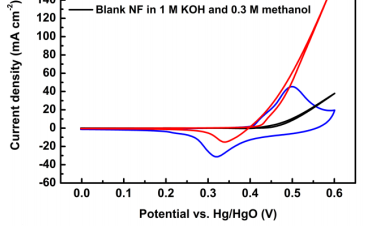
循环伏安图--三电极测试阳极甲醇氧化性能,黑色的为基底泡沫镍,红色的为加入甲醇之后的,蓝色的为没有加甲醇的 返回小木虫查看更多




 京公网安备 11010802022153号
这种专业问题建议去相关专业版交流
求大神呀~一筹莫展
建议测一下阳极产生氧气的量,如果没有氧气,那么催化电流就完全贡献于甲醇的氧化。
1、 1.3 V vs. RHE 确实有点高 理论上会有析氧反应的
2、实验过程中观察有没有气泡产生 这是最简单的办法
3、要定量的话 测量放出氧气的体积,
请问楼主解决了吗,我现在也是做过渡金属电催化的,在1.2v 出峰,对电极观察到有气泡,感觉析出氧气了,不知道怎么解决