









| 查看: 2609 | 回复: 0 | ||
小卉leaf金虫 (著名写手)
|
[求助]
关于EIS拟合问题,电感的拟合
|

|
投了一个关于防腐的文章,用了EIS作为一个辅助的表征手段,结果审稿人就在EIS拟合上给我出难题了。 我的原图在低频端有个类似电感一样的半圆弧(原图“0”),我在文章把原图放上去了,但是拟合的时候又是把这部分数据删除之后的拟合结果,所以只弄出一个时间常数的EEC(见1-1和1-2)。 然后审稿人第一次给的意见就说这明显不止一个时间常数啊,有电感啊。 我的回答:我们判断时间常数主要看了半圆的个数和Bode图里的peak个数,(这个我们也意识到不对了),关于电感我们解释是膜层与基底的相互作用,但是我们将膜与基底视为一个整体,所以没有考虑这个电感。 这个审稿人明显对于我们的解释不满意,所以又回了:指出我们对时间常数的判断是错的,(这个我认,相关叙述会改),还对我们的电感死死不放,让我们重新拟合过。 原话是这样的:The authors say that they do not take the inductive loop into account because they only study the "the coating and substrate as a unit to resist the acid" and not "the strong interaction between the coating and and substrate" . It does not justify to use an EEC with a single (distributed) time constant. How many points are you using to fit to the proposed EEC?. If you use the whole impedance spectrum an underestimated value for Rct will be obtained. From a visual inspection of the Nyquist plot, I think that Rct value (=957 ohms/cm^2) is underestimated. You should try to fit the experimental impedance data using the EEC: Rs+[CPE//(Rct+(C//R))] where R and C are negative values (R<0 and C<0) modelling the inductive part. "+" denotes series and "//" denotes parallel. A more exact value for Rct will be obtained. 我按照他提的这个模型再拟合了一遍,见2-1和2-2,当然也是去除了那些电感的点的,误差十分大。我不知道我是不是弄对了。 还有他提到要拟合电感部分,把R和C弄成负数,他的意思是不是正半圆和负半圆分开拟合?然后再相加吗? 对于这个问题我要怎么回答呢?是坚持我原来的拟合,跟他说把电感那段去掉了,还是按照他的来,那要怎么拟合呢?求大神帮忙啊,定重金答谢啊!!! 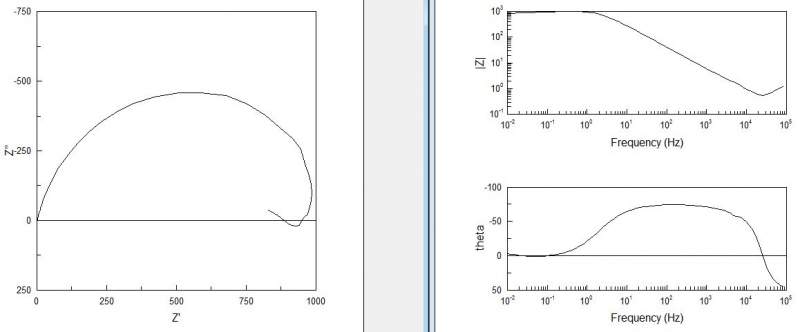 0.JPG 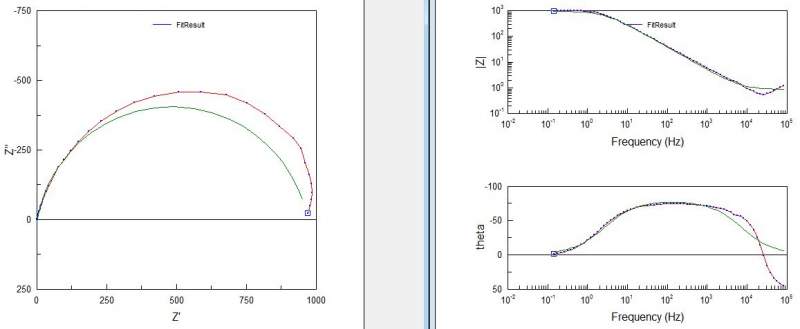 1-1.JPG 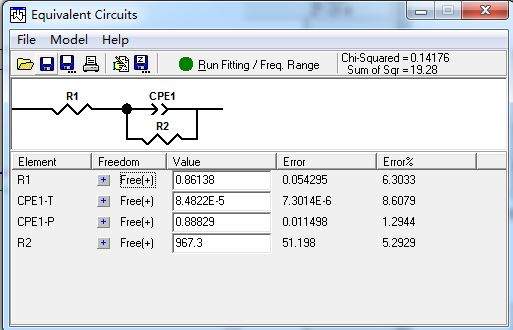 1-2.JPG 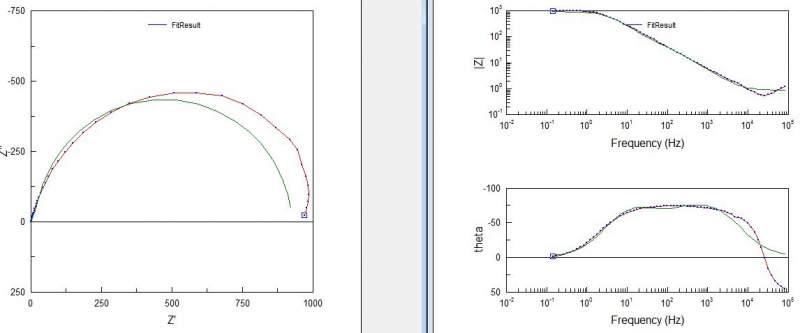 2-1.JPG 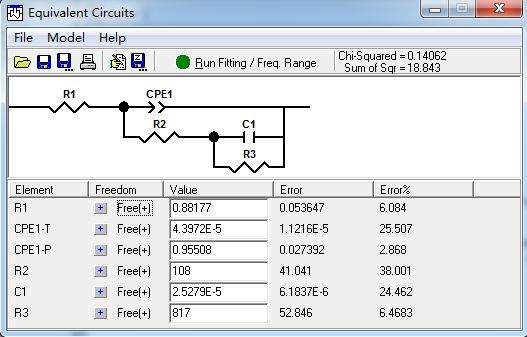 2-2.JPG |
 回复此楼
回复此楼» 猜你喜欢
 氧化铝浆液
已经有2人回复
氧化铝浆液
已经有2人回复
-
铁基改性石墨催化电极的制备、表征及电催化降解性能研究
已经有0人回复
-
物理化学论文润色/翻译怎么收费?
已经有100人回复
-
N2O分解催化
已经有1人回复
-
石墨电极生产缺陷成因及工艺优化控制技术研究
已经有0人回复
-
三维电极体系催化极板应用优势,大幅提升废水处理容积负荷
已经有0人回复
-
西华大学-化学、生物与医药-研究生招生信息-欢迎报考
已经有0人回复
-
中科院东莞材料所|新能源材料研究部招聘研究员 / 副研究员(可中央事业编制)
已经有0人回复
-
复合催化电极在高盐难降解废水电催化体系中的工程应用研究
已经有1人回复
-
化工难降解废水处理中催化电极自由基生成效率与反应选择性研究
已经有0人回复

找到一些相关的精华帖子,希望有用哦~
 从拟合的等效电路上可以看出有几个时间常数吗?这个等效电路图有几个时间常数???
已经有6人回复
从拟合的等效电路上可以看出有几个时间常数吗?这个等效电路图有几个时间常数???
已经有6人回复
- 电路拟合时如何选合适的电阻值?
已经有18人回复
- EIS分析求助!
已经有4人回复
- ZsimpWin拟合问题
已经有11人回复
- EIS拟合高手求助
已经有8人回复
- EIS交流阻抗 电化学腐蚀问题
已经有8人回复
- 关于交流阻抗拟合软件Zview,它是用来做什么的,能解决什么问题
已经有5人回复
- EIS拟合,等效电路的选择。。。
已经有5人回复
- 交流阻抗EIS拟合
已经有3人回复
- EIS图拟合处理,急求助!
已经有8人回复
- 电化学阻抗拟合问题
已经有33人回复
- 交流阻抗拟合!
已经有20人回复
- 关于zview软件拟合
已经有4人回复
- 用Zsimpin等效电路拟合阻抗值的问题
已经有7人回复
- 关于拟合穆斯堡尔谱
已经有6人回复
- 【求助】大侠帮忙拟合个EIS图
已经有9人回复
- 【讨论】等效电路Q和CPE的区别?
已经有25人回复
- 【求助】EIS拟合的等效电路
已经有5人回复
 点击这里搜索更多相关资源
科研从小木虫开始,人人为我,我为人人

