









| 查看: 425 | 回复: 0 | ||
[求助]
关于氧化动力的计算
|

|
Oxidation fo Zircaloy-4 Zircaloy-4 is used principally as fuel cladding in pressurized water nuclear reactors (PWRs). The alloy’s mean composition is as follows: Zr – 1.5 % Sn – 0.2 % Fe – 0.1 %Cr. In the primary circuit, liquid metal exists under 100 bar pressure at 315°C and alloy oxidation leads to the almost exclusive formation of zirconia, ZrO2. In order to simulate this behaviour in a lab out of a reactor, oxidation in autoclaves is carried out under pressurized water vapour or even in oxygen under atmospheric pressure. The kinetic data has been obtained in the latter case, at 415 and 470°C, respectively, is given in Table 1. It will be assumed in the following exercise that only ZrO2 is formed during zircaloy oxidation. Q: 1) Plot the kinetic curves for both temperatures. Describe the curves as a series of three stages. 2) Identify the zirconia thickness at which the kinetic transition takes place and verify that this thickness is the same for both temperatures. 3) Pre-transition oxidation: a. Can the pre-transition oxidation of Zircaloy-4 be considered to be parabolic? b. If this is not the case, then the oxidation kinetics may be described by the general rate equation: (Δm)n = k t. Determine the value of n. Is this value the same at both temperatures? c. Indicate the rate limiting step. What type of further phenomenon may lead to the same exponent ‘n’? (hint: calculate the Pilling and Bedworth ratio and recall that zirconia is a n-type semiconductor with oxygen vacancies as predominant ionic defects). d. Is it reasonable to determine the apparent activation energy of the constant k in the rate equation: (Δm)n = k t? 4) Time and nature of the transition: (in order to determine the transition using a mathematical method, plot the transforms y = f[t/y] ) a. Under what conditions are these transforms straight lines? What does one observe if the rate equation is linear? b. What are the transition times determined using this method? c. Explain the origin of this transition. 5) Post-transition oxidation a. Determine, at 415 and 470°C, the linear rate constants kl expressed in terms of the thickness of corroded metal (assumed to be pure zirconium) per unit of time. b. The lifetime of PWR fuel rods is defined as the time necessary to corrode 10% of the zircaloy clad thickness, originally 570 μm thick at start of life. What is the lifetime deduced from the plots of the two kinetic curves, assuming, as a simplification, that the rate equation is linear from time zero? c. What is the apparent activation energy of kl ? d. What is the lifetime at 315°C, which is the operating temperature of the fuel rods? (it should be noted that in industrial reactors, three additional phenomenon that effect cladding lifetime are observed but are not considered here: 1) hydridation of the alloy; 2) thermal flux through the cladding and the oxide scale; and 3) massive neutron irradiation) 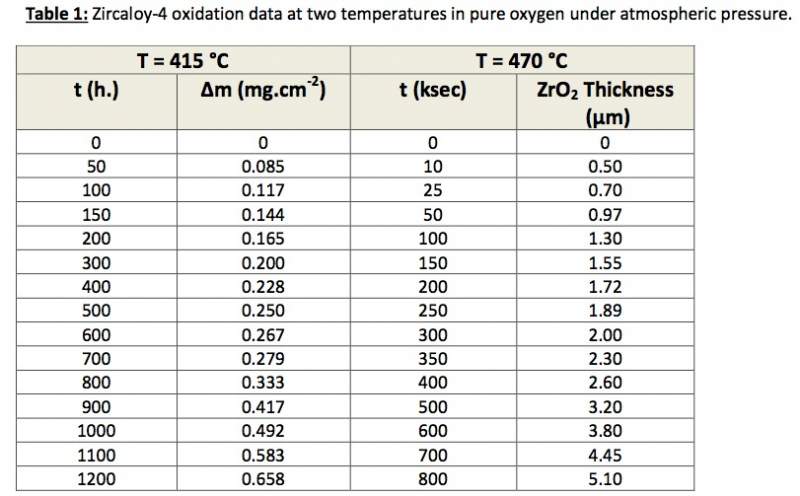 Screen Shot 2015-05-20 at 11.56.10.jpg |
 回复此楼
回复此楼» 猜你喜欢
 仿真模拟
已经有0人回复
仿真模拟
已经有0人回复
-
求一个催化的学术会议群
已经有0人回复
-
金属材料论文润色/翻译怎么收费?
已经有73人回复
-
材料模拟计算
已经有0人回复
-
多孔结构的镍基催化剂
已经有7人回复
-
Data征稿(EI检索收录),选题方向:环境风险管理的数据分析
已经有106人回复
-
征稿:Data(EI工程索引、ESCI中科院四区);主题:面向环境风险管理的数据分析;
已经有103人回复
-
国家纳米科学中心孙向南课题组招收2027级硕士1名
已经有7人回复
-
福建农林大学材料工程学院招收材料与化学方向博士
已经有0人回复


找到一些相关的精华帖子,希望有用哦~
 关于催化氧化CO的催化剂活性问题
已经有12人回复
关于催化氧化CO的催化剂活性问题
已经有12人回复
- 求助如何分析动力学学后的结果
已经有6人回复
- 动力学曲线和穿透曲线有什么区别
已经有3人回复
- 铝表面(100)最稳定,为啥氧化成Al2O3后就变成(111)最稳定了呢?
已经有9人回复
- 化学反应的热力学平衡计算中物质标态选择问题
已经有4人回复
- 反应速率的计算方法
已经有3人回复
- 有关㶲效率的计算
已经有11人回复
- MS Discover 动力学求助
已经有10人回复
- 金属氧化物催化剂TOF计算
已经有6人回复
- 反应的起始温度与动力学还是热力学有关
已经有4人回复
- 烧结动力学与晶粒生长动力学
已经有6人回复
- 知道重均分子量,如何计算官能团的物质的量
已经有6人回复
- 问一道五氧化二氮反应生成二氧化氮的动力学题目
已经有14人回复
- 求两个动力学常数的计算
已经有6人回复
- 文献学习:Co3O4零下77度催化氧化CO(TEM和动力学分析可以发nature)
已经有34人回复
- 【讨论】关于TOC计算的问题!
已经有3人回复
- 【求助】绝对熵值的计算
已经有8人回复
- 【求助】关于vasp进行分子动力学模拟的求助
已经有12人回复
- 【求助】反应速率常数怎么算
已经有5人回复
- 【求助】关于计算结果的运用
已经有11人回复
- 【求助】氧化动力学曲线用什么软件求?
已经有7人回复
- 【原创】相图热力学介绍
已经有57人回复
 点击这里搜索更多相关资源
科研从小木虫开始,人人为我,我为人人