









| 查看: 793 | 回复: 1 | ||||
staventchoke铁杆木虫 (著名写手)
|
[求助]
聚合物晶胞优化 已有1人参与
|

本人构建聚合物晶胞后进行几何优化处理,收敛曲线老是出现下图情况,请问MS高手这是怎么回事?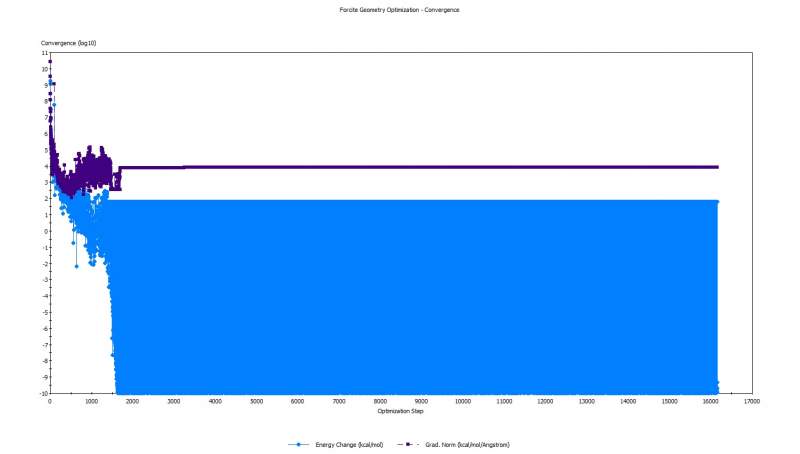 1 Convergence.jpg |
 回复此楼
回复此楼» 猜你喜欢
 现代”学阀”该如何界定
已经有14人回复
现代”学阀”该如何界定
已经有14人回复
-
求合成方法
已经有8人回复
-
师弟论文见刊大半年才想起来申请专利,还能抢救一下吗?
已经有4人回复
-
上海工程技术大学 激光智能制造课题组 2027级博士研究生招生
已经有5人回复
-
课题组招2027级博士 上海工程技术大学 激光智能制造方向
已经有5人回复
-
有机合成以后会不会被AI改变?做科研的虫友怎么看
已经有8人回复
-
我的奶奶
已经有3人回复
» 本主题相关价值贴推荐,对您同样有帮助:
- MS Amorphous cell 封装聚合物链 有些问题求助
已经有10人回复
- Material studio软件中Forcite模块结构优化时的参数设置问题
已经有13人回复
- vasp优化晶胞参数变化太大
已经有7人回复
- 几何结构最优化
已经有10人回复
- 求助于懂超级电容器原理的大神,下面这一段英文,咋理解?求助啊求助
已经有5人回复
- MS软件计算聚合物cell自由体积
已经有16人回复
- [求助]如何利用MS搭建晶胞结构
已经有14人回复
- 想请问一下,几何优化之后的晶格角度变化的问题
已经有12人回复
- CASTEP和DMo3l做离子型晶体几何优化的问题
已经有7人回复
- 按文献值优化Fe3O4晶胞后偏小(附有详细参数)
已经有20人回复
- forcite模块中的opotimize cell 选项问题?
已经有5人回复
- 聚合物链建晶胞时,Amorphous Cell模块没法用,求解释
已经有9人回复
- 结构优化的结果竟然重复不出来,每次优化后的结构都不一样,求高手解答……
已经有9人回复
- 在vasp计算里,有没有好的只优化原子位置和晶胞体积的方法?
已经有8人回复
- 请教:有谁用CASTEP优化过CuO的晶胞结构?
已经有12人回复
- 利用CASTEP对建立的晶胞进行几何优化的问题 (急!!!)
已经有13人回复
- 【求助】勾选与不选optimize cell 的差异
已经有15人回复
- 【求助】怎样优化晶胞才能使晶胞密度稳定且接近真实物质密度
已经有3人回复
- 【求助】关于晶胞中取代一个原子的优化问题
已经有14人回复

月只蓝
主管区长 (职业作家)
-

专家经验: +1059 - 模拟EPI: 1
- 应助: 1712 (讲师)
- 贵宾: 8.888
- 金币: 68176.7
- 散金: 1938
- 红花: 443
- 沙发: 4
- 帖子: 4373
- 在线: 3292.4小时
- 虫号: 1122189
- 注册: 2010-10-14
- 专业: 宇宙学
- 管辖: 计算模拟区
【答案】应助回帖
感谢参与,应助指数 +1
|
Common reasons for minimization to fail Forcefield typing error. Discover needs the forcefield type of each atom in the structure in order to determine which forcefield parameters to use. In some cases forcefield typing may fail. If this happens, you will not be able to successfully run a Discover job. See If typing fails for more information. Charging failure. Discover needs a structure to be charged to be able to calculate the electrostatic energy. In some cases charging may fail or warnings be reported. In this case, a Discover job will be allowed to run, but any results obtained should be checked. See If charging fails for more information. Discover job failure. See If a remote job fails for more information. The cell multipole non-bond summation method is not supported for periodic systems in parallel. Switching to another summation method, such as charge groups or running on a single core will allow the job to run. See Selecting a summation method for more information. Forcefield cross term failure. Some forcefields such as COMPASS have additional valence terms called cross terms. These terms are required, for instance, to accurately reproduce experimental vibrational frequencies. However, if a structure is significantly distorted these terms can become large in magnitude and cause the optimizer to become trapped in a local minimum that is an artifact of these cross terms. If the output indicates that the cross terms are large and the final structure is not chemically reasonable, it is likely that a cross term failure has occurred. In this case pre-optimize the structure using the BTCL "forcefield scale cross = 0.0" command. (To do this you need to use the Files facility: set the required minimizer options on the minimizer dialog, save the input files from the Files dialog, edit the .inp file to add the "forcefield scale cross = 0.0" command and then run the job from the Files dialog). In most cases this will remove any unrealistic geometries. Finally optimize the structure obtained against the required forcefield. |

2楼2014-04-15 18:29:18