









| 查看: 2121 | 回复: 10 | ||||
[求助]
求问 分子模拟中 提高温度是否就能实现增强抽样呢?
|
||||

|
http://wenku.baidu.com/link?url= ... OWPEiaMSpcSOGRSvStm 最近在看上面这篇文章,想对 分子模拟中的 增强抽样方法有一个基本的了解 ———————————————— 想问一个问题 提高温度是不是就能达到增强抽样的目的了呢? 比如原来的温度是T1 现在把温度变成更高的温度T2,在这个温度下,就能达到增强抽样了? 怎么理解呢? |
 回复此楼
回复此楼» 猜你喜欢
 烦躁
已经有8人回复
烦躁
已经有8人回复
-
入职后第一次管课题组的专利缴费,对账才发现官费比别人多掏了一倍
已经有3人回复
-
各位大佬,路线设计求助
已经有7人回复
-
我应该选哪条合成路线让实验成功率高一些?
已经有4人回复
» 本主题相关商家推荐: (我也要在这里推广)

» 本主题相关价值贴推荐,对您同样有帮助:
- 分子模拟中体系势能和总能量为很大的正值
已经有8人回复
- 分子动力学能量守恒的相关问题
已经有18人回复
- gromacs可以做空间分布函数(spatial distribution function)吗
已经有4人回复
- DPD方法初始条件的实现
已经有6人回复
- 【求助】帮忙蒙特卡罗原理
已经有4人回复
- 【求助】Materials explorer可以模拟预测晶体生长的形貌吗?
已经有9人回复
- 【求助】如何计算结合自由能
已经有9人回复
- 【在线答疑】经典粒子体系的Monte Carlo 模拟之基础篇
已经有73人回复
lsloneil
专家顾问 (正式写手)
-

专家经验: +49 - 模拟EPI: 2
- 应助: 148 (高中生)
- 金币: 8640.9
- 散金: 507
- 红花: 30
- 帖子: 505
- 在线: 598.4小时
- 虫号: 556471
- 注册: 2008-05-11
- 性别: GG
- 专业: 理论和计算化学
- 管辖: 分子模拟
【答案】应助回帖
★ ★ ★ ★ ★ ★ ★ ★ ★ ★ ★ ★ ★ ★ ★ ★ ★ ★ ★ ★ ★ ★ ★ ★ ★
月只蓝: 金币+5, 感谢指导! 2014-04-07 10:28:45
leukos: 金币+20, ★★★很有帮助 2014-04-07 19:45:42
月只蓝: 金币+5, 感谢指导! 2014-04-07 10:28:45
leukos: 金币+20, ★★★很有帮助 2014-04-07 19:45:42
|
是的,升温可以增强抽样。因为温度对应于分子的平均动能,当势能面上有一个很深的势阱的时候在里面的粒子由于动能不够高是很难跳出这个势阱的,这样的话你的采样基本就在势阱里面采样而无法在势能面的其他位置采样,升高温度就可以使粒子跳出势阱。升温来增加抽样的经典方法是Replica Exchange MD (REMD). Enhanced Sampling是分子模拟中当前非常热门的课题。你可以看看本版EPI ChemiAndy写的这篇关于自由能计算的文章:http://muchong.com/bbs/viewthread.php?tid=3672663 里面谈到的Umbrella Sampling, WHAM等都是常用的方法。 |

3楼2014-04-07 02:00:43
lsloneil
专家顾问 (正式写手)
-
专家经验: +49 - 模拟EPI: 2
- 应助: 148 (高中生)
- 金币: 8640.9
- 散金: 507
- 红花: 30
- 帖子: 505
- 在线: 598.4小时
- 虫号: 556471
- 注册: 2008-05-11
- 性别: GG
- 专业: 理论和计算化学
- 管辖: 分子模拟
【答案】应助回帖
★ ★ ★ ★ ★ ★ ★ ★ ★ ★ ★ ★ ★ ★ ★ ★ ★ ★ ★ ★ ★ ★ ★ ★ ★ ★ ★ ★ ★ ★ ★ ★ ★ ★ ★ ★ ★ ★ ★ ★ ★ ★ ★ ★ ★ ★ ★ ★ ★ ★ ★ ★ ...
leukos: 金币+45, ★★★★★最佳答案, 再次感谢~~思路清晰了不少呢 2014-04-08 12:48:00
月只蓝: 金币+10, 感谢您的耐心和劳动付出! 2014-04-08 19:03:13
leukos: 金币+45, ★★★★★最佳答案, 再次感谢~~思路清晰了不少呢 2014-04-08 12:48:00
月只蓝: 金币+10, 感谢您的耐心和劳动付出! 2014-04-08 19:03:13
|
见下,我在latex里用英文敲的,你凑合着看吧。 \section{First Question} I think your answer with regard to the probability distribution of potential energy is correct. There is indeed an expression in term of ensemble average for this probability distribution, which is given below. For a system with N particles, the potential energy is where Then the probability distribution of potential energy P(U) can be written as For most systems, there is no analytical way of calculating P(U), but one could just sample P(U) in simulations, which can be done very easily. In general the P(U) obtained from sampling is not perfectly Gaussian, but one could fit it to Gaussian. \section{Second Question} From the figure you showed, one could see that the mean value of potential energy increases as temperature increases. Also, the width of the potential energy distribution (i.e. fluctuations) also increases as temperature increases. This is a natural result from thermodynamics and statistical mechanics. First, the derivative of mean potential energy with respect to temperature is just the heat capacity (here it means the non-ideal part of the heat capacity). Apparently the heat capacity is greater than zero (because of the convexity of free energy function), so the mean potential energy increases with temperature. On the other hand, one could easily find the relation between fluctuation of energy (the width of potential energy distribution) and temperature in a standard stat mech textbook. So the fluctuation increases as temperature increases. So, to answer your question, I would say that in canonical (NVT) ensemble, molecules would always prefer configurations that minimizes free energy. Since free energy comprises parts both from energy and entropy, molecules have to choose configurations that find a balance between energy and entropy (i.e. minimize energy but also maximize entropy). \section{Last Question} The last question is much easier to answer. Suppose to get sufficient statistics, you need to sample at least 100 ps in the region of stable configuration. However, since you're using REMD, you spend 50 ps of your 100 ps exploring other parts of the phase space, then you have to spend more time totally in order to obtain as good statistics as your previous simulations for your stable configuration. |
6楼2014-04-08 10:36:30
lsloneil
专家顾问 (正式写手)
-
专家经验: +49 - 模拟EPI: 2
- 应助: 148 (高中生)
- 金币: 8640.9
- 散金: 507
- 红花: 30
- 帖子: 505
- 在线: 598.4小时
- 虫号: 556471
- 注册: 2008-05-11
- 性别: GG
- 专业: 理论和计算化学
- 管辖: 分子模拟
8楼2014-04-09 12:56:59
2楼2014-04-06 19:42:30
★ ★ ★
月只蓝: 金币+3, 鼓励交流! 2014-04-08 19:01:52
月只蓝: 金币+3, 鼓励交流! 2014-04-08 19:01:52
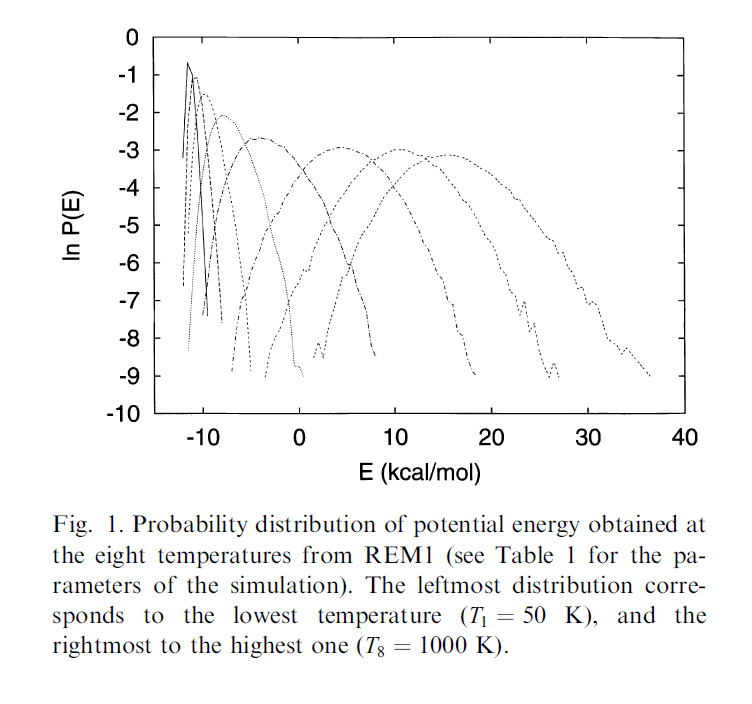 另外希望问问上面这张图 来自 Chemical Physics Letters 332 (2000) 131-138 发现还是不是很能理解 Probability distribution of potential energy的意义 是指 模拟过程中, 分子在某个特定温度下, 处于势能U 的概率? 可是是否有 具体有解析的表达式可以算出这样的一个 高斯的分布的样子呢? 还是这种 图只能通过模拟来得到呢? 从物理上应该怎样来理解这个图像呢? 比如低温的时候,分子动能小,所以就只能主要处于一个低的势能U上? 不过不是无论温度高低,分子都应该最主要会处在一个 能量极小值的位置吗? 感觉还是有点晕。。。求指点呢>< 感谢 ———————————————————————————— 另外一个问题是: 一楼处的那篇文章中提到,“然而仅仅通过降低势垒或升高温度来增加对小概率事件的取样,虽然可以提高对化学反应或分子构象变化过 程的计算,但由于损失掉了对目标温度下稳定构象 的充分取样,往往会使得模拟中的热力学计算收敛 变慢。” 这个损失掉对目标温度下稳定构象的充分取样 是什么意思呢? 没理解这句话。。。。 |
4楼2014-04-07 21:13:09
lsloneil
专家顾问 (正式写手)
-
专家经验: +49 - 模拟EPI: 2
- 应助: 148 (高中生)
- 金币: 8640.9
- 散金: 507
- 红花: 30
- 帖子: 505
- 在线: 598.4小时
- 虫号: 556471
- 注册: 2008-05-11
- 性别: GG
- 专业: 理论和计算化学
- 管辖: 分子模拟
5楼2014-04-08 10:23:11
7楼2014-04-08 14:26:51
9楼2014-04-13 18:15:28
hiyesterday
至尊木虫 (著名写手)
- 应助: 4 (幼儿园)
- 金币: 16386.4
- 散金: 326
- 红花: 1
- 帖子: 1732
- 在线: 71.6小时
- 虫号: 997098
- 注册: 2010-04-15
- 性别: GG
- 专业: 理论和计算化学
10楼2016-12-05 16:43:53