








| 查看: 976 | 回复: 7 | ||
[求助]
求教数学高人
|

各位是否遇到过如下问题,见图,高中生都可看得懂,请教高手解决!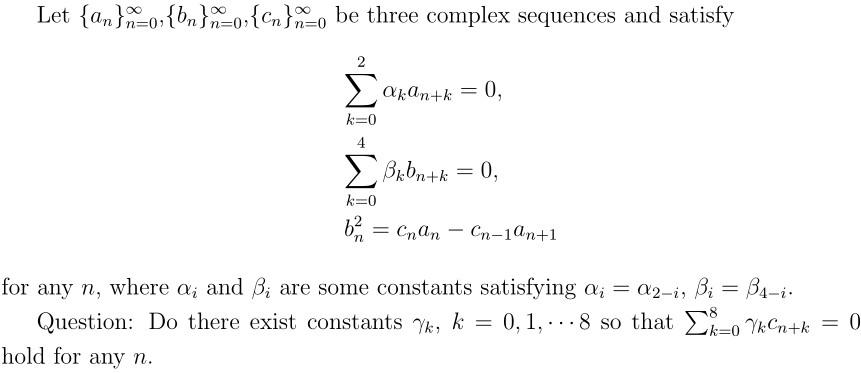 {Q99X4QKT3STPMI6WN(`T]I.jpg |
 回复此楼
回复此楼» 猜你喜欢
 售SCI一区T0P文章,我:8O.55.1.O.5.4,科目齐全,可+急
已经有5人回复
售SCI一区T0P文章,我:8O.55.1.O.5.4,科目齐全,可+急
已经有5人回复
-
售SCI一区T0P文章,我:8.O.55.1.O.5.4,科目全,可+急
已经有4人回复
-
售SCI一区T0P文章,我:8.O.55.1.O54,科目全,可伽急
已经有4人回复
-
售SCI一区T0P文章,我:8O.55.1.O.5.4,科目齐全,可+急
已经有3人回复
-
浙江师范大学是怎么坑我的
已经有15人回复
-
浙江师范大学是怎么坑我的
已经有4人回复
-
求教各位大神:2026教育部人文社科青年基金项目何时公示呀?
已经有6人回复
-
面上有专家说实验设备不是我们单位的
已经有8人回复
-
科研求助
已经有4人回复
» 本主题相关价值贴推荐,对您同样有帮助:
- 今天遇见一数学题,做不来,求高人指点!
已经有7人回复
- 实验数据分析方面的问题 求教
已经有3人回复
- 求通信高人点拨
已经有7人回复
- 跪求1stOpt2.5以上版本,或者请高人帮忙拟合包含复数的函数的参数
已经有8人回复
- 【求教】有哪位高人做过长链伯胺与环氧基团的固化反应?
已经有23人回复
- 高人求教 ,F-Cecure SSH Client 怎么样实现在非实验室的条件下远程登录?
已经有4人回复
- 求教:概率和统计的一些基础知识。
已经有21人回复
- 都不知道怎么命名标题:迭代法解方程组?
已经有16人回复
- 求教一个表达式的积分???exp(-x^2)
已经有5人回复
- 【求助】传感器制作步骤
已经有4人回复
- 【求助】自己写的C语言,突然想看看C++是什么,求助一下。还有C语言和C++有什么区别啊
已经有22人回复
- 【求助】求教定积分问题
已经有13人回复
- 【求助】求教 多元指数方程如何解 有软件否?
已经有6人回复
- 【求助】请高人帮忙三元二次方程
已经有11人回复
hank612
至尊木虫 (著名写手)
- 数学EPI: 14
- 应助: 225 (大学生)
- 金币: 14270.6
- 散金: 1055
- 红花: 95
- 帖子: 1526
- 在线: 1375.8小时
- 虫号: 2530333
- 注册: 2013-07-03
- 性别: GG
- 专业: 理论和计算化学
【答案】应助回帖
|
我无法彻底解决你的问题,仅能提供一个可能努力的方向. 序列是线性递归的 当且仅当 生成函数是有理多项式. If x_n=a_1*x_{n-1} +...+a_k*x_{n-k}, then the degree of the denominator of the rational generating function is at most k. 故序列a_n是二次的, b_n是四次的,要求证明c_n是八次的. 利用alpha_2=alpha_0, it is easy to see that alpha_0*(b_{n+1}^2 - b_n^2)=a_{n+1}*(alpha_0 c_{n-1} +alpha_1 c_{n} + alpha_0 c_{n+1}). 然后我就被卡住了,冒似生成函数没法做除法. 抱歉. |


2楼2013-07-12 06:48:24
3楼2013-07-12 14:01:04
hank612
至尊木虫 (著名写手)
- 数学EPI: 14
- 应助: 225 (大学生)
- 金币: 14270.6
- 散金: 1055
- 红花: 95
- 帖子: 1526
- 在线: 1375.8小时
- 虫号: 2530333
- 注册: 2013-07-03
- 性别: GG
- 专业: 理论和计算化学
【答案】应助回帖
|
I seriously doubt that c_n is a linear recursive sequence. See the following example. Let d_n be a new sequence defined by d_n = c_{n-1} + alpha_1 / alpha_0 * c_n + c_{n+1}. If c_n is linear recursive, as you questioned, then d_n is also a linear recursive sequence with the same linear relation SUM_{k=0}^8 gamma_k d_{n+k} = 0. http://en.wikipedia.org/wiki/Lin ... nstant_coefficients Now we let a_n = 1/4 * 4^n + 4 * 4^{-n}, b_n = 2^n + 2^{-n}. Consequently, the expression of d_n in the form of a_n and b_n is d_n= (b_{n+1}^2 - b_n^2) / a_{n+1} = (3*4^n - 3/4 * 4^{-n}) / (4^n + 4^{-n} ) =3 - (15/4) * ( 1/(16^n+1) ). Take look at the generating function of d_n, which is sum_{n=0}^infty d_n*x^n. Ignore the constant (3) and the scalar (15/4), the main term is of the form \sum_n (x^n/ (a^n+1) ) with a= 16. I do not believe (with probability >80%) that this summation function will ends up with a rational function, although I cannot prove it. You may construct your own example to give hints before you try to prove the assertion. |
4楼2013-07-13 02:48:02
5楼2013-07-13 12:00:50
 ,谢谢详细思考与答复!我感觉是对的,但目前还没解决。
 6楼2014-08-30 15:44:43
7楼2014-08-30 15:45:26
8楼2014-08-30 15:46:28