









| 查看: 1719 | 回复: 3 | ||
[求助]
投稿后大修,关于SPR的,求高人帮忙看看如何回答审稿人意见!
|

|
实验中用到Biacore测抗体和抗原的亲和力,文章写道抗体A比抗体B亲和力高(A是我挑选得到的)审稿人对Biacore结果提出质疑,以下是一些问题,我本人对这个领域不熟悉,求高人能否帮忙回答一下。 Reviewer #1: The Biacore Data presented in the publication is everything but convincing for several reasons: 1.) The authors state that association and dissociation constants were calculated by using the Biacore evaluation version 4.1 software. What is missing, is the information which models have been used for the fits that are necessary to derive the kinetic data. 2.) Looking at the sensogramms CWPa in Figure 5 A. It seems that the curves for 0.36 µM and 0.71 µM as well as 1.79 µM and 1.43 µM overlap in the dissociation phase, even though different capture levels were reached (at least before correction of RI, which is not shown). How did the software deal with this? 3.) In Figure 5C two sensograms are shown at 0.36 µM here we clearly see a slower Offrate Koff for the CWP2 than for CWPa, in the Table 3 the authors claim that Koff for CWPa is 6 times slower (1,3E-3) that the Koff for CWP2 (7,34E-3). Looking at this, together with the missing fits, the large RI in all the curves the numbers presented in the table are not very convincing. 4.) The high signals of >2000 RU indicate that the target epitope is very abundant in the CWP preparation, for a monovalent scenario, even if the size of the protein is 5 kDa only >20% of the CWP preparation should be the target protein. This seems a lot. It would be nice if the authors would comment on this in the context of what is known about the target protein. Therefore, the authors should provide some more insight into the generation of the kinetic data presented in Table 3 since these Kinetic measurements are the basis for the claim that a >10 fold increase of affinity was achieved. 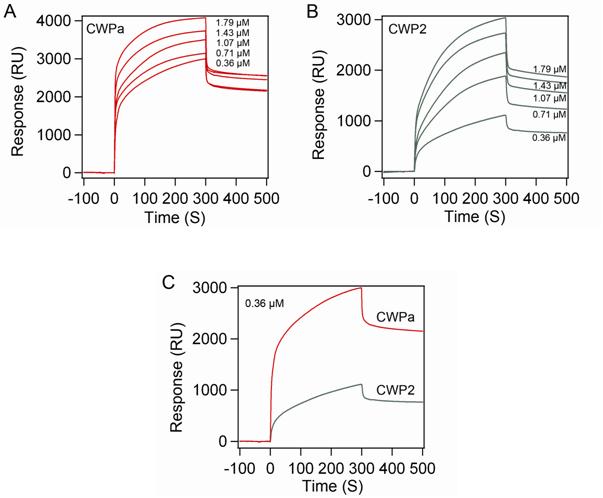 [ Last edited by wg423 on 2011-12-25 at 19:38 ] |
 回复此楼
回复此楼» 猜你喜欢
 OpenAI又攻克数学难题了,离AI做有机合成还有多远?
已经有6人回复
OpenAI又攻克数学难题了,离AI做有机合成还有多远?
已经有6人回复
-
售SCI一区T0P文章,我:8.O.55.1.O.5.4,科目全,可+急
已经有10人回复
-
售SCI一区文章,我:8O5.5.1.O5.4,科目全,可伽急
已经有9人回复
-
售SCI一区T0P文章,我:8.O55.1.O.54,科目全,可十急
已经有8人回复
-
售SCI文章,我:8O.5.5.1O.54,科目全,可十急
已经有7人回复
-
售SCI文章,我:8O5.5.1.O.54,科目齐全,可+急
已经有9人回复
-
售SCI文章,我:8O.5.5.1O.54,科目全,可十急
已经有8人回复
-
售SCI-T0P文章,我:8O.5.5.1.O.54,科目齐全,可+急
已经有8人回复
-
售SCI一区T0P文章,我:8O.55.1.O.5.4,科目齐全,可+急
已经有7人回复
-
售SCI一区T0P文章,我:8.O55.1.O.54,科目全,可十急
已经有7人回复
» 本主题相关价值贴推荐,对您同样有帮助:
- Revise-大修还是小修?第二个审稿人什么意思?
已经有27人回复
- 已经要求大修的文章,能给编辑写信说自己感觉审稿人不合适吗?
已经有13人回复
- 两个审稿人,一个大修,一个拒了,编辑让修改后重投,
已经有8人回复
- 大修过程中,自己除了审稿人给的意见外,发现一些小的语法错误
已经有19人回复
- SSCI大修后再送另一审稿人被拒,请大家帮看一下意见
已经有32人回复
- 投稿PLOS one 大修,审稿人要求补实验,不补的话被拒概率多少
已经有12人回复
- SCI文章大修,四个审稿人,有一个不同意发表,大修返回后,据的这个审稿人态度会改变吗
已经有15人回复
- 大修后被编辑拒掉,重投会换审稿人吗?
已经有13人回复
- 一个审稿人同意接受,一个审稿人大修,结果主编给拒了,该怎么办
已经有7人回复
- 文章大修,这种情况,怎么回复审稿人啊?
已经有26人回复
- 初审意见两个审稿人,一个强调创新性不强,一个要求大修. 该 怎样回复啊? 谢谢
已经有39人回复
- 大修之后还会送原来的审稿人吗?
已经有12人回复
- 审稿人要求大修,却被编辑给拒了,是否可以申诉?
已经有15人回复
- 稿件大修,审稿人一句话不明白,求高手赐教
已经有4人回复
- 审稿人说大修,但是论文被拒,给编辑再发邮件申诉有用吗 7.19 更新
已经有30人回复
- 有没有两个审稿人一个拒,一个大修,然后编辑reject但是可以resubmit
已经有16人回复
- 大修之后还有两个审稿人认为语言不行,该怎么办呢
已经有13人回复
- 大修回复审稿人和编辑用第几人称?
已经有7人回复
- 文章大修审稿人提出的问题有一个不能解释原因还能被录用吗
已经有11人回复
- 大修时对英语写作做了相应修改,应该如何回复审稿人意见
已经有4人回复
- 审稿意见回来,一个审稿人让据,编辑说大修,大家帮我看看希望大不
已经有24人回复
【答案】应助回帖
longxy(金币+5): 谢谢您的帮助!我早已经回复过审稿人了!您的回复大多指出我试验的错误并没有指出如何回复 2011-11-11 14:33:05
|
Answer for reviwer #1 1.) you need is: the global fit 1:1 (one to one) binding model 2.) In figure A, show different binding level (5 lines) but the dissociation see some overlap (only 3 lines). The reviwer can see they are different from unshown data. So, there is some mistake in the fitting. 3.) The CWPa Koff is quicker than CWP2, see from figure C. The large RI, means you have not have control or in line control Fc in the test. or not fit the data by deducted the refernce cell. 4.) Normally for Kd analysis, the max RU should <2000 RU |

2楼2011-11-09 10:06:09
| Reviewer很内行,重做吧,我们公司也有,海归博士专门值守,Biacore 3000,经典机型,仪器很新,价钱也很公道。联系Email:guanyanbin@crownbio.com |
3楼2012-04-12 14:44:35
4楼2014-01-09 00:08:00