













| 查看: 13817 | 回复: 130 | ||||||||
[交流]
欢迎大家投稿新创刊的Journal of Advanced Dielectrics 【很快就Sci检索啦】
|
||||||||

|
做功能电介质的虫虫们,西交大姚熹院士创办了一份英文期刊,Journal of Advanced Dielectrics,新加坡出版,副主编都是大牛。 Aims & Scope The Journal of Advanced Dielectrics is an international peer-reviewed journal for original contributions on the understanding and applications of dielectrics in modern electronic devices and systems. The journal seeks to provide an interdisciplinary forum for the rapid communication of novel research of high quality in, but not limited to, the following topics: Fundamentals of dielectrics (ab initio or first-principles calculations, density functional theory, phenomenological approaches). Polarization and related phenomena (spontaneous polarization, domain structure, polarization reversal). Dielectric relaxation (universal relaxation law, relaxor ferroelectrics, giant permittivity, flexoelectric effect). Ferroelectric materials and devices (single crystals and ceramics). Thin/thick films and devices (ferroelectric memory devices, capacitors). Piezoelectric materials and applications (lead-based piezo-ceramics and crystals, lead-free piezoelectrics). Pyroelectric materials and devices Multiferroics (single phase multiferroics, composite ferromagnetic ferroelectric materials). Electrooptic and photonic materials. Energy harvesting and storage materials (polymer, composite, super-capacitor). Phase transitions and structural characterizations. Microwave and milimeterwave dielectrics. Nanostructure, size effects and characterizations. Engineering dielectrics for high voltage applications (insulation, electrical breakdown). Modeling (microstructure evolution and microstructure-property relationships, multiscale modeling of dielectrics). JAD is sponsored by the International Center for Dielectric Research (ICDR), Xi'an Jiaotong University, China. Discover and keep up-to-date with the latest research on Advanced Dielectrics with free electronic subscription of Journal of Advanced Dielectrics (JAD) for 2011. Sign up here and gain Free Access to the full text articles for 2011! Editor-in-Chief Xi Yao Electronic Materials Research Laboratory (EMRL) Xi'an Jiaotong University, Xi'an 710049, P.R. China xyao@mail.xjtu.edu.cn Tel: +86-29-82668908 Fax: +86-29-82668794 Editors Alexander K. Tagantsev Ceramics Laboratory, Materials Science and Engineering Swiss Federal Institutes of Technology (EPFL) IMX STI Station 12 EPFL Lausanne 1015, Switzerland alexander.tagantsev@epfl.ch Zuo-Guang Ye Department of Chemistry Simon Fraser University, Burnaby, B.C., V5A 1S6, Canada zye@sfu.ca Satoshi Wada Department of Applied Chemistry University of Yamanashi 4-4-37 Takeda, Kofu, Yamanashi 400-8510, Japan swada@yamanashi.ac.jp Weiguang Zhu Division of Microelectronics, School of Electrical & Electronic Engineering Nanyang Technological University, Singapore 639798, Singapore ewzhu@ntu.edu.sg Board Members Marin Alexe Max Planck Institute of Microstructure Physics Weinberg 2, 06120 Halle (Saale), Germany malexe@mpi-halle.mpg.de Miguel Algueró Instituto de Ciencia de Materiales de Madrid (ICMM) Consejo Superior de Investigaciones Científicas (CSIC) Cantoblanco, Madrid 28049, Spain malguero@icmm.csic.es Amar Bhalla Department of Electrical and Computer Engineering University of Texas at San Antonio San Antonio, TX 78249, USA amar.bhalla@utsa.edu Alexei A. Bokov Simon Fraser University Burnaby, BC, V5A 1S6, CANADA abokov@sfu.ca David Cann School of Mechanical, Industrial, and Mechanical Engineering Oregon State University, Corvallis, OR 97331, USA cann@engr.orst.edu Yanfeng Chen Department of Materials Science and Engineering National Laboratory of Solid-State Microstructures Nanjing University, Nanjing 210093, P.R. China yfchen@nju.edu.cn Zhongyang Cheng Materials Engineering 275 Wilmore Lab, Auburn University, AL 36849, USA chengzh@eng.auburn.edu Dragan Damjanovic Ceramics Laboratory, Institute of Materials, School of Engineering, EPFL EPFL-STI-IMX-LC, Station 12, CH-1015 Lausanne, Switzerland dragan.damjanovic@epfl.ch José Antonio Eiras Grupo de Cerâmicas Ferroelétricas Universidade Federal de São Carlos Rod. Washington Luis, km 235, São Carlos - SP - Brasil eiras@df.ufscar.br Catherine Elissalde Institute of Condensed Matter Chemistry of Bordeaux (ICMCB) - CNRS, 87 Avenue du Docteur A. Schweitzer, 33608 Pessac cedex, France elissald@icmcb-bordeaux.cnrs.fr Chunlin Jia Institut für Festkörperforschung Forschungszentrum Jülich 52425 Jülich, Germany c.jia@fz-juelich.de Andrei Kholkin DECV & CICECO, University of Aveiro 3810-193 Aveiro, Portugal kholkin@ua.pt Eung Soo Kim Department of Materials Engineering Kyonggi University Suwon 443-760, Korea eskim@kyonggi.ac.kr Yan-Rong Li School of Microelectronics and Solid-State Electronics University of Electronics Science and Technology of China No.4, Section 2, North Jianshe Road, Chengdu 610054, P.R. China yrli@uestc.edu.cn Yongxiang Li Shanghai Institute of Ceramics, Chinese Academy of Sciences 1295 Dingxi Road, Shanghai 200050, P.R. China yxli@mail.sic.ac.cn Yun Liu Research School of Chemistry The Australian National University, ACT 0200, Australia yliu@rsc.anu.edu.au Hanxing Liu School of Materials Science and Engineering Wuhan University of Technology 122 Luoshi Road, Wuhan 430070, P.R. China lhxhp@whut.edu.cn Cewen Nan Department of Material Science and Engineering Tsinghua University, Beijing 100084, P.R. China cwnan@mail.tsinghua.edu.cn Shashank Priya Mechanical Engineering Virginia Tech 310 Durham Hall, Blacksburg, VA 24061, USA spriya@vt.edu Yimnirun Rattikorn School of Physics, Institute of Science Suranaree University of Technology Nakhon Ratchasima 30000, Thailand rattikorn@sut.ac.th Mike Reece Eng 336, Department of Materials Queen Mary, University of London London E1 4NS, UK m.j.reece@qmul.ac.uk Wei Ren Electronic Materials Research Laboratory (EMRL) Xi'an Jiaotong University, Xi'an 710049, P.R. China wren@mail.xjtu.edu.cn Vladimir Ya. Shur Ferroelectric Laboratory, Institute of Physics & Applied Mathematics Ural State University, 51 Lenin Ave., Ekaterinburg 620083, Russia Vladimir.shur@usu.ru R. P. Tandon Department of Physics and Astrophysics University of Delhi, Delhi-110007, India ram_tandon@hotmail.com Tseung-Yuen Tseng Department of Electronics Engineering & Institute of Electronics National Chiao-Tung University 1001 Ta Hsueh Road, Hsinchu 300, Taiwan tseng@cc.nctu.edu.tw Takaaki Tsurumi Graduate School of Science and Engineering, Tokyo Institute of Technology, 2-12-1 Ookayama, Meguro, Tokyo 152-8552, Japan ttsurumi@ceram.titech.ac.jp Chunlei Wang School of Physics, Shandong University 27 South Shanda Road, Jinan 250100, P.R. China wangcl@sdu.edu.cn Yugong Wu School of Electronic and Information Engineering Tianjin University, 92 Weijing Road, Tianjin 300072, P.R. China wuyugong@tju.edu.cn Kai Wu State Key Lab. of Power Equipment and Electrical Insulation Xi'an Jiaotong University, Xi'an 710049, P. R. China wukai@mail.xjtu.edu.cn Jiwei Zhai Functional Materials Research Laboratory (FMRL) Tongji University, 1239 Siping Road, Shanghai 200092, P.R. China apzhai@mail.tongji.edu.cn Jianguo Zhu College of Materials Science and Engineering Sichuan University, Wangjiang Road 29, Chengdu 610064, P.R. China nic0400@scu.edu.cn 目前第一卷四期都已出版,第二卷已经完成了两期的稿件。到第三卷就可以sci检索了。大家想投稿的,赶快了。等sci检索了,稿件量就要剧增了,要投稿的赶紧,呵呵  主页:http://www.worldscinet.com/jad 最新文章列表 http://www.worldscinet.com/jad/01/0104/S2010135X110104.html 欢迎来信咨询 |
 回复此楼
回复此楼» 收录本帖的淘帖专辑推荐
 论文写作与发表 论文写作与发表 | 铁电材料 | 投稿杂志 | cal and model |
| 科研 |
» 猜你喜欢
 297求调剂
已经有12人回复
297求调剂
已经有12人回复
-
26调剂 086003
已经有3人回复
-
265求调剂
已经有20人回复
-
271分求调剂学校
已经有11人回复
-
320分人工智能调剂
已经有6人回复
-
求调剂,一志愿南京航空航天大学 ,080500材料科学与工程学硕
已经有8人回复
-
280求调剂
已经有19人回复
-
求材料调剂,一志愿郑州大学289分
已经有15人回复
-
26考研调剂0710 0860
已经有6人回复
-
282求调剂
已经有22人回复
» 本主题相关价值贴推荐,对您同样有帮助:
- Journal of advanced ceramics影响因子怎么查不到?
已经有7人回复
- 最新SCI分区 Journal of Electromagnetic Waves and Applications
已经有6人回复
- Journal of Asian Ceramic Societies创刊
已经有17人回复
- Max Planck Institute for Mathematics in the Sciences怎么样??
已经有3人回复
- 欢迎大家投稿新创刊的Journal of Advanced Dielectrics (科学网广告链接)
已经有6人回复
- Materials Sciences and Applications 投稿 出版
已经有9人回复
- 稀土中金属分离投哪个SCI比较快?加急
已经有5人回复
- Advanced Engineering Informatics上的文章一般几个月后会被SCI收录
已经有4人回复
- 咨询INFORMATION-AN INTERNATIONAL INTERDISCIPLINARY JOURNAL期刊投稿和SCI检索问题
已经有6人回复
- 杂志ELECTRONIC JOURNAL OF DIFFERENTIAL EQUATIONS是SCI检索么?
已经有6人回复
- 【其它】热烈祝贺英文国际学术期刊《Journal of Advanced Dielectrics>>创刊
已经有8人回复
- Chinese Physics B是不是现在已经不是SCI了
已经有8人回复
» 抢金币啦!回帖就可以得到:
-
河北大学分析化学招收多名调剂考生
 +5/724
-
2026年山东科技大学低碳能源化工实验室招收化工工艺、环境工程硕士调剂信息
+1/181
-
岭南师范学院化学化工学院招收生物与医药硕士调剂
+1/86
-
欢迎优秀考生调剂江西理工大学稀土学院
+1/86
-
武汉纺织大学学硕调剂
+2/62
-
化学,材料方向研究生调剂
+2/52
-
河南工业大学化学化工学院 2026 年硕士调剂正在进行!
+1/39
-
企业出国访问交流求助
+1/38
-
河南工业大学化学化工学院 2026 年硕士调剂正在进行!
+1/35
-
2026年西华大学材料学院-材料近净成形与表面技术研究团队-招收调剂研究生
+1/17
-
重庆工商大学 教育部研究中心招收化工/环境/材料/石油/机械方向2026年调剂研究生
+1/11
-
青年长江学者团队 2026年 硕士研究生 招收调剂考生
+1/11
-
大连工业大学招生 08工学:化工、环境、材料 07理学:化学 调剂招生!
+1/10
-
【上海调剂】985联合培养!别错过能送你去丹麦/交大/同济/中科院的神仙导师!
+1/9
-
中科院动物所和北京工商大学招收2026博士(化学背景)
+1/8
-
浙江宁波 生物与医药 接受生物学、园艺学、作物学、农业调剂
+1/6
-
广东医科大学(东莞松山湖校区)生物医学工程学术型硕士接收调剂!
+1/6
-
合工大具身智能柔性机器人方向招博士
+1/6
-
【招收调剂】07/08/09学生看过来 环境 农业 生态学 生物 化学 计算机 材料 市政
+1/6
-
找好工作来我这-广东唯一石化院校——资源与环境专硕招生
+1/2
ceramic: 回帖置顶 2011-12-29 05:34:44
|
上传一些该杂志发表的文章 Volume: 1, Issue: 1(2011) p. v Abstract | Full Text (PDF, 32KB) Title: EDITORIAL NOTE |

» 本帖附件资源列表
-
欢迎监督和反馈:小木虫仅提供交流平台,不对该内容负责。
本内容由用户自主发布,如果其内容涉及到知识产权问题,其责任在于用户本人,如对版权有异议,请联系邮箱:xiaomuchong@tal.com - 附件 1 : J.Adv.Dielec. 2011 V.pdf
2011-12-29 05:29:20, 32.24 K
77楼2011-12-29 05:29:25
ceramic: 回帖置顶 2011-12-29 05:34:49
|
Volume: 1, Issue: 1(2011) pp. 1-16 DOI: 10.1142/S2010135X11000021 Abstract | Full Text (PDF, 2,276KB) | References Title: MAGNETOELECTRIC RESPONSES IN MULTIFERROIC COMPOSITE THIN FILMS Author(s): JIA-MIAN HU Department of Materials Science and Engineering and State Key Lab of New Ceramics and Fine Processing, Tsinghua University, Beijing 100084, P. R. China JING MA Department of Materials Science and Engineering and State Key Lab of New Ceramics and Fine Processing, Tsinghua University, Beijing 100084, P. R. China JING WANG Department of Materials Science and Engineering and State Key Lab of New Ceramics and Fine Processing, Tsinghua University, Beijing 100084, P. R. China ZHENG LI Department of Materials Science and Engineering and State Key Lab of New Ceramics and Fine Processing, Tsinghua University, Beijing 100084, P. R. China YUAN-HUA LIN Department of Materials Science and Engineering and State Key Lab of New Ceramics and Fine Processing, Tsinghua University, Beijing 100084, P. R. China C. W. NAN Corresponding author. Department of Materials Science and Engineering and State Key Lab of New Ceramics and Fine Processing, Tsinghua University, Beijing 100084, P. R. China History: Received 20 September 2010 Abstract: Multiferroic composite thin films of ferroelectrics and magnets have attracted ever-increasing interest in most recent years. In this review, magnetoelectric (ME) responses as well as their underlying ME coupling mechanisms in such multiferroic composite thin films are discussed, oriented by their potential applications in novel ME devices. Among them, the direct ME response, i.e., magnetic-field control of polarization, can be exploited for micro-sensor applications (sensing magnetic field, electric current, light, etc.), mainly determined by a strain-mediated coupling interaction. The converse ME response, i.e., electric-field modulation of magnetism, offers great opportunities for new potential devices for spintronics and in data storage applications. A series of prototype ME devices based on both direct and converse ME responses have been presented. The review concludes with a remark on the future possibilities and scientific challenges in this field. Keywords: Multiferroic; magnetoelectric effect; composite thin film; magnetoelectric devices; memory devices[ Last edited by ceramic on 2011-12-29 at 05:32 ] |
» 本帖附件资源列表
-
欢迎监督和反馈:小木虫仅提供交流平台,不对该内容负责。
本内容由用户自主发布,如果其内容涉及到知识产权问题,其责任在于用户本人,如对版权有异议,请联系邮箱:xiaomuchong@tal.com - 附件 1 : J.Adv.Dielec. 2011 1.pdf
2011-12-29 05:32:11, 2.22 M
78楼2011-12-29 05:31:00
ceramic: 回帖置顶 2011-12-29 05:34:52
|
Volume: 1, Issue: 1(2011) pp. 17-31 DOI: 10.1142/S2010135X11000033 Abstract | Full Text (PDF, 1,495KB) | References Title: LOSS DETERMINATION METHODOLOGY FOR A PIEZOELECTRIC CERAMIC: NEW PHENOMENOLOGICAL THEORY AND EXPERIMENTAL PROPOSALS Author(s): KENJI UCHINO Corresponding author. Electrical Engineering Department, International Center for Actuators and Transducers, The Pennsylvania State University, University Park, PA 16802, USA Materials Science and Engineering, International Center for Actuators and Transducers, The Pennsylvania State University, University Park, PA 16802, USA Office of Naval Research Global – Asia, Minato-ku, Tokyo 106-0032, Japan YUAN ZHUANG Electrical Engineering Department, International Center for Actuators and Transducers, The Pennsylvania State University, University Park, PA 16802, USA SEYIT O. URAL Materials Science and Engineering, International Center for Actuators and Transducers, The Pennsylvania State University, University Park, PA 16802, USA History: Received 2 December 2010 Abstract: The key factor to the miniaturization of piezoelectric devices is power density, which is limited by the heat generation or loss mechanisms. There are three loss components in general in piezoelectric vibrators/resonators, i.e., dielectric, elastic and piezoelectric losses. The mechanical quality factor, determined by these three factors, is the Figure Of Merit (FOM) in the sense of loss or heat generation. In this paper, we introduce a new loss phenomenology and innovative measuring methods based on the theory. First, quality factors at resonance and antiresonance for the k31, k33, kt and k15 vibration modes are derived theoretically, and the methodology for determining loss factors in various orientations (i.e., loss anisotropy) is provided. For simplicity, we focus on materials with ∞ mm (equivalent to 6 mm) crystal symmetry for deriving the loss factors of a polycrystalline ceramic, and 14 different loss factors among 20 in total can be obtained from the measurements. Second, we propose the experimental methods for measuring both mechanical quality factors QA and QB at the resonance and antiresonance modes: a continuous admittance/impedance spectrum measuring method (traditional with temperature rise) and a burst mode (to circumvent the temperature effect). Keywords: Piezoelectric; loss factor; quality factor; high power; piezoelectric loss; dielectric loss; elastic loss; admittance/impedance spectrum; burst mode |
» 本帖附件资源列表
-
欢迎监督和反馈:小木虫仅提供交流平台,不对该内容负责。
本内容由用户自主发布,如果其内容涉及到知识产权问题,其责任在于用户本人,如对版权有异议,请联系邮箱:xiaomuchong@tal.com - 附件 1 : J.Adv.Dielec. 2011 17.pdf
2011-12-29 05:33:52, 1.46 M
79楼2011-12-29 05:34:14
ceramic: 回帖置顶 2012-06-07 15:08:11
|
Volume: 2, Issue: 1(2012) 1230001 (18 pages) DOI: 10.1142/S2010135X12300010 Abstract | Full Text (PDF, 2,367KB) | References Title: REVIEW ON PIEZOELECTRIC, ULTRASONIC, AND MAGNETOELECTRIC ACTUATORS Author(s): SHUXIANG DONG Abstract: Piezoelectric actuators operating in piezoelectric-induced strain/stress or electromechanical resonance-induced vibration or wave-motion friction drive mechanism have shown many advantages over traditional electromagnetic motors, especially, when miniaturizing into millimeter-scale size, while magnetoelectric actuators operating in magnetostrictive mechanism are capable of piezoelectric self-sensing and remote operation under an applied magnetic field. This paper summarizes the recent progresses in piezoelectric ceramic and single crystal materials based actuators and micromotors, ferromagnetic/ferroelectric laminated magnetoelectric actuators, including rotary, linear, planner, and spherical motion actuators, and bending motion magnetoelectric actuators. Their driving mechanisms, operation properties, and applications are also explained. Keywords: Piezoelectric; ultrasonic; magnetoelectric; actuator; micromotor 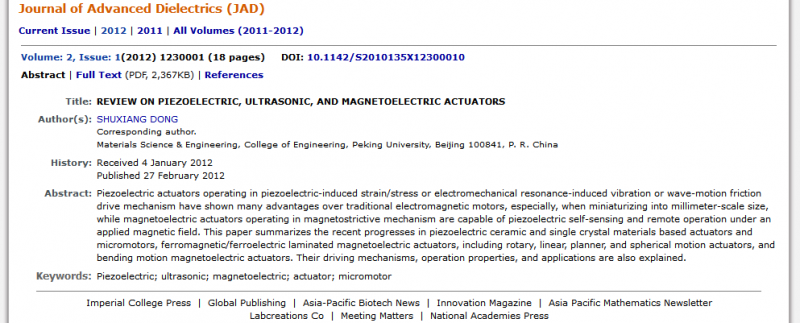 [ Last edited by ceramic on 2012-6-7 at 15:20 ] |
» 本帖附件资源列表
-
欢迎监督和反馈:小木虫仅提供交流平台,不对该内容负责。
本内容由用户自主发布,如果其内容涉及到知识产权问题,其责任在于用户本人,如对版权有异议,请联系邮箱:xiaomuchong@tal.com - 附件 1 : 1. REVIEW ON PIEZOELECTRIC, ULTRASONIC, AND MAGNETOELECTRIC ACTUATORS.pdf
2012-06-07 15:08:01, 2.31 M
119楼2012-06-07 15:08:04
ceramic: 回帖置顶 2012-06-07 15:10:40
|
Volume: 2, Issue: 1(2012) 1230002 (15 pages) DOI: 10.1142/S2010135X12300022 Abstract | Full Text (PDF, 1,744KB) | References Title: RELAXOR FERROELECTRIC MATERIALS FOR MICROWAVE TUNABLE APPLICATIONS Author(s): QIWEI ZHANG, JIWEI ZHAI, LING BING KONG Abstract: With strong dependences of dielectric constant on external applied electric fields, relaxor barium zirconium titanate (BaZrxTi1-xO3 or BZT) and barium stannate titanate (BaSnxTi1-xO3 or BTS), in both bulk ceramic and thin film forms, are increasingly being recognized as potential candidates of microwave tunable materials for device applications. This paper is aimed to review the recent progress in understanding the dielectric properties (such as tunability, dielectric loss and dielectric constant) of these relaxor materials. However, due to their relatively high dielectric constant and loss tangent, pure Ba(Zr,Ti)O3 and Ba(Sn,Ti)O3 do not fully satisfy the requirements of practical device applications. Therefore, various strategies have been developed to improve the dielectric properties of these two groups of relaxor materials. In this paper, we first discussed the dielectric tunability characteristics of pure Ba(Zr,Ti)O3 and Ba(Sn,Ti)O3 and then summarized the strategies that have been used, including (i) small amount acceptor or donor doping (such as rare-earth ions and transition metal ions) and (ii) forming composites with low loss and low dielectric constant microwave dielectric materials (such as MgO, MgTiO3 and so on). At the same time, the relationship between relaxor behavior and dielectric tunability was also discussed. Keywords: Relaxor materials; barium zirconium titanate; barium stannate titanate; dielectric tunability; ferroelectric composites 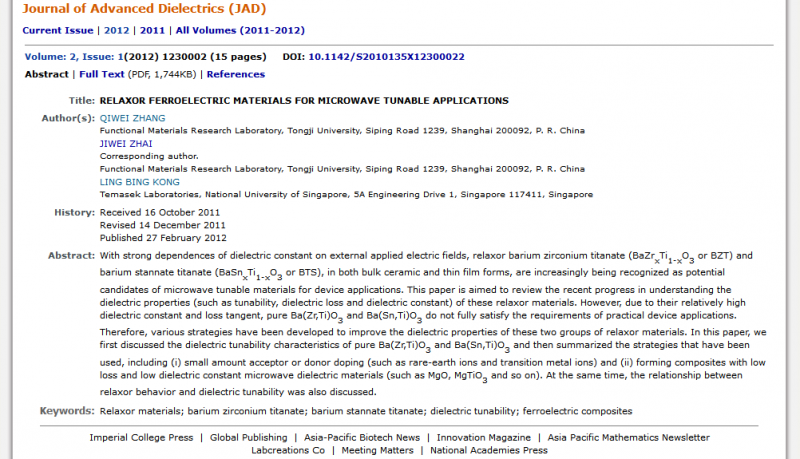 [ Last edited by ceramic on 2012-6-7 at 15:19 ] |
» 本帖附件资源列表
-
欢迎监督和反馈:小木虫仅提供交流平台,不对该内容负责。
本内容由用户自主发布,如果其内容涉及到知识产权问题,其责任在于用户本人,如对版权有异议,请联系邮箱:xiaomuchong@tal.com - 附件 1 : 2. RELAXOR FERROELECTRIC MATERIALS FOR MICROWAVE TUNABLE APPLICATIONS.pdf
2012-06-07 15:10:22, 1.7 M
120楼2012-06-07 15:10:30
ceramic: 回帖置顶 2012-06-07 15:22:08
|
Volume: 2, Issue: 1(2012) 1250001 (14 pages) DOI: 10.1142/S2010135X12500014 Abstract | Full Text (PDF, 2,621KB) | References Title: SYNTHESIS, CHARACTERIZATION AND ELECTRICAL PROPERTIES OF Nd/Zr CO-DOPED NANO BaTiO3 CERAMICS Author(s): CH. SAMEERA DEVI, M. B. SURESH, G. S. KUMAR, G. PRASAD Abstract: Ceramic samples of composition Ba1-3xNd2xTi1-yZryO3 (x = 0.025;y = 0,0.025 and 0.05) were synthesized by modified sol–gel technique. Phase confirmation, surface morphology and electrical properties of the samples were studied using XRD, FESEM, impedance spectroscopy and DC conductivity. Impedance, AC and DC conductivities of the samples were recorded in the temperature range room temperature (RT) –500°C. From impedance data, various parameters like bulk resistance (Rb), bulk capacitance (Cb), grain resistance (Rg), grain boundary resistance (Rgb), grain capacitance (Cg) and grain boundary capacitance (Cgb) were determined. These parameters were found to be function of both temperature and frequency. Grain and grain boundary relaxation times (τg,τgb) were also evaluated as a function of temperature. From AC and DC conductivity plots activation energies for conduction were obtained. Results obtained lead to improved understanding of conductivity and charge transportation kinetics in the present system of samples. Keywords: Sol–gel method; BaTiO3; impedance spectroscopy; DC conductivity; AC conductivity 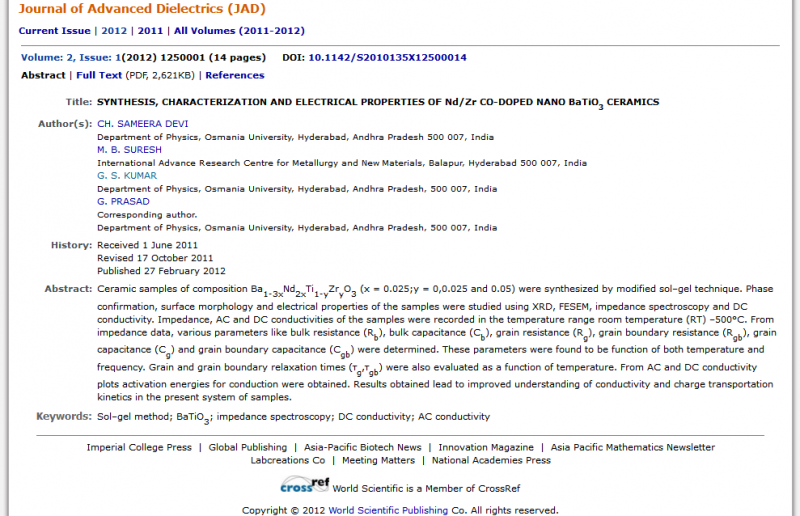 [ Last edited by ceramic on 2012-6-7 at 15:21 ] [ Last edited by ceramic on 2012-6-7 at 15:21 ] |
» 本帖附件资源列表
-
欢迎监督和反馈:小木虫仅提供交流平台,不对该内容负责。
本内容由用户自主发布,如果其内容涉及到知识产权问题,其责任在于用户本人,如对版权有异议,请联系邮箱:xiaomuchong@tal.com - 附件 1 : 3.SYNTHESIS,CHARACTERIZATIONANDELECTRICALPROPERTIESOFNdZrCO-DOPEDNANOBaTiO3CERAMICS.pdf
2012-06-07 15:16:44, 2.56 M
121楼2012-06-07 15:14:49
ceramic: 回帖置顶 2012-06-07 15:24:04
|
Volume: 2, Issue: 1(2012) 1250002 (11 pages) DOI: 10.1142/S2010135X12500026 Abstract | Full Text (PDF, 791KB) | References Title: IMPEDANCE AND MODULUS SPECTROSCOPY CHARACTERIZATION OF SODIUM-BISMUTH TITANATE-BASED LEAD-FREE FERROELECTRIC MATERIALS Author(s): DHANANJAY K. SHARMA, RAJU KUMAR, RADHESHYAM RAI Abstract: In this paper, we present impedance spectroscopy of Sodium Bismuth Titanate-based materials belonging to (1-x)Na1/2Bi1/2TiO3-xBaTiO3 (x = 0.04) (NBT–BT) system. NBT–BT ceramics are prepared by high temperature solid-state reaction method. X-ray diffraction technique showed single-phase polycrystalline sample with an ABO3 perovskite structure. Dielectric behavior and the impedance relaxation were investigated in a wide range of temperature (room temperature (RT) –500°C) and frequency (1 kHz–1 MHz). A broad dielectric constant peak was observed over a wide temperature range around the phase transition temperature. The complex impedance plot exhibited one impedance semicircle identified over the frequency range of 1 kHz–1 MHz, which is explained by the grain effect of the bulk. The centers of the impedance semicircles lie below the real axis, which indicates that the impedance response is a Cole–Cole type relaxation. Keywords: Ceramics; X-ray diffraction; piezoelectricity perovskite; dielectric properties 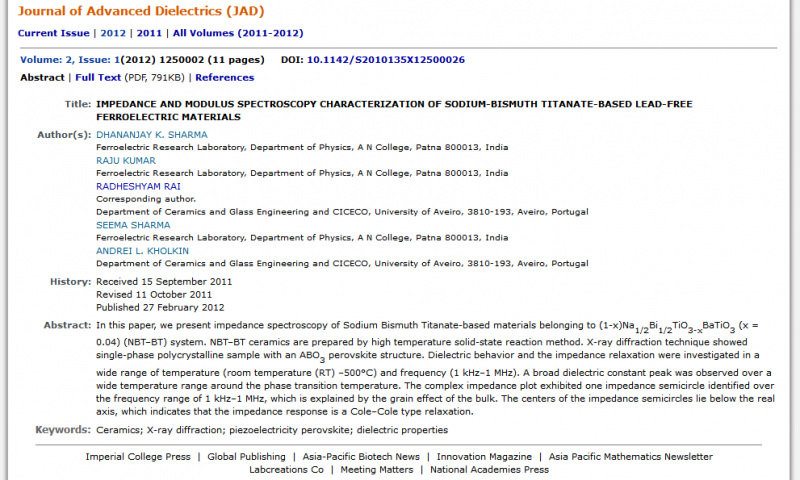 |
» 本帖附件资源列表
-
欢迎监督和反馈:小木虫仅提供交流平台,不对该内容负责。
本内容由用户自主发布,如果其内容涉及到知识产权问题,其责任在于用户本人,如对版权有异议,请联系邮箱:xiaomuchong@tal.com - 附件 1 : 4. IMPEDANCE AND MODULUS SPECTROSCOPY CHARACTERIZATION OF SODIUM-BISMUTH TITANATE-BASED LEAD-FREE FERROELECTRIC MATERIALS.pdf
2012-06-07 15:23:36, 791.71 K
122楼2012-06-07 15:23:53
★
ceramic(金币+1): 谢谢参与
ceramic(金币+1): 谢谢参与
 这个期刊不错,但是不知道如何下载文章啊。http://www.worldscientific.com/doi/abs/10.1142/S2010135X11000264 这个期刊不错,但是不知道如何下载文章啊。http://www.worldscientific.com/doi/abs/10.1142/S2010135X11000264 |
126楼2012-09-02 09:04:49
2楼2011-12-24 06:54:03
3楼2011-12-24 09:54:38
4楼2011-12-24 17:41:39
6楼2011-12-24 19:51:39
7楼2011-12-24 20:08:33
8楼2011-12-24 20:09:06
 ceramic
9楼2011-12-25 11:03:40
10楼2011-12-25 11:43:46
12楼2011-12-25 11:56:28
24楼2011-12-25 17:30:01
26楼2011-12-25 18:26:47
33楼2011-12-25 18:55:41
35楼2011-12-25 18:59:04
简单回复
PHDlong5楼
2011-12-24 19:29
回复
ceramic(金币+1):谢谢参与

tianma33311楼
2011-12-25 11:50
回复
ceramic(金币+1):谢谢参与

shaojin13楼
2011-12-25 11:56
回复
ceramic(金币+1):谢谢参与

majingjie314楼
2011-12-25 11:59
回复
ceramic(金币+1):谢谢参与
91088397415楼
2011-12-25 12:10
回复
ceramic(金币+1):谢谢参与

91088397416楼
2011-12-25 12:10
回复
ceramic(金币+1):谢谢参与
untrue17楼
2011-12-25 12:11
回复
ceramic(金币+1):谢谢参与
dlyan18楼
2011-12-25 12:12
回复
ceramic(金币+1):谢谢参与
dlyan19楼
2011-12-25 12:13
回复
ceramic(金币+1):谢谢参与
youth082620楼
2011-12-25 13:23
回复
ceramic(金币+1):谢谢参与
youth082621楼
2011-12-25 13:23
回复
ceramic(金币+1):谢谢参与
xyz88xyz22楼
2011-12-25 14:30
回复
ceramic(金币+1):谢谢参与
祝福
xyz88xyz23楼
2011-12-25 14:30
回复
ceramic(金币+1):谢谢参与
祝福
李恒091525楼
2011-12-25 18:18
回复
ceramic(金币+1):谢谢参与
xiaocui198727楼
2011-12-25 18:45
回复
ceramic(金币+1):谢谢参与
xiaocui198728楼
2011-12-25 18:45
回复
ceramic(金币+1):谢谢参与
untrue29楼
2011-12-25 18:49
回复
ceramic(金币+1):谢谢参与

untrue30楼
2011-12-25 18:49
回复

ruifenghaha31楼
2011-12-25 18:49
回复
ceramic(金币+1):谢谢参与
ruifenghaha32楼
2011-12-25 18:49
回复
ceramic(金币+1):谢谢参与
haixing200834楼
2011-12-25 18:55
回复
ceramic(金币+1):谢谢参与
jeehee36楼
2011-12-25 19:02
回复
ceramic(金币+1):谢谢参与
2011-12-25 19:04
回复
ceramic(金币+1):谢谢参与
2011-12-25 19:04
回复
ceramic(金币+1):谢谢参与
zyxme39楼
2011-12-25 19:17
回复
ceramic(金币+1):谢谢参与
祝福
mlanqiang40楼
2011-12-25 20:10
回复
ceramic(金币+1):谢谢参与
boyuehu41楼
2011-12-25 20:36
回复
ceramic(金币+1):谢谢参与
张希昂42楼
2011-12-25 20:43
回复
ceramic(金币+1):谢谢参与
江南的竹43楼
2011-12-25 20:58
回复
ceramic(金币+1):谢谢参与
hsluping44楼
2011-12-25 21:01
回复
ceramic(金币+1):谢谢参与
icebergwu45楼
2011-12-25 21:10
回复
ceramic(金币+1):谢谢参与
gter_wang46楼
2011-12-25 21:11
回复
ceramic(金币+1):谢谢参与
wangjing6347楼
2011-12-25 21:12
回复
ceramic(金币+1):谢谢参与
ly200530648楼
2011-12-25 21:13
回复
ceramic(金币+1):谢谢参与
asil32449楼
2011-12-25 21:16
回复
ceramic(金币+1):谢谢参与
悦迷00850楼
2011-12-25 21:18
回复
ceramic(金币+1):谢谢参与


