











| 查看: 20038 | 回复: 314 | ||
| 当前只显示满足指定条件的回帖,点击这里查看本话题的所有回帖 | ||
[资源]
Biological Wastewater Treatment(Grady, C. p. Leslie Lim, Henry C.)第三版
|
||

第一次发帖 ,好多东西都还不太熟悉,图书信息可以在亚马逊上看到(http://www.amazon.cn/Biological- ... slie/dp/0849396794),目录有些长,大家多指教 ,好多东西都还不太熟悉,图书信息可以在亚马逊上看到(http://www.amazon.cn/Biological- ... slie/dp/0849396794),目录有些长,大家多指教 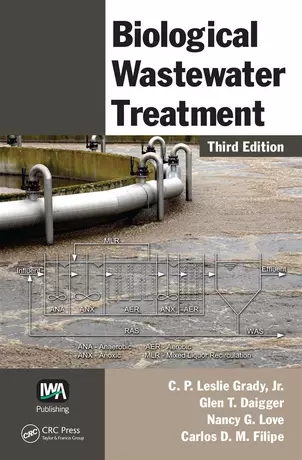 基本信息 出版社: CRC Press Inc; 3rd Revised edition (2011年5月10日) 精装: 1022页 语种: 英语 ISBN: 0849396794 条形码: 9780849396793 商品尺寸: 25.4 x 18 x 5.1 cm 商品重量: 2 Kg ASIN: 0849396794 图书描述 出版日期: 2011年5月10日 Following in the footsteps of previous highly successful and useful editions, Biological Wastewater Treatment, Third Edition presents the theoretical principles and design procedures for biochemical operations used in wastewater treatment processes. It reflects important changes and advancements in the field, such as a revised treatment of the microbiology and kinetics of nutrient removal and an update of the simulation of biological phosphorous removal with a more contemporary model. See what's new in the Third Edition: A chapter devoted to the description and simulation of anaerobic bioreactors Coverage of applications of submerged attached growth bioreactors Expanded discussion of modeling attached growth systems Increased information on the fate and effects of trace contaminants as they relate to xenobiotic organic chemicals A chapter on applying biochemical unit operations to design systems for greater sustainability The book describes named biochemical operations in terms of treatment objectives, biochemical environment, and reactor configuration; introduces the format and notation used throughout the text; and presents the basic stoichiometry and kinetics of microbial reactions that are key to quantitative descriptions of biochemical operations. It then examines the stoichiometry and kinetics used to investigate the theoretical performance of biological reactors containing microorganisms suspended in the wastewater. The authors apply this theory to the operations introduced, taking care to highlight the practical constraints that ensure system functionality in the real world. The authors focus on further biochemical operations in which microorganisms grow attached to solid surfaces, adding complexity to the analysis, even though the operations are often simpler in application. They conclude with a look to the future, introducing the fate and effects of xenobiotic and trace contaminants in wastewater treatment systems and examining how the application of biochemical operations can lead to a more sustainable world. 目录 Contents Part I Introduction and Background Chapter 1 Classification of Biochemical Operations 3 The Role of Biochemical Operations 3 Criteria for Classification 5 The Biochemical Transformation 5 Removal of Soluble Organic Matter 5 Stabilization of Insoluble Organic Matter 6 Conversion of Soluble Inorganic Matter 6 The Biochemical Environment 7 Bioreactor Configuration 7 Suspended Growth Bioreactors 7 Attached Growth Bioreactors 8 Common “Named” Biochemical Operations 9 Suspended Growth Bioreactors 9 Activated Sludge 9 Biological Nutrient Removal 17 Aerobic Digestion 20 High-Rate Suspended Growth Anaerobic Processes 22 Anaerobic Digestion 23 Fermenters 24 Lagoons 24 Attached Growth Bioreactors 26 Fluidized Bed Biological Reactors 26 Rotating Biological Contactor (RBC) 26 Trickling Filter (TF) 27 Packed Bed 28 Integrated Fixed Film Activated Sludge Systems 29 Miscellaneous Operations 30 Key Points 30 Study Questions 30 References 30 Chapter 2 Fundamentals of Biochemical Operations 33 Overview of Biochemical Operations 33 Major Types of Microorganisms and Their Roles 34 Bacteria 35 Archaea 37 Eucarya 37 Microbial Ecosystems in Biochemical Operations 38 Aggregation and Bioflocculation 38 Aerobic/Anoxic Operations 41 Suspended Growth Bioreactors 41 Attached Growth Bioreactors 45 Anaerobic Operations 46 General Nature of Methanogenic Anaerobic Operations 46 Microbial Groups in Methanogenic Communities and Their Interactions 48 Anaerobic Ammonia Oxidation 50 The Complexity of Microbial Communities: Reality versus Perception 50 Important Processes in Biochemical Operations 51 Biomass Growth, Substrate Utilization, and Yield 51 Overview of Energetics 51 Effects of Growth Environment on ATP Generation 52 Factors Influencing Energy for Synthesis 55 True Growth Yield 56 Constancy of Y in Biochemical Operations 57 Maintenance, Endogenous Metabolism, Decay, Lysis, and Death 58 Formation of Extracellular Polymeric Substances and Soluble Microbial Products 61 Solubilization of Particulate and High Molecular Weight Soluble Organic Matter 62 Ammonification 62 Phosphorus Uptake and Release 62 The Modified Mino PAO Model 63 Filipe–Zeng GAO Model 66 Overview 66 Key Points 67 Study Questions 68 References 68 Chapter 3 Stoichiometry and Kinetics of Aerobic/Anoxic Biochemical Operations 75 Stoichiometry and Generalized Reaction Rate 75 Alternative Bases for Stoichiometry 75 Generalized Reaction Rate 78 Multiple Reactions: The Matrix Approach 79 Biomass Growth and Substrate Utilization 80 Generalized Equation for Biomass Growth 80 Half-Reaction Approach 80 Empirical Formulas for Use in Stoichiometric Equations 83 Determination of fs 84 Aerobic Growth of Heterotrophs with Ammonia as the Nitrogen Source 85 Aerobic Growth of Heterotrophs with Nitrate as the Nitrogen Source 86 Growth of Heterotrophs with Nitrate as the Terminal Electron Acceptor and Ammonia as the Nitrogen Source 87 Aerobic Growth of Autotrophs with Ammonia as the Electron Donor 88 Kinetics of Biomass Growth 90 Effect of Substrate Concentration on μ 91 The Monod Equation 91 Simplifications of the Monod Equation 93 Inhibitory Substrates 93 Effects of Other Inhibitors 94 Specific Substrate Removal Rate 95 Multiple Limiting Nutrients 95 Interactive and Noninteractive Relationships 96 Implications of Multiple Nutrient Limitation 97 Representative Kinetic Parameter Values for Major Microbial Groups 99 Aerobic Growth of Heterotrophic Bacteria 99 Anoxic Growth of Heterotrophic Bacteria 100 Aerobic Growth of Autotrophic Bacteria 101 Maintenance, Endogenous Metabolism, Decay, Lysis, and Death 104 The Traditional Approach 104 The Lysis:Regrowth Approach 106 Endogenous Respiration with Storage 108 Soluble Microbial Product Formation 109 Solubilization of Particulate and High Molecular Weight Organic Matter 110 Ammonification and Ammonia Utilization 111 Phosphorus Uptake and Release 112 Simplified Stoichiometry and Its Use 116 Determination of the Quantity of Terminal Electron Acceptor Needed 116 Determination of Quantity of Nutrient Needed 117 Effects of Temperature 118 Methods of Expressing Temperature Effects 119 Effects of Temperature on Kinetic Parameters 120 Biomass Growth and Substrate Utilization 120 Maintenance, Endogenous Metabolism, Decay, Lysis, and Death 121 Solubilization of Particulate and High Molecular Weight Soluble Organic Matter 122 Phosphorus Uptake and Release 122 Other Important Microbial Processes 122 Key Points 122 Study Questions 125 References 127 PartII theory: Modeling of Ideal Suspended Growth reactors Chapter 4 Modeling Suspended Growth Systems 137 Modeling Microbial Systems 137 Mass Balance Equation 138 Reactor Types 138 Ideal Reactors 139 Continuous Stirred Tank Reactor 139 Plug-Flow Reactor 140 Batch Reactor 141 Nonideal Reactors 142 Residence Time Distribution 142 Experimental Determination of Residence Time Distribution 144 Modeling Nonideal Reactors 145 Continuous Stirred Tank Reactors in Series Model 145 Axial Dispersion Model 147 Representation of Complex Systems 148 Key Points 148 Study Questions 149 References 150 Chapter 5 Aerobic Growth of Heterotrophs in a Single Continuous Stirred Tank Reactor Receiving Soluble Substrate 151 Basic Model for a Continuous Stirred Tank Reactor 151 Methods of Solids Separation and Wastage 152 Definitions of Residence Times 153 Format for Model Presentation 154 Alternative Methods of Expressing Biomass Concentrations and Yields 157 Concentrations of Soluble Substrate and Biomass 158 Mass Balance on Biomass 158 Mass Balance on Soluble Substrate 161 Mass Balance on Biomass Debris 163 Total Biomass Concentration 163 Active Fraction 163 Observed Yield 164 Excess Biomass Production Rate, Oxygen Requirement, and Nutrient Requirements 165 Excess Biomass Production Rate 165 Oxygen Requirement 166 Nutrient Requirement 166 Process Loading Factor or F/M Ratio 168 First-Order Approximation 169 Effect of Solids Retention Time on the Performance of a Continuous Stirred Tank Reactor as Predicted by Model 170 Extensions of the Basic Model 173 Soluble, Nonbiodegradable Organic Matter in Influent 174 Inert Suspended Solids in Influent 174 Biomass in Influent 177 Biodegradable Solids in Influent 184 Effects of Influent Solids on the Performance of a Continuous Stirred Tank Reactor as Predicted by Model 185 Effects of Kinetic Parameters 188 Biomass Wastage and Recycle 188 Garrett Configuration 188 Conventional Configuration 189 Membrane Bioreactors 190 Key Points 190 Study Questions 191 References 193 Chapter 6 Multiple Microbial Activities in a Single Continuous Stirred Tank Reactor 195 International Water Association Activated Sludge Models 196 Components in Model No. 1 196 Reaction Rate Expressions in Model No. 1 199 Representative Parameter Values in Model No. 1 201 Model Nos. 2 and 2d 201 Model No. 3 203 Application of International Water Association Activated Sludge Models 203 Effect of Particulate Substrate 204 Steady-State Performance 205 Dynamic Performance 207 Nitrification and Its Impacts 210 Special Characteristics of Nitrifying Bacteria 210 Interactions between Heterotrophs and Autotrophs 213 Effects of Nitrification in Bioreactors Receiving Only Biomass 216 Denitrification and Its Impacts 216 Characteristics of Denitrification 216 Factors Affecting Denitrification 217 Multiple Events 221 Effects of Diurnal Variations in Loading 221 Intermittent Aeration 222 Closure 224 Key Points 225 Study Questions 226 References 227 Chapter 7 Multiple Microbial Activities in Complex Systems 231 Modeling Complex Systems 231 Representing Complex Systems 231 Significance of Solids Retention Time 233 Importance of the Process Loading Factor 234 Conventional and High Purity Oxygen Activated Sludge 235 Description 235 Effect of SRT on Steady-State Performance 235 Dynamic Performance 237 Variations within the System 240 Step Feed Activated Sludge 242 Description 242 Effect of SRT on Steady-State Performance 243 Dynamic Performance 245 Variations within the System 246 Contact Stabilization Activated Sludge 249 Description 249 Effect of SRT on Steady-State Performance 249 Dynamic Performance 251 Effects of System Configuration 253 Modified Ludzack–Ettinger Process 256 Description 256 Effect of SRT on Steady-State Performance 257 Effects of System Configuration 259 Four-Stage Bardenpho Process 264 Description 264 Effect of SRT on Steady-State Performance 264 Biological Phosphorus Removal Process 266 Description 266 Effect of SRT on Steady-State Performance 268 Effects of System Configuration 271 Factors Affecting the Competition between Phosphate Accumulating and Glycogen Accumulating Organisms 274 Sequencing Batch Reactor 274 Description 274 Analogy to Continuous Systems 277 Effects of Cycle Characteristics 279 Key Points 282 Study Questions 284 References 286 Chapter 8 Stoichiometry, Kinetics, and Simulations of Anaerobic Biochemical Operations 289 Stoichiometry of Anaerobic Biochemical Operations 289 Solubilization of Particulate and High Molecular Weight Organic Matter 290 Fermentation and Anaerobic Oxidation Reactions 291 Methanogenesis 293 Physical and Chemical Processes in Anaerobic Systems 293 Acid–Base Dissociations 293 Gas Transfer 294 Precipitation 294 Kinetics of Anaerobic Biochemical Operations 295 Disintegration and Hydrolysis 295 Fermentation and Anaerobic Oxidation Reactions 296 Methanogenesis 299 Maintenance, Endogenous Metabolism, Decay, Lysis, and Death 299 Inhibition Factors in Anaerobic Biochemical Operations 299 Effects of Temperature on Kinetic Parameters 300 Anaerobic Digestion Model No. 1 300 Components of Anaerobic Digestion Model No. 1 300 Simulating the Anaerobic Digestion of Primary and Waste Activated Sludge 300 Key Points 306 Study Questions 306 References 307 Chapter 9 Techniques for Evaluating Kinetic and Stoichiometric Parameters 311 Treatability Studies 311 Simple Soluble Substrate Model with Traditional Decay as Presented in Chapter 5 313 Data to Be Collected 313 Determination of YH,T and bH 314 Determination of fD 316 Estimation of Inert Soluble COD, SI 317 Estimation of Monod Parameters, μˆ H and KS 317 Hanes Linearization 318 Hofstee Linearization 318 Lineweaver–Burk Linearization 319 Estimation of ke,T 320 Simple Soluble Substrate Model with Traditional Decay in the Absence of Data on the Active Fraction 323 Data to Be Collected 323 Determination of bH 324 Determination of YH,T 325 Determination of SI, μˆ H, KS, and ke,T 325 Use of Batch Reactors to Determine Monod Kinetic Parameters for Single Substrates 327 Intrinsic versus Extant Kinetics 327 Intrinsic Kinetics 328 Extant Kinetics 329 Complex Substrate Model with Lysis:Regrowth Approach to Decay as Presented in Chapter 6 (International Water Association Activated Sludge Model No. 1) 330 Data to Be Collected 330 Characterization of Wastewater and Estimation of Stoichiometric Coefficients 330 Determination of YH 332 Determination of Influent Readily Biodegradable COD (SSO) 332 Determination of Influent Inert Particulate COD (XIO) ... 334 Characterization of Nitrogen-Containing Material 334 Estimation of Kinetic Parameters 335 Aerobic Growth of Heterotrophs 335 Decay of Autotrophs 335 Aerobic Growth of Autotrophs 336 Decay of Heterotrophs 337 Correction Factors for Anoxic Conditions, ηg and ηh 337 Hydrolysis and Ammonification 338 Order of Determination 339 Using Traditional Measurements to Approximate Wastewater Characteristics for Modeling 339 Key Points 343 Study Questions 345 References 347 Part III applications: Suspended Growth reactors Chapter 10 Design and Evaluation of Suspended Growth Processes 353 Guiding Principles 353 Iterative Nature of Process Design and Evaluation 355 Basic Decisions during Design and Evaluation 357 Biochemical Environment 357 Solids Retention Time 359 Aerobic/Anoxic Systems 360 Anaerobic Systems 362 Items from Process Stoichiometry 363 Interactions among Decisions 364 Levels of Design and Evaluation 366 Preliminary Design and Evaluation Based on Guiding Principles 366 Stoichiometric-Based Design and Evaluation 372 Simulation-Based Design and Evaluation 374 Effluent Goals versus Discharge Requirements 375 Optimization 375 Key Points 376 Study Questions 378 References 379 Chapter 11 Activated Sludge 381 Process Description 381 General Description and Facilities 381 Process Options and Comparison 382 Typical Applications 385 Factors Affecting Performance 387 Floc Formation and Filamentous Growth 387 Solids Retention Time 392 Mixed Liquor Suspended Solids Concentration 395 Dissolved Oxygen 395 Oxygen Transfer and Mixing 396 Nutrients 398 Temperature 399 Process Design 400 Overview 400 Factors to be Considered during Design 401 Selection of the Appropriate Process Option 401 Selection of the Solids Retention Time 402 Consideration of the Effects of Temperature 405 Consideration of the Effects of Transient Loadings 406 Distribution of Volume, Mixed Liquor Suspended Solids, and Oxygen in Nonuniform Systems 409 Design of a Completely Mixed Activated Sludge System—The General Case 409 Basic Process Design for the Steady-State Case 410 Consideration of the Effects of Transient Loadings 417 Conventional, High Purity Oxygen, and Selector Activated Sludge—Systems with Uniform Mixed Liquor Suspended Solids Concentrations but Variations in Oxygen Requirements 421 Approximate Technique for Spatially Distributing Oxygen Requirements 422 Design of Conventional Activated Sludge Systems 429 Design of High Purity Oxygen Activated Sludge Systems 432 Design of Selector Activated Sludge Systems 432 Step Feed and Contact Stabilization Activated Sludge— Systems with Nonuniform Mixed Liquor Suspended Solids Concentrations 436 Design of Step Feed Activated Sludge Systems 437 Design of Contact Stabilization Activated Sludge Systems 440 Batch Reactors—Sequencing Batch Reactor Activated Sludge 448 Process Optimization Using Dynamic Models 452 Process Operation 453 Solids Retention Time Control 453 Determination of Solids Wastage Rate 453 Solids Retention Time Control Based on Direct Analysis of Mixed Liquor Suspended Solids Concentration 455 Solids Retention Time Control Based on Centrifuge Analysis of Mixed Liquor Suspended Solids Concentration 455 Hydraulic Control of Solids Retention Time 455 Qualitative Observations 456 Bioreactor 457 Clarifier 457 During Sludge Volume Index Measurement 458 Microscopic Examination 459 Activated Sludge Oxidation to Control Settleability 459 Dynamic Process Control 460 Key Points 461 Study Questions 464 References 466 Chapter 12 Biological Nutrient Removal 471 Process Description 471 General Description 471 Process Options and Comparison 471 Typical Applications 479 Factors Affecting Performance 480 Solids Retention Time 480 Ratios of Wastewater Organic Matter to Nutrient 482 Composition of Organic Matter in Wastewater 486 Effluent Total Suspended Solids 486 Environmental and Other Factors 487 Process Design 489 Biological Nitrogen Removal Processes 489 Nitrification 490 Design of an Anoxic Selector 493 Design of an MLE System to Achieve a Desired Effluent Nitrate-N Concentration 498 Four-Stage Bardenpho Process—Addition of Second Anoxic and Aerobic Zones 503 Simultaneous Nitrification and Denitrification 506 Separate Stage Denitrification 509 Biological Phosphorus Removal Processes 510 Processes That Remove Both Nitrogen and Phosphorus 514 Process Optimization by Dynamic Simulation 517 Process Operation 518 Key Points 519 Study Questions 522 References 524 Chapter 13 Aerobic Digestion 529 Process Description 529 General Description 529 Process Options and Comparison 534 Conventional Aerobic Digestion 535 Anoxic/Aerobic Digestion 536 Autothermal Thermophilic Aerobic Digestion 538 Typical Applications 541 Factors Affecting Performance 542 Solids Retention Time and Temperature 542 13.2.2 pH 545 Mixing 546 Solids Type 546 Bioreactor Configuration 547 Process Design 549 Overview 549 Design from Empirical Correlations 549 Design from Batch Data 552 Design by Simulation 554 Process Operation 554 Key Points 555 Study Questions 556 References 558 Chapter 14 Anaerobic Processes. 561 Process Description 561 General Description 561 Anaerobic Digestion 562 High-Rate Anaerobic Processes 565 Upflow Anaerobic Sludge Blanket 566 Anaerobic Filter 568 Hybrid Upflow Anaerobic Sludge Blanket/ Anaerobic Filter 568 Expanded Granular Sludge Bed 568 Solids Fermentation Processes 569 Comparison of Process Options 571 Typical Applications 574 Factors Affecting Performance 576 Solids Retention Time 577 Volumetric Organic Loading Rate 577 Total Hydraulic Loading 579 Temperature 580 14.2.5 pH 582 Inhibitory and Toxic Materials 586 Light Metal Cations 586 Ammonia 586 Sulfide 589 Heavy Metals 590 Volatile Acids 590 Other Organic Compounds 591 Nutrients 591 Mixing 592 Waste Type 593 Process Design 594 Anaerobic Digestion 595 High Rate Anaerobic Processes 601 Fermentation Systems 602 Other Design Considerations 604 Process Operation 605 Process Monitoring and Control 605 Common Operating Problems 606 Key Points 607 Study Questions 610 References 612 Chapter 15 Lagoons 617 Process Description 617 General Description 617 Process Options and Comparison 618 Anaerobic Lagoon 618 Facultative and Facultative/Aerated Lagoon. 619 Aerobic Lagoon 621 Comparison of Lagoon Systems 622 Typical Applications 623 Factors Affecting Performance 625 Solids Retention Time/Hydraulic Residence Time 625 Volumetric Organic Loading Rate 627 Areal Organic Loading Rate 627 Mixing 628 Temperature 630 Other Factors 630 Process Design 631 Completely Mixed Aerated Lagoons 631 Completely Mixed Aerated Lagoon with Aerobic Solids Stabilization 639 Completely Mixed Aerated Lagoon with Benthal Stabilization and Storage 641 Process Operation 647 Key Points 648 Study Questions 649 References 650 PartIV theory: Modeling of Ideal attached Growth reactors Chapter 16 Biofilm Modeling 655 Nature of Biofilms 655 Effects of Transport Limitations 660 Mass Transfer to and within a Biofilm 660 Modeling Transport and Reaction: Effectiveness Factor Approach 663 Effectiveness Factor 663 Application of Effectiveness Factor 666 Modeling Transport and Reaction: Pseudoanalytical Approach 669 Pseudoanalytical Approach 669 Application of Pseudoanalytical Approach 672 Normalized Loading Curves 676 Parameter Estimation 680 Modeling Transport and Reaction: Limiting-Case Solutions 680 Deep Biofilm 681 Fully Penetrated Biofilm 681 First-Order Biofilm 681 Zero-Order Biofilm 682 Other Cases 682 Error Analysis 682 Effects of Multiple Limiting Nutrients 682 Multispecies Biofilms 685 Multidimensional Mathematical Models of Biofilms 689 Key Points 691 Study Questions 693 References 694 Chapter 17 Biofilm Reactors 697 Packed Towers 697 Description and Simplifying Assumptions for Model Development 697 Model Development 698 Dependence of Substrate Flux on Bulk Substrate Concentration 702 Performance of a Packed Tower without Flow Recirculation (α = 0) 707 Performance as a Function of Tower Depth 707 Effect of Biofilm Surface Area on Tower Performance 707 Effect of Influent Substrate Concentration on Tower Performance 709 Effect of Influent Flow Rate on Tower Performance 711 Performance of a Packed Tower with Flow Recirculation 712 Factors Not Considered in Model 714 External Mass Transfer 714 Biomass Detachment 715 Other Factors Not Considered 715 Other Packed Tower Models 717 Grady and Lim Model 717 Velz Model 718 Eckenfelder Model 718 Kornegay Model 719 Schroeder Model 720 Logan, Hermanowicz, and Parker Model 720 Hinton and Stensel Model 720 Rotating Disc Reactors 721 Description and Model Development 721 Description 721 External Mass Transfer 722 Model for the Submerged Sector 724 Model for the Aerated Sector 725 Performance of Rotating Disc Reactor Systems 726 Other Rotating Disc Reactor Models 732 Grady and Lim Model 732 Kornegay Model 733 Model of Hansford, Andrews, Grieves, and Carr 733 Model of Famularo, Mueller, and Mulligan 734 Model of Watanabe 734 Model of Gujer and Boller 734 Model of Spengel and Dzombak 734 Key Points 735 Study Questions 736 References 737 Chapter 18 Fluidized Bed Biological Reactors 739 Description of Fluidized Bed Biological Reactor 739 General Characteristics 739 Nature of the Biofilm 741 Fluidization 742 Fluidization of Clean Media 742 Effects of Biomass on Fluidization 745 Terminal Settling Velocity 745 Bed Porosity and Expansion 747 Solids Mixing 749 Relationship between Fluidization and Biomass Quantity 751 Modeling Fluidized Bed Biological Reactors 753 Biofilm Submodel 754 Fluidization Submodel 756 Reactor Flow Submodel 756 Theoretical Performance of Fluidized Bed Biological Reactors 757 Sizing a Fluidized Bed Biological Reactor 759 Key Points 761 Study Questions 762 References 763 Part V applications: attached Growth reactors Chapter 19 Trickling Filter 767 Process Description 767 General Description 767 Process Options 770 Treatment Objectives 770 Media Type 771 Coupled Trickling Filter/Activated Sludge Systems 774 Comparison of Process Options 775 Typical Applications 778 Factors Affecting Performance 779 Process Loading 779 Recirculation 783 Media Depth 784 Temperature 785 Ventilation 786 Media Type 788 Distributor Configuration 789 Wastewater Characteristics 791 Effluent Total Suspended Solids 791 Process Design 792 Sizing Trickling Filters with Black-Box Correlations 793 Sizing Trickling Filters with Loading Factor Relationships 794 Sizing Trickling Filters with the Modified Velz/Germain Equation 799 The Model of Logan, Hermanowicz and Parker 803 Ventilation System 804 Coupled Trickling Filter/Activated Sludge Processes 804 Process Operation 811 Typical Operation 811 Coupled Processes 812 Nuisance Organisms 813 Key Points 813 Study Questions 815 References 816 Chapter 20 Rotating Biological Contactor 819 Process Description 819 General Description 819 Process Options 821 Treatment Objectives 821 Equipment Type 823 Comparison of Process Options 823 Typical Applications 824 Factors Affecting Performance 825 Organic Loading 825 Hydraulic Loading 828 Staging 829 Temperature 829 Wastewater Characteristics 830 Biofilm Characteristics 831 Process Design 832 Removal of Biodegradable Organic Matter 832 General Approach 832 First-Order Model 833 Second-Order Model 835 Separate Stage Nitrification 838 Combined Carbon Oxidation and Nitrification 840 Pilot Plants 843 General Comments 847 Process Operation 848 Key Points 848 Study Questions 850 References 851 Chapter 21 Submerged Attached Growth Bioreactors 853 Process Description 853 General Description 853 Downflow Packed Bed Bioreactors 855 Upflow Packed Bed Bioreactors 857 Fluidized and Expanded Bed Biological Reactors 859 Moving Bed Biological Reactors 859 Integrated Fixed Film Activated Sludge 860 Other Process Options 862 Comparison of Process Options 863 Typical Applications 864 Factors Affecting Performance 865 Total Volumetric Loading 865 Substrate Flux and Surface Loading 868 Total Hydraulic Loading 869 Solids Retention Time 869 Hydraulic Residence Time 872 Dissolved Oxygen Concentration 872 Other Factors 873 Process Design 873 General Design Procedures 873 Packed Bed Bioreactors 875 Fluidized and Expanded Bed Biological Reactors 879 Moving Bed Biological Reactors 881 Integrated Fixed Film Activated Sludge Systems 881 General Design Experience 885 Process Operation 885 Key Points 886 Study Questions 887 References 888 Part VI Future Challenges Chapter 22 Fate and Effects of Xenobiotic Organic Chemicals 895 Biodegradation 895 Requirements for Biodegradation 896 Factors Influencing Biodegradation 897 Classes of Biodegradation and Their Models 897 Growth-Linked Biodegradation 897 Cometabolic Biodegradation 898 Abiotic Removal Mechanisms 899 Volatilization 900 Models for Volatilization 900 Estimation of Coefficients 901 Sorption 902 Mechanisms and Models 902 Estimation of Coefficients 903 Relative Importance of Biotic and Abiotic Removal 904 Effects of Xenobiotic Organic Chemicals 907 Mechanisms and Models for Inhibition and Toxicity 908 Effects of Xenobiotic Organic Chemicals on Carbon Oxidation and Nitrification 909 References 913 Chapter 23 Designing Systems for Sustainability 917 Defining Sustainability 917 The Context for Improved Sustainability 917 Demographic Trends 917 Resource Consumption 918 Sustainable Development 918 The Triple Bottom Line: Social, Economic, Environmental 918 Technical Objectives for More Sustainable Systems 920 Greater Water Resource Availability 920 Lowering Energy and Chemical Consumption 921 Recovering Resources 921 Technologies to Achieve Greater Water Resource Availability 921 Membrane Bioreactors 921 Technology Description 921 Contribution to Sustainability 922 Biological Nutrient Removal 923 Technology Description 923 Contribution to Sustainability 923 Advanced Treatment Coupled with Biodegradation 923 Technology Description 924 Contribution to Sustainability 924 Technologies to Achieve Lower Energy and Chemical Consumption 924 Anaerobic Treatment 924 Technology Description 925 Contribution to Sustainability 926 Biological Nutrient Removal 927 Technology Description 927 Contribution to Sustainability 927 Nitritation and Denitritation 927 Technology Description 927 Contribution to Sustainability 930 Biological Air Treatment 930 Technology Description 930 Contribution to Sustainability 931 Technologies to Achieve Resource Recovery 931 Biological Nutrient Removal and Recovery 932 Technology Description 932 Contribution to Sustainability 933 Land Application of Biosolids 933 Technology Description 934 Contribution to Sustainability 934 Closing Comments 934 Key Points 935 Study Questions 936 References 937 Appendix A: Acronyms 939 Appendix B: Symbols 943 Appendix C: Unit Conversions 961 Index 963 |
 回复此楼
回复此楼» 本帖附件资源列表
-
欢迎监督和反馈:小木虫仅提供交流平台,不对该内容负责。
本内容由用户自主发布,如果其内容涉及到知识产权问题,其责任在于用户本人,如对版权有异议,请联系邮箱:xiaomuchong@tal.com - 附件 1 : Biological_Wastewater_Treatme.pdf
2014-04-22 14:45:52, 11.48 M
» 本帖已获得的红花(最新10朵)
 xinwen1856
» 猜你喜欢
 安徽工程大学化学与环境工程学院2026级硕士研究生还有部分调剂名额-资源与环境专硕
已经有9人回复
安徽工程大学化学与环境工程学院2026级硕士研究生还有部分调剂名额-资源与环境专硕
已经有9人回复
-
IEEE出版,确保EI检索/2026第6届电子技术、通信与信息国际会议(ICETCI 2026)
已经有6人回复
-
建筑环境与结构工程论文润色/翻译怎么收费?
已经有174人回复
-
论文征稿/第二十一届固体废物管理与技术国际会议
已经有0人回复
-
安徽工程大学化学与环境工程学院2026级硕士研究生还有部分调剂名额-资源与环境专硕
已经有10人回复
-
安徽工程大学化学与环境工程学院2026级硕士研究生还有部分调剂名额-资源与环境专硕
已经有10人回复
-
中科院大连化物所/香港城市大学招聘联合培养优秀博士后人才
已经有41人回复
-
广元市朝天区老年养护院建设项目地块土壤污染状况初步调查报告
已经有0人回复
-
广东工业大学环境科学与工程学院招环境专博
已经有0人回复

139楼2015-03-05 14:50:07
4楼2014-04-22 22:11:35
 讲的真的很详细,就是有点厚
 5楼2014-04-22 22:48:30
13楼2014-04-24 20:16:01
简单回复
环境19893楼
2014-04-22 21:29
回复
三星好评 顶一下,感谢分享!
2014-04-22 23:01
回复
五星好评 赞 [ 发自小木虫客户端 ]
2014-04-23 04:55
回复
五星好评 顶一下,感谢分享!
2014-04-23 07:32
回复
五星好评 顶一下,感谢分享!
ajlin9楼
2014-04-23 12:18
回复
五星好评 顶一下,感谢分享!
zhaolang10楼
2014-04-23 12:40
回复
五星好评 顶一下,感谢分享!
贵研11楼
2014-04-23 12:46
回复
五星好评 谢谢分享 [ 发自小木虫客户端 ]
pillow8612楼
2014-04-24 15:13
回复
五星好评 顶一下,感谢分享!