









| 查看: 9253 | 回复: 2 | |||
| 【悬赏金币】回答本帖问题,作者lm20220613将赠送您 5 个金币 | |||
| 当前只显示满足指定条件的回帖,点击这里查看本话题的所有回帖 | |||
[求助]
二氧化铈功函数计算求助 已有1人参与
|
|||

请教大家:我用VASP计算二氧化铈(200)晶面的功函数,表面静电势结果如下,波动峰的高度不一致,这是为啥呢?还有,我加了偶极矫正,但是真空能级的位置还是向下倾斜。我附上了我的INCAR和晶胞结构,烦请大家帮我看看,非常感谢大家 。 。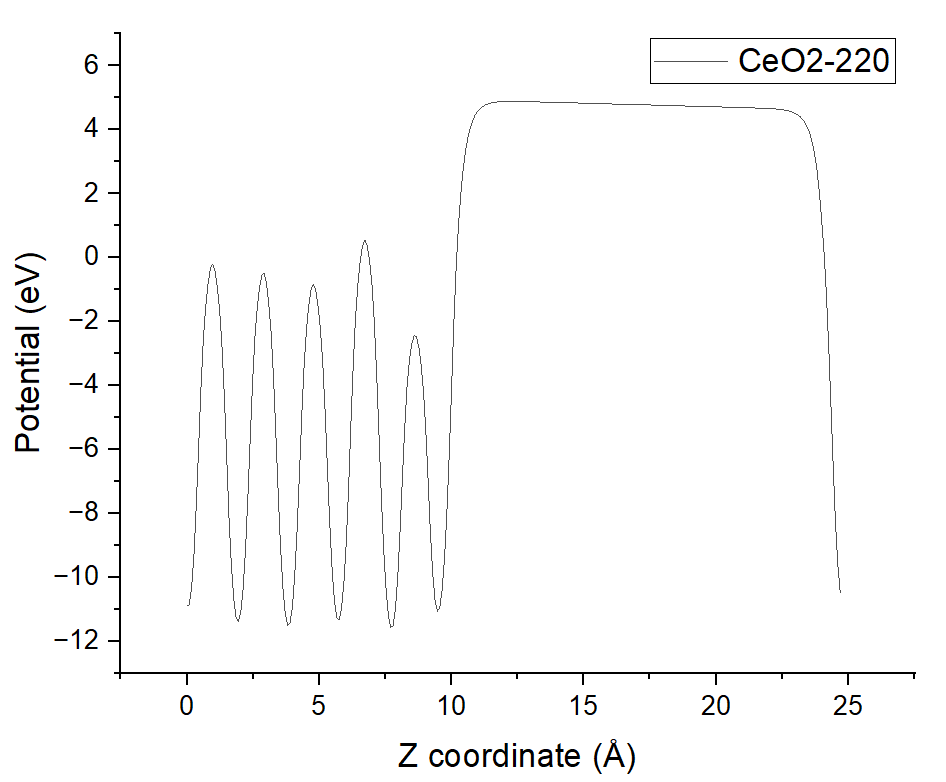 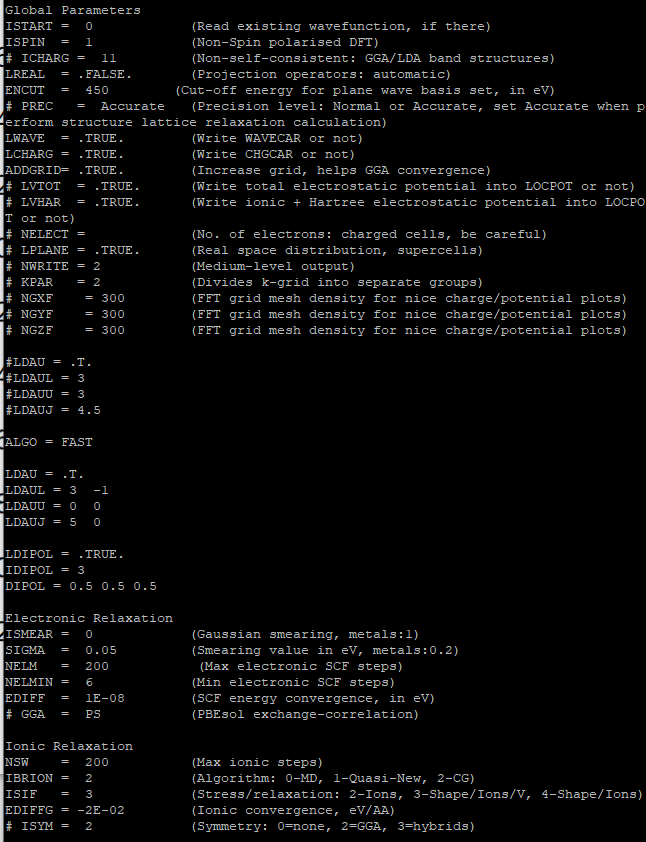 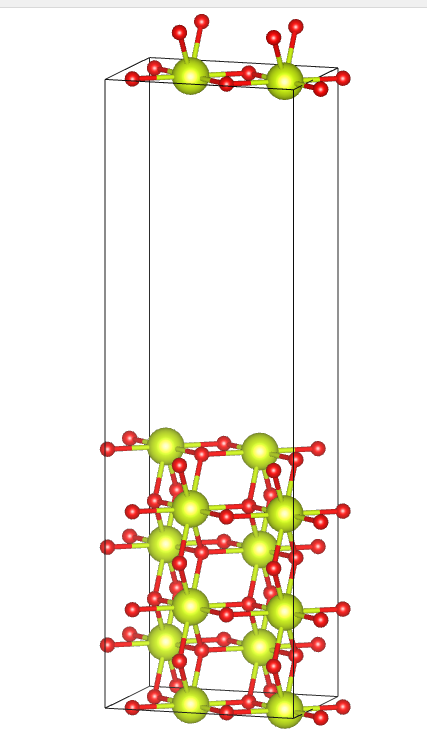 |
 回复此楼
回复此楼» 猜你喜欢
 售SCI一区文章,我:8.O.551.O.5.4,科目全,可伽急
已经有4人回复
售SCI一区文章,我:8.O.551.O.5.4,科目全,可伽急
已经有4人回复
-
寻找合作团队
已经有3人回复
-
售SCI一区文章,我:8.O.551.O.5.4,科目全,可伽急
已经有4人回复
-
售一区SCI文章T0P,我:8O.551.O54,科目全,可十急
已经有6人回复
-
售SCI一区T0P文章,我:8.O.55.1.O.54,科目齐全,可+急
已经有4人回复
-
同一个分子,一条来自文献,一条来自AI——不告诉你答案,你会选哪条?
已经有9人回复
-
售SCI一区文章,我:8.O.551.O.5.4,科目全,可伽急
已经有4人回复
-
售一区SCI文章T0P,我:8O.551.O54,科目全,可十急
已经有4人回复
-
售SCI一区T0P文章,我:8.O.55.1.O54,科目全,可伽急
已经有8人回复
-
售SCI一区T0P文章,我:8.O.55.1.O.54,科目齐全,可+急
已经有4人回复
【答案】应助回帖
|
Your slab model contains roughly 5 atomic planes. For cerium dioxide ($\text{CeO}_2$), this is quite thin. Without a thick enough "bulk core," the structural relaxations from both surfaces propagate through the entire slab. The interlayer distances and planar charge densities vary from layer to layer, preventing the electrostatic potential from stabilizing into a perfectly periodic oscillation. By default, VASP's dipole correction algorithm expects the slab to be continuous in the center of the cell and the vacuum to be at the boundaries ($Z=0$ and $Z=c$). Alternatively, if it evaluates the center of charge automatically without an explicit DIPOL tag, the split nature of your slab misleads the algorithm. The potential step/jump intended to cancel the dipole field is likely being placed in the wrong position potentially overlapping with the atoms at the top of your box ($Z > 24\text{ \AA}$), which causes the sharp drop-off and leaves an uncompensated field in the vacuum. Modify your POSCAR so that the entire slab is continuous and centered in the middle of the simulation box (around $Z = c/2$). The vacuum should be split evenly at the bottom ($Z = 0$) and the top ($Z = c$). This allows VASP to easily identify the vacuum region and properly apply the dipole step function. |

3楼2026-05-20 17:26:26
HER12025
铁虫 (小有名气)
- 应助: 0 (幼儿园)
- 金币: 205.3
- 散金: 35
- 帖子: 213
- 在线: 119.6小时
- 虫号: 36722173
- 注册: 2025-12-26
- 专业: 高分子材料结构与性能
2楼2026-01-06 16:38:11

