|
|
【答案】应助回帖
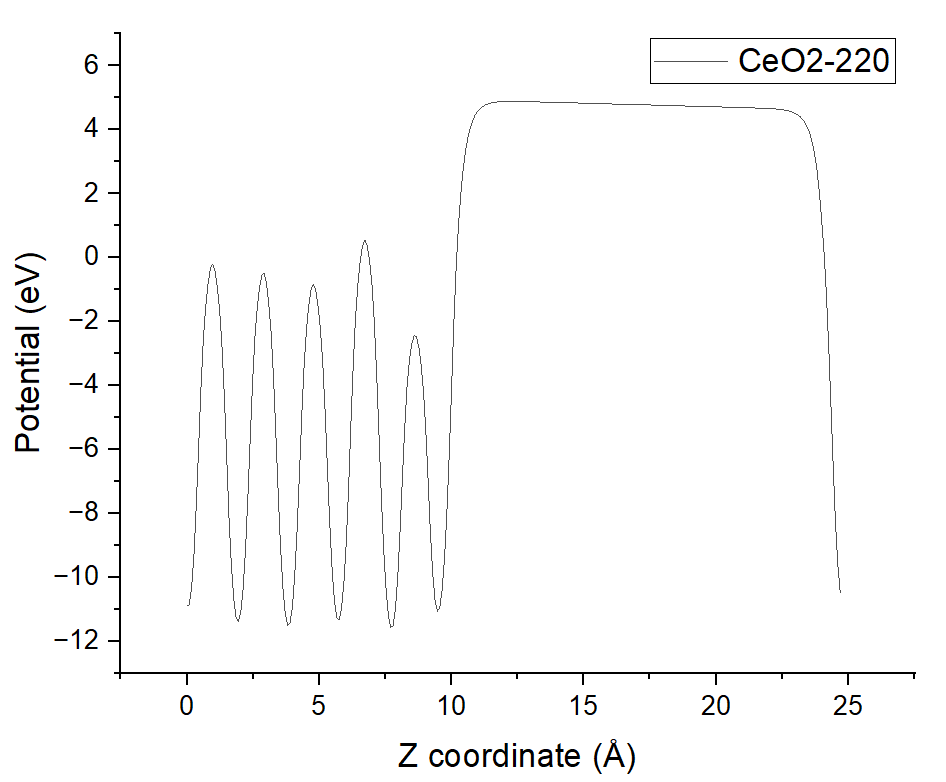
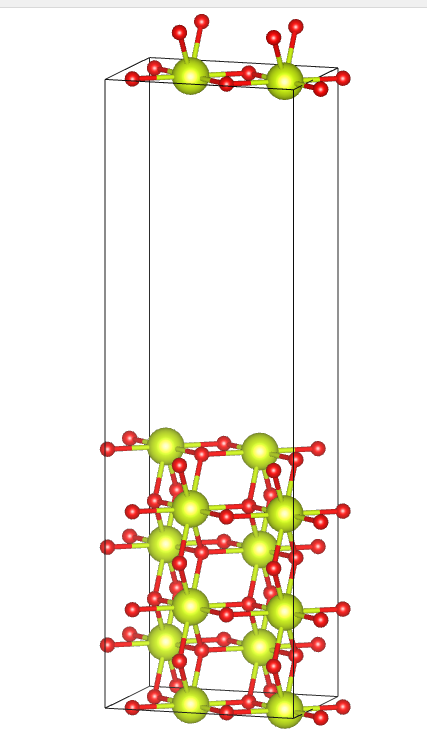
Your slab model contains roughly 5 atomic planes. For cerium dioxide ($\text{CeO}_2$), this is quite thin. Without a thick enough "bulk core," the structural relaxations from both surfaces propagate through the entire slab. The interlayer distances and planar charge densities vary from layer to layer, preventing the electrostatic potential from stabilizing into a perfectly periodic oscillation.
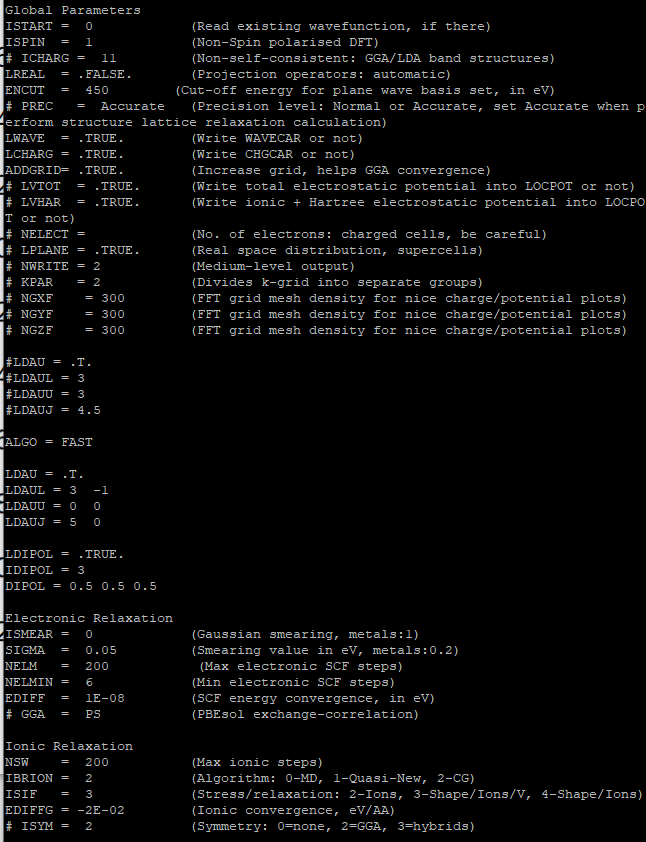
By default, VASP's dipole correction algorithm expects the slab to be continuous in the center of the cell and the vacuum to be at the boundaries ($Z=0$ and $Z=c$). Alternatively, if it evaluates the center of charge automatically without an explicit DIPOL tag, the split nature of your slab misleads the algorithm. The potential step/jump intended to cancel the dipole field is likely being placed in the wrong position potentially overlapping with the atoms at the top of your box ($Z > 24\text{ \AA}$), which causes the sharp drop-off and leaves an uncompensated field in the vacuum.
Modify your POSCAR so that the entire slab is continuous and centered in the middle of the simulation box (around $Z = c/2$). The vacuum should be split evenly at the bottom ($Z = 0$) and the top ($Z = c$). This allows VASP to easily identify the vacuum region and properly apply the dipole step function. |
|











 。
。
 回复此楼
回复此楼
