









| 查看: 408 | 回复: 0 | ||
[求助]
关于有机物中charge transport计算的讨论
|

|
在有机物中,charge transport不能又电子输运来完全德表述.如果电声作用强,电荷输运不能用band模型去描述,只能用polaron mode. "electrons are considered as the electrical conducting carriers in the organic materials, which is appropriate only when the electron-phonon interaction is much weaker than the intermolecular coupling. In organic materials, polaron transport should be considered since the electron-phonon interaction is much stronger compared to the inorganic materials.". [1] "The intrinsic charge transport in organic semiconductors is an electron–phonon interacting process. Due to the ‘‘soft’’ nature of organic materials, the existence of an electron can cause significant deformation of local nuclear vibrations, which moves together with the electron itself, and thus the effective diffusing quasiparticle is composed of the electron and its accompanying phonons. This is the basic idea of the polaron mechanism." [2] 附件的图 [3] 描述的是hopping mechanism和band mechanism对mobility的贡献随温度的变化情况.可以看出,在低温(100 K - 200 K)下,band mechanism的作用强.高温是hoping mechanism占主导. 有几个问题请教大家: 1.板块内有进行有机物charge transport计算的虫友吗? 2.polaron的计算一般用Holstein’s small-polaron model计算吗?有没有类似的软件包?(莫非要自己写code?) 3.如何判断electron–phonon coupling是不是弱到可以只用band mechanism来计算charge transport呢? 问题可能问得有些怪啊,主要是我也不太懂,相关的文献里公式太多已经看晕了. Ref: [1] J. Phys. Chem. C 2011, 115, 24418–24428 [2] Z. Shuai et al., Theory of Charge Transport in Carbon Electronic Materials, SpringerBriefs in Molecular Science [3] Phys. Review B 79, 235206 ͑2009͒ 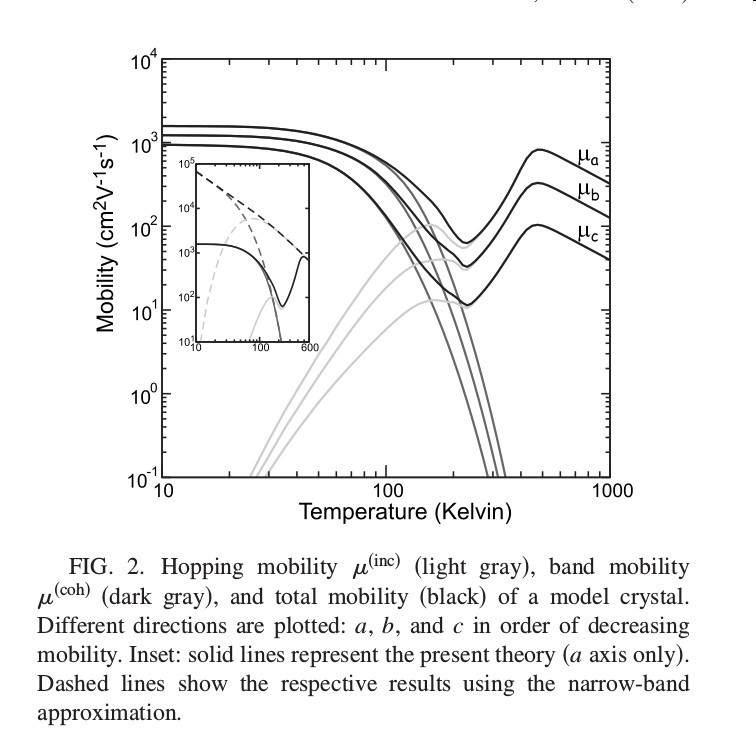 mobility.jpg |
 回复此楼
回复此楼» 猜你喜欢
 售SCI一区T0P文章,我:8.O55.1.O.54,科目全,可十急
已经有7人回复
售SCI一区T0P文章,我:8.O55.1.O.54,科目全,可十急
已经有7人回复
-
售SCI一区T0P文章,我:8O.55.1.O.5.4,科目齐全,可+急
已经有8人回复
-
国社科又开始会评了,不知道这次命运如何
已经有14人回复
-
售SCI一区T0P文章,我:8O.55.1.O.54,科目全,可伽急
已经有8人回复
-
售SCI一区文章,我:8.O.55.1.O.54,科目齐全,可伽急
已经有8人回复
-
麻烦专家们看看评委们的意见(F口面上)
已经有13人回复
-
售SCI-T0P文章,我:8O.5.5.1.O.54,科目齐全,可+急
已经有4人回复
-
售SCI文章,我:8O5.5.1.O.54,科目齐全,可+急
已经有6人回复
-
科研人应该花精力去思考如何解决问题,而不是去凝练问题
已经有14人回复
-
要骂人了,新模版改版就是要淡化问题凝练这种虚的东西,结果有个评委还在说凝练得不够
已经有17人回复


 20
20