









| 查看: 2743 | 回复: 7 | |||||
Parker一班木虫 (正式写手)
水牛生态学家
|
[交流]
大牛Andrew Bocarsly最新光催化力作(Chemical Reviews,2015年10月07日) 已有6人参与
|

|
题目:Light-Driven Heterogeneous Reduction of Carbon Dioxide: Photocatalysts and Photoelectrodes 作者:James L. White†, Maor F. Baruch†, James E. Pander III†, Yuan Hu†, Ivy C. Fortmeyer†, James Eujin Park†, Tao Zhang†, Kuo Liao†, Jing Gu‡, Yong Yan‡, Travis W. Shaw†, Esta Abelev†, and Andrew B. Bocarsly*† † Department of Chemistry, Princeton University, Princeton, New Jersey 08544, United States ‡ Chemical and Materials Science Center, National Renewable Energy Laboratory, Golden, Colorado 80401, United States 摘要:Although modern photoelectrochemistry is often traced back to 1972 and the report by Honda and Fujishima(1) that a TiO2 photoanode in an electrochemical cell caused the splitting of water into O2 and H2 when illuminated, the first report of this type of phenomenon dates back to Becquerel’s studies, published in 1839.(2) This makes photoelectrochemistry one of the oldest investigated techniques for the conversion of sunlight into usable energy. Over this time frame, two general types of photoelectrochemical cells have been developed. The first, typified by Honda’s electrochemistry, is focused primarily on the storage of light energy as high-energy chemical products. Initially, this was termed “artificial photosynthesis” and was focused for the most part on splitting water to generate H2 as an environmentally benign fuel. The second type of photoelectrochemical cell utilizes a chemically reversible redox couple that undergoes a redox change of state at the photoelectrode, followed by conversion of the product species back to the reactant at the counter electrode. The net effect of this reaction is a chemically invariant system that generates electricity from light. The initial implementation of the Grätzel cell, which used a reversible I2/I3– couple and a dye-sensitized TiO2 photoanode, is an example of this type of system.(3) The work under consideration in this paper focuses on the photosynthetic cells and related systems. However, an analysis of these systems, as is more obviously critical to electricity-generating systems, must take into account whether the system is merely catalytic for the reaction of interest or is a system that actually converts light energy into stored chemical energy. Thus, how one parametrizes and evaluates a heterogeneous photoinduced charge transfer process becomes a critical issue that is therefore reviewed in this work. A second tension that is fundamental to synthetic photoelectrochemistry is the comparison between a pure photoelectrochemical process (i.e., a monolithic process based on a semiconductor-liquid junction) versus the use of an electrochemical cell (utilizing metal electrodes) that is driven by an external solid-state photovoltaic device to build a multicomponent system.(4) Although the latter process is not a photoelectrochemical process, there is a long-standing debate about which system’s approach is more efficient in terms of energy conversion. We will not enter that debate in this paper, other than to note that the answer is system-specific. In this paper, we consider both types of approaches so that the reader may evaluate the energy conversion efficiency and product selectivity of these two types of devices as applied to a well-specified chemistry. In this review, we turn our attention from the well-studied water-splitting photoelectrochemical cells to heterogeneous processes that hold the promise of using insolation (incident sunlight) to drive both thermodynamically and kinetically the uphill conversion of CO2 to organic products. Production of C1 species is the primary focus of this paper because most work has been aimed at this class of reactions. Although a classical photoelectrochemical environment is the primary discussion topic presented, alternate heterogeneous environments ranging from metal-based reactions to nanoparticle semiconductor systems to MOFs (metal-organic frameworks) are also reviewed. 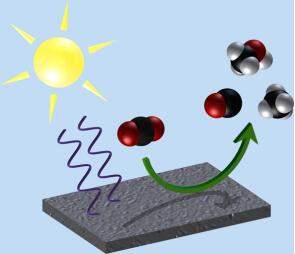 111.jpg |
 回复此楼
回复此楼» 本帖附件资源列表
-
欢迎监督和反馈:小木虫仅提供交流平台,不对该内容负责。
本内容由用户自主发布,如果其内容涉及到知识产权问题,其责任在于用户本人,如对版权有异议,请联系邮箱:xiaomuchong@tal.com - 附件 1 : Andrew_ChemRev_2015.pdf
2015-10-08 09:02:24, 7.49 M
» 收录本帖的淘帖专辑推荐
 光伏&光催化 光伏&光催化 | 先进材料与制备 |
» 本帖已获得的红花(最新10朵)
 swallowqiu
» 猜你喜欢
 27年化学方向博士自荐
已经有0人回复
27年化学方向博士自荐
已经有0人回复
-
印染废水脱色之争
已经有0人回复
-
分析化学论文润色/翻译怎么收费?
已经有220人回复
-
辰华电化学工作站型号及软件版本
已经有0人回复
-
石墨极板 改性增效 还是 概念包装?表面改性技术的实测检验
已经有0人回复
-
电化学方向博士生招生(请直接邮件联系)
已经有15人回复
-
六价铬废水的石墨阴极还原处理:达标排放还是资源回收?
已经有0人回复
-
欢迎大家研究生报考----211大连海事大学双一流专业---轮机工程
已经有5人回复
» 本主题相关价值贴推荐,对您同样有帮助:
- 《读懂天然产物系列》-15-基因与化学联姻:破译生物合成70年未解之谜
已经有75人回复
- Electroanalytical Chemistry (A. J. Bard) 电分析化学PDF资源
已经有129人回复
- 出国申请 我的potential supervisor名单
已经有13人回复
- [欧美][奇幻][波西·杰克逊与魔兽之海][BD-RMVB/735M][英语中字][2013最新魔幻大作]
已经有0人回复
- 【迅雷】经典动作剧情《众神与将军》BD中英双字1024/1280高清
已经有0人回复
- 【迅雷】1024分辨率《铁拳男人》BD中英双字
已经有0人回复
- 【迅雷】1024分辨率《好心先生》BD中英双字
已经有1人回复
- 自由之路(The Freedom Trail)
已经有25人回复
- 【分享】我认为比较经典的岩土工程英文书籍
已经有26人回复
- 【分享】MacMillan 获得2011年ACS National Award
已经有15人回复
- 【资源】催化的世界里那些Super Masters和那些Classic Reviews
已经有5人回复
- 【分享】Mendeley很牛很牛的文献管理软件
已经有73人回复

swallowqiu
铁杆木虫 (著名写手)
- 应助: 8 (幼儿园)
- 金币: 9107.7
- 散金: 2511
- 红花: 160
- 帖子: 1547
- 在线: 1206.5小时
- 虫号: 1161955
- 注册: 2010-12-03
- 性别: GG
- 专业: 功能与智能高分子
2楼2015-10-08 10:02:33
3楼2015-10-08 21:21:43
| 谢谢分享 |
4楼2015-10-09 15:05:20
| 谢谢分享 |
5楼2015-10-22 11:13:19
forever_le
木虫 (正式写手)
- 应助: 22 (小学生)
- 金币: 4846.5
- 散金: 639
- 红花: 5
- 帖子: 549
- 在线: 718.6小时
- 虫号: 1075046
- 注册: 2010-08-15
- 性别: GG
- 专业: 功能与智能高分子

6楼2015-10-22 12:09:17
Parker一班
木虫 (正式写手)
水牛生态学家
- 应助: 6 (幼儿园)
- 金币: 3641.7
- 散金: 27
- 红花: 57
- 帖子: 882
- 在线: 159.4小时
- 虫号: 2499414
- 注册: 2013-06-07
- 性别: MM
- 专业: 电化学
7楼2015-10-22 12:17:57
mufeng1990
银虫 (小有名气)
- 应助: 2 (幼儿园)
- 金币: 1277.7
- 散金: 837
- 红花: 2
- 帖子: 158
- 在线: 118.7小时
- 虫号: 2780680
- 注册: 2013-11-05
- 专业: 无机材料化学
8楼2015-12-01 11:21:14