









| 查看: 2233 | 回复: 9 | ||||
| 当前只显示满足指定条件的回帖,点击这里查看本话题的所有回帖 | ||||
shileijerry至尊木虫 (知名作家)
|
[交流]
无机化合物的分子模拟(英文第3版) 已有1人参与
|
|||

Molecular Modeling of Inorganic Compounds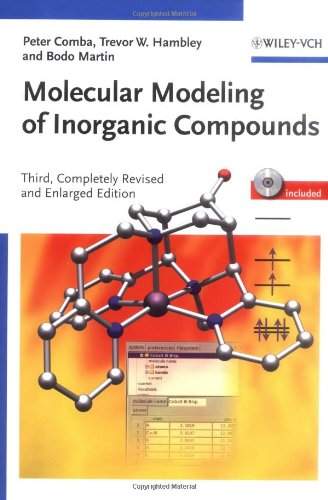 After the second edition introduced first density functional theory aspects, this third edition expands on this topic and offers unique practice in molecular mechanics calculations and DFT. In addition, the tutorial with its interactive exercises has been completely revised and uses the very latest software, a full version of which is enclosed on CD, allowing readers to carry out their own initial experiments with forcefield calculations in organometal and complex chemistry. Note: CD-ROM/DVD and other supplementary materials are not included as part of eBook file. Table of contents : Molecular Modeling of Inorganic Compounds......Page 5 Contents......Page 7 Preface to the Third Edition......Page 15 Preface to the Second Edition......Page 17 Preface to the First Edition......Page 19 Part I: Theory......Page 21 1.1 Molecular Modeling......Page 23 1.2 Historical Background......Page 26 2.1 Molecular Mechanics......Page 29 2.2 Quantum Mechanics......Page 31 2.2.1 Hartree–Fock Calculations......Page 32 2.2.3 Density Functional Theory......Page 33 2.2.4 Methods and Basis Sets......Page 34 2.3.1.2 Molecular Dynamics......Page 35 2.3.3 Cluster Analysis......Page 36 2.3.5 QSAR......Page 37 3.1 Concepts......Page 39 3.2 Potential Energy Functions......Page 43 3.2.1 Bond Length Deformation......Page 45 3.2.2 Valence Angle Deformation......Page 47 3.2.3 Torsion Angle Deformation......Page 51 3.2.5 van der Waals Interactions......Page 53 3.2.6 Electrostatic Interactions......Page 55 3.2.7 Hydrogen Bonding Interactions......Page 57 3.3 Force-Field Parameters......Page 58 3.3.1 Bond Length Deformation......Page 62 3.3.2 Valence Angle Deformation......Page 63 3.3.3 Torsion Angle Deformation......Page 65 3.3.4 Out-of-Plane Deformation......Page 67 3.3.5 Non-Bonded Interactions......Page 68 3.3.6 Electrostatic Interactions......Page 69 3.4 Spectroscopic Force Fields......Page 70 3.5 Model and Reality......Page 72 3.6 Electronic Effects......Page 73 3.7 The Environment......Page 75 3.8 Entropy Effects......Page 77 3.9 Summary......Page 78 4.1 Input and Output......Page 81 4.2 Energy Minimization......Page 83 4.2.2 Gradient Methods......Page 85 4.2.4 The Newton–Raphson Method......Page 86 4.3 Constraints and Restraints......Page 87 5 The Multiple Minima Problem......Page 89 5.2 Stochastic Methods......Page 90 5.3 Molecular Dynamics......Page 91 5.4 Practical Considerations......Page 92 5.5 Making Use of Experimental Data......Page 93 6 Conclusions......Page 95 Part II: Applications......Page 97 7.1 Accuracy of Structure Prediction......Page 99 7.2 Molecular Visualization......Page 100 7.3 Isomer Analysis......Page 102 7.4 Analysis of Structural Trends......Page 103 7.6 Unraveling Crystallographic Disorder......Page 104 7.7 Enhanced Structure Determination......Page 106 7.8 Comparison with Solution Properties......Page 108 8.1 Conformational Analysis......Page 109 8.2 Enantioselectivities......Page 112 8.2.1 Racemate Separation......Page 113 8.2.2 Stereoselective Synthesis......Page 115 8.2.3 Prediction of Enantioinduction......Page 118 8.3 Structure Evaluation......Page 120 8.4 Mechanistic Information......Page 125 9 Metal Ion Selectivity......Page 131 9.1 Chelate Ring Size......Page 132 9.2 Macrocycle Hole Size......Page 136 9.3 Preorganization......Page 140 9.4 Quantitative Correlations Between Strain and Stability Differences......Page 143 9.5 Conclusions......Page 145 10 Spectroscopy......Page 147 10.1 Vibrational Spectroscopy......Page 148 10.2 Electronic Spectroscopy......Page 149 10.3 EPR Spectroscopy......Page 161 10.4 NMR Spectroscopy......Page 167 10.5 QM-Based Methods......Page 168 11 Electron Transfer......Page 169 11.1 Redox Potentials......Page 171 11.2 Electron-Transfer Rates......Page 174 12 Electronic Effects......Page 179 12.1 d-Orbital Directionality......Page 180 12.2 The trans Influence......Page 183 12.3 Jahn–Teller Distortions......Page 184 13.1 Complexes of Amino Acids and Peptides......Page 191 13.2 Metalloproteins......Page 192 13.3 Metalloporphyrins......Page 195 13.4 Metal–Nucleotide and Metal–DNA Interactions......Page 197 13.5 Other Systems......Page 199 13.6 Conclusions......Page 201 14 Organometallics......Page 203 14.1 Metallocenes......Page 204 14.3 Transition Metal–Phosphine Compounds......Page 208 14.4 Metal–Metal Bonding......Page 210 14.5 Carbonyl Cluster Compounds......Page 212 15.1.1 Crown Ethers......Page 215 15.1.2 Cryptands......Page 216 15.1.4 Biologically Relevant Ligands......Page 217 15.2 Main Group Elements......Page 218 15.3 Lanthanoids and Actinoids......Page 219 15.4 Conclusions......Page 221 Part III: Practice of Molecular Mechanics......Page 223 16.2 The Starting Model......Page 225 16.3 The Force Field......Page 226 16.4 The Energy Minimization Procedure......Page 227 16.5 Local and Global Energy Minima......Page 230 16.6 Pitfalls, Interpretation, and Communication......Page 231 17 Tutorial......Page 235 17.1.1 Motivation and Rationale......Page 236 17.1.2 The Program Setup and Philosophy......Page 237 17.2.1 Theory......Page 240 17.2.2 Practice......Page 241 17.3.1 Theory......Page 242 17.3.2 Practice......Page 246 17.4.1 Theory......Page 248 17.4.2.1 Building [Co(en)3]3+......Page 249 17.4.2.2 Changing Conformations......Page 250 17.5.1 Theory......Page 251 17.5.2 Practice......Page 252 17.6.1 Theory......Page 253 17.6.3 Exercise......Page 254 17.7.2.1 Importing Structures from Other Sources......Page 255 17.7.2.2 Building Fragments......Page 256 17.8.2 Practice......Page 257 17.9.1 Theory......Page 259 17.9.2 Practice......Page 260 17.9.2.1 Bond Length Deformation......Page 261 17.9.2.2 Valence Angle Deformation......Page 262 17.9.2.4 Torsion Angle or Dihedral Angle Functions......Page 263 17.10.1 Theory......Page 266 17.10.2 Practice......Page 267 17.10.3.1 Hydrogen Bonds......Page 268 17.10.5.1 Electrostatic Interactions......Page 269 17.10.6 Practice......Page 270 17.11.1 Theory......Page 271 17.11.2 Practice......Page 274 17.11.3 Exercise......Page 275 17.12.1 Theory......Page 276 17.12.2 Practice......Page 277 17.12.3 Exercise......Page 278 17.13.2 Practice......Page 279 17.13.4 Exercise......Page 281 17.14.1 Theory......Page 282 17.14.2 Practice......Page 283 17.15.1 Theory......Page 286 17.15.2 Practice......Page 288 17.16.1 Theory......Page 289 17.16.2 Practice......Page 290 17.17.1 Theory......Page 292 17.17.2 Practice......Page 295 17.17.3 Exercise......Page 299 17.18.1 Theory......Page 300 17.18.2 Practice......Page 301 17.19.1 Theory......Page 302 17.19.2 Practice......Page 305 17.19.3 Exercise......Page 307 17.20.2 Practice......Page 308 17.21.1 Theory......Page 310 17.21.2 Practice......Page 311 17.21.3 Exercise......Page 312 Appendix 1 Glossary......Page 313 A2.2 Basic SI Units......Page 317 A2.4 Energy Units in Molecular Mechanics Calculations......Page 318 Appendix 3 Software and Force Fields......Page 319 A4.1 List of Books on Molecular Modeling......Page 321 A4.2 List of Reviews in the Field of Inorganic Molecular Modeling......Page 322 A4.3 List of Publications on the Momec Force Field......Page 324 References......Page 325 Index......Page 343 |
 回复此楼
回复此楼» 本帖附件资源列表
-
欢迎监督和反馈:小木虫仅提供交流平台,不对该内容负责。
本内容由用户自主发布,如果其内容涉及到知识产权问题,其责任在于用户本人,如对版权有异议,请联系邮箱:xiaomuchong@tal.com - 附件 1 : Molecular_Modeling_of_Inorganic_Compounds.pdf
2014-12-01 20:59:34, 3.6 M
» 收录本帖的淘帖专辑推荐
 化学参考书目 化学参考书目 |
» 猜你喜欢
 PDMS膜在溶液中的离子透过率
已经有0人回复
PDMS膜在溶液中的离子透过率
已经有0人回复
-
攒人品 论文祈福
已经有139人回复
-
有机高分子材料论文润色/翻译怎么收费?
已经有132人回复
-
science advances的AAAS系统上返修
已经有0人回复
-
science advances的AAAS系统上返修问题
已经有4人回复
-
LDPE黑十字为什么那么大
已经有0人回复
-
西南交通大学医学院2027年接收推荐免试攻读研究生(含直博生)
已经有159人回复
-
西南交通大学医学院2027年接收推荐免试攻读研究生(含直博生)
已经有159人回复
-
西南交通大学医学院2027年接收推荐免试攻读研究生(含直博生)
已经有157人回复
-
西南交通大学医学院2027年接收推荐免试攻读研究生(含直博生)
已经有152人回复
-
博士申请
已经有14人回复
» 本主题相关商家推荐: (我也要在这里推广)

» 本主题相关价值贴推荐,对您同样有帮助:
- 求推荐有关金及其化合物性质的资料或者书籍
已经有3人回复
- 做虚拟筛选判断一个化合物好坏的标准是什么
已经有6人回复
- 含硅或硼无机元素的化合物能归类为有机金属聚合物吗?
已经有4人回复
- 请教: 有哪些无机非金属化合物具有金属性质?
已经有5人回复
- 怎样利用所学的仪器快速地鉴定某一未知化合物是有机物还是无机物?
已经有30人回复
- 求高手,已知化合物结构式,怎么查询名字等相关信息
已经有4人回复
- 虚构一种有机化合物,想知道这种未知化合物的物化性能,用什么软件合适?
已经有6人回复
- 我想求助下,如何计算化合物的优势构象?
已经有3人回复
- 蛋白分子建模 小分子化合物画图 酶与配体的分子模拟
已经有11人回复
- 关于锰的化合物,熟悉的虫友进
已经有5人回复
- 【求助】ICP法测定某无机化合物中的K、Ti、P、W前,需要配制哪些溶液啊?怎么配?
已经有4人回复
- 【求助】求助该化合物中的无机盐如何分析
已经有5人回复
- 【求助】外行求助用什么软件可以表示出一个化合物的电荷分布
已经有3人回复

0.8
| 顶一下,感谢分享! |
4楼2014-12-01 22:21:53
0.8
| 顶一下,感谢分享! |
2楼2014-12-01 21:46:00
0.8
| 顶一下,感谢分享! |
3楼2014-12-01 22:07:54
0.8
| 顶一下,感谢分享! |
5楼2014-12-01 22:35:03