









| 查看: 7370 | 回复: 125 | ||
| 当前只显示满足指定条件的回帖,点击这里查看本话题的所有回帖 | ||
[资源]
复合材料必备英文书:显微复合材料的微观组织设计(英文版)
|
||

Microstructural Design of Fiber Composites (Cambridge Solid State Science Series)分享给大家,欢迎下载交流学习,记得好评!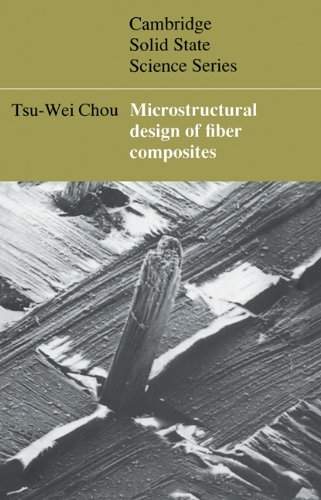 简介: This book addresses the issue of designing the microstructure of fiber composite materials in order to obtain optimum performance. Besides the systematic treatment of conventional continuous and discontinuous fiber composites, the book also presents the state-of-the-art of the development of textile structural composites as well as the nonlinear elastic finite deformation theory of flexible composites. The author's experience during twenty years of research and teaching on composite materials is reflected in the broad spectrum of topics covered, including laminated composites, statistical strength theories of continuous fiber composites, short fiber composites, hybrid composites, two- and three-dimensional textile structural composites and flexible composites. This book provides the first comprehensive analysis and modeling of the thermo-mechanical behaviour of fiber composites with these distinct micro-structures. Overall, the inter-relationships among the processing, microstructures and properties of these materials are emphasized throughout the book. The book is intended as a text for graduate or advanced undergraduate students, but will also be an excellent reference for all materials scientists and engineers who are researching or working with these materials. 目录: Preface xvii Introduction Evolution of engineering materials Fiber composite materials Why composites? 1.3.1 Economic aspect 1.3.2 Technological aspect Trends and opportunities Microstructure-performance relationships 1.5.1 Versatility in performance 1.5.2 Tailoring of performance 1.5.3 Intelligent composites Concluding remarks Thermoelastic behavior of laminated composites Introduction Elastic behavior of a composite lamina 2.2.1 Elastic constants 2.2.2 Constitutive relations Elastic behavior of a composite laminate 2.3.1 Classical composite lamination theory 2.3.2 Geometrical arrangements of laminae Thick laminates 2.4.1 Three-dimensional constitutive relations of a composite lamina 46 2.4.2 Constitutive relations of thick laminated composites 48 2.5 Thermal and hygroscopic behavior 54 2.5.1 Basic equations 55 2.5.1.1 Constitutive relations 55 2.5.1.2 Thermal and moisture diffusion equations 61 2.5.2 Hygroscopic behavior 62 2.5.2.1 Moisture concentration functions 62 2.5.2.2 Hygroscopic stress field 65 目录很详细,中间部分省略,需要的可以下载下来自己看看 6.12 Nonlinear stress-strain behavior 366 6.13 Mechanical properties 368 6.13.1 Friction and wear behavior 368 6.13.2 Notched strength 371 7 Three-dimensional textile structural composites 374 7.1 Introduction 374 7.2 Processing of textile preforms 376 7.2.1 Braiding 377 7.2.1.1 2-step braiding 377 7.2.1.2 4-step braiding 379 7.2.1.3 Solid braiding 382 7.2.2 Weaving 382 7.2.2.1 Angle-interlock multi-layer weaving 383 7.2.2.2 Orthogonal weaving 387 7.2.3 Stitching 387 7.2.4 Knitting 389 7.3 Processing windows for 2-step braids 389 7.3.1 Packing of fibers and yarn cross-sections 390 7.3.2 Unit cell of the preform 395 7.3.3 Criterion for yarn jamming 398 7.4 Yarn packing in 4-step braids 402 7.4.1 Unit cell of the preform 402 7.4.2 Criterion for yarn jamming 403 7.5 Analysis of thermoelastic behavior of composites 405 7.5.1 Elastic strain-energy approach 406 7.5.2 Fiber inclination model 407 7.5.3 Macro-cell approach 414 7.5.3.1 Geometric relations 414 7.5.3.2 Elastic constants 416 7.6 Structure-performance maps of composites 419 7.7 Mechanical properties of composites 428 7.7.1 Tensile and compressive behavior 428 7.7.2 Shear behavior 431 7.7.3 Fracture behavior 432 7.7.3.1 In-plane fracture 432 7.7.3.2 Interlaminar fracture 435 7.7.4 Impact 440 8 Flexible composites 443 8.1 Introduction 443 8.2 Cord/rubber composites 445 8.2.1 Rubber and cord properties 446 8.2.2 Unidirectional composites 447 8.2.3 Laminated composites 449 8.2.4 Cord loads in tires 453 8.3 Coated fabrics 456 8.4 Nonlinear elastic behavior - incremental analysis 459 8.4.1 Geometry of wavy fibers 460 8.4.2 Axial tensile behavior 462 8.4.2.1 Iso-phase model 462 8.4.2.2 Random-phase model 465 8.4.2.3 Nonlinear tensile stress-strain behavior 467 8.4.3 Transverse tensile behavior 471 8.4.3.1 Iso-phase model 471 8.4.3.2 Random-phase model 472 9 Nonlinear elastic finite deformation of flexible composites 474 9.1 Introduction 474 9.2 Background 478 9.2.1 Tensor notation 478 9.2.2 Lagrangian and Eulerian descriptions 480 9.3 Constitutive relations based on the Lagrangian description 485 9.3.1 Finite deformation of a composite lamina 485 9.3.2 Constitutive equations for a composite lamina 487 9.3.2.1 Strain-energy function 487 9.3.2.2 General constitutive equations for a unidirectional lamina 488 9.3.2.3 Pure homogeneous deformation 490 9.3.2.4 Simple shear 492 9.3.2.5 Simple shear superposed on simple extension 495 9.3.3 Constitutive equations of flexible composite laminates 499 9.3.3.1 Constitutive equations 499 9.3.3.2 Homogeneous deformation 500 9.3.3.3 Simple extension of a symmetric composite laminate 502 9.3.4 Determination of elastic constants 505 9.3.4.1 Tensile properties 505 9.3.4.2 Shear properties 506 9.4 Constitutive relations based on the Eulerian description 508 9.4.1 Stress-energy function 509 9.4.2 General constitutive equations 511 9.4.3 Pure homogeneous deformation 514 9.4.4 Simple shear superposed on simple extension 515 9.4.5 Determination of elastic compliance constants 517 9.5 Elastic behavior of flexible composites reinforced with wavy fibers 519 9.5.1 Introduction 519 9.5.2 Longitudinal elastic behavior based on the Lagrangian approach 520 9.5.3 Longitudinal elastic behavior based on the Eulerian approach 522 References 526 Author index 556 Subject index 563 |
 回复此楼
回复此楼» 本帖附件资源列表
-
欢迎监督和反馈:小木虫仅提供交流平台,不对该内容负责。
本内容由用户自主发布,如果其内容涉及到知识产权问题,其责任在于用户本人,如对版权有异议,请联系邮箱:xiaomuchong@tal.com - 附件 1 : Microstructural_Design_of_Fiber_Composites_(Cambridge_Solid_State_Science_Series).djvu
2014-11-29 08:32:46, 3.65 M
» 猜你喜欢
 上海海事大学安全科学与工程学科有部分名额,欢迎调剂
已经有0人回复
上海海事大学安全科学与工程学科有部分名额,欢迎调剂
已经有0人回复
-
土木考研调剂-08开头和计算机专业+V:18173116706
已经有0人回复
-
建筑环境与结构工程论文润色/翻译怎么收费?
已经有207人回复
-
【广州】仲恺农业工程学院城乡建设学院土木水利专业硕士招大量调剂,线上复试
已经有0人回复
-
【广州】仲恺农业工程学院城乡建设学院土木水利专业硕士招大量调剂,线上复试
已经有0人回复
-
广西大学土木博士招生
已经有5人回复
-
E口2026重点国际合作项目
已经有2人回复
-
2027 博士自荐
已经有2人回复
-
学术人生就像一场马拉松,不松懈、不放弃!祝愿所有为学术梦想而打拼的人都能如愿!
已经有441人回复
-
哈尔滨工业大学博士申请考核制9月29日截止
已经有14人回复
-
哈尔滨工业大学博士申请考核制延长至10月7日截止
已经有0人回复
» 本主题相关商家推荐: (我也要在这里推广)

103楼2016-07-04 13:52:13
简单回复
雷智锋石芸竹2楼
2014-11-29 09:15
回复
五星好评 顶一下,感谢分享!
2014-11-29 09:42
回复
五星好评 顶一下,感谢分享!
cqyn4楼
2014-11-29 09:43
回复
五星好评 顶一下,感谢分享!
2014-11-29 13:29
回复
五星好评 顶一下,感谢分享!
2014-11-29 13:31
回复
顶一下,感谢分享!
2014-11-29 20:43
回复
五星好评 顶一下,感谢分享!
胡艳志9楼
2014-11-29 22:58
回复
五星好评 顶一下,感谢分享!
idealsun10楼
2014-11-29 23:04
回复
五星好评 顶一下,感谢分享!
2014-11-30 00:03
回复
五星好评 顶一下,感谢分享!
wjy201112楼
2014-11-30 02:22
回复
五星好评 顶一下,感谢分享!
zch668200313楼
2014-11-30 05:17
回复
五星好评 顶一下,感谢分享!
wtiger14楼
2014-11-30 09:05
回复
五星好评 顶一下,感谢分享!