| ²é¿´: 900 | »Ø¸´: 7 | ||
wc596520206½ð³æ (ÕýʽдÊÖ)
|
[ÇóÖú]
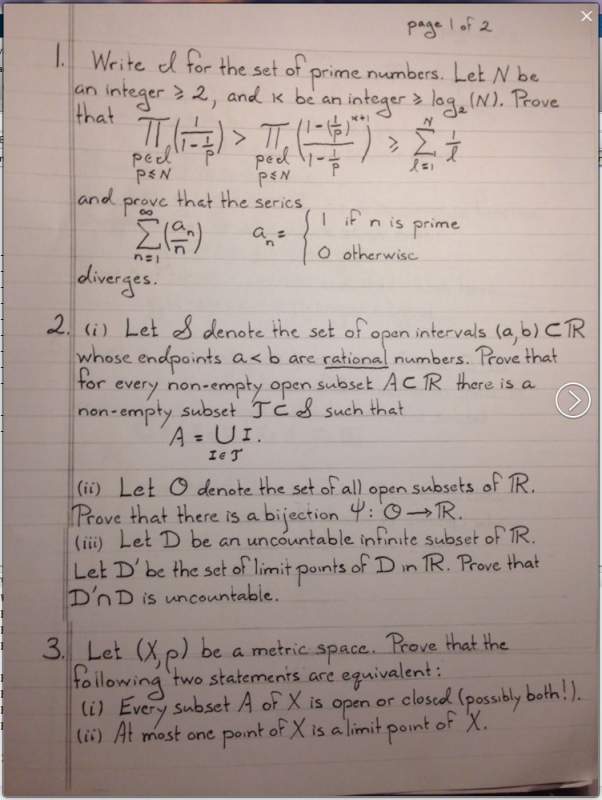
´ó¼Ò¿´¿´ ¸øµã˼·ҲÐУ¬Ö»Òª1ºÍ3.µÚÒ»¸ö¿´ÆðÀ´²»ÄÑ¡£
|
» ±¾Ö÷ÌâÏà¹Ø¼ÛÖµÌùÍÆ¼ö£¬¶ÔÄúͬÑùÓаïÖú:
ÄÄλ´óÉñÀ´Ö¸µ¼ÏÂÊý×ÖÐźŴ¦ÀíÔõôѧ£¬¸Ð¼¤²»¾¡
ÒѾÓÐ30È˻ظ´
wc596520206
½ð³æ (ÕýʽдÊÖ)
- Ó¦Öú: 2 (Ó×¶ùÔ°)
- ½ð±Ò: 1365.1
- É¢½ð: 353
- ºì»¨: 3
- Ìû×Ó: 486
- ÔÚÏß: 78.8Сʱ
- ³æºÅ: 2416257
- ×¢²á: 2013-04-13
- רҵ: Ô˳ïѧ
2Â¥2014-11-25 11:25:18
hank612
ÖÁ×ðľ³æ (ÖøÃûдÊÖ)
- ÊýѧEPI: 14
- Ó¦Öú: 225 (´óѧÉú)
- ½ð±Ò: 14270.6
- É¢½ð: 1055
- ºì»¨: 95
- Ìû×Ó: 1526
- ÔÚÏß: 1375.8Сʱ
- ³æºÅ: 2530333
- ×¢²á: 2013-07-03
- ÐÔ±ð: GG
- רҵ: ÀíÂۺͼÆË㻯ѧ
¡¾´ð°¸¡¿Ó¦Öú»ØÌû
¡ï ¡ï ¡ï ¡ï ¡ï ¡ï ¡ï ¡ï ¡ï ¡ï ¡ï ¡ï ¡ï ¡ï ¡ï ¡ï ¡ï ¡ï ¡ï ¡ï ¡ï ¡ï ¡ï ¡ï ¡ï ¡ï ¡ï ¡ï ¡ï ¡ï ¡ï ¡ï ¡ï ¡ï ¡ï ¡ï ¡ï ¡ï ¡ï ¡ï ¡ï ¡ï ¡ï ¡ï ¡ï ¡ï ¡ï ¡ï ¡ï ¡ï ¡ï ¡ï ...
¸Ðл²ÎÓ룬ӦÖúÖ¸Êý +1
wc596520206(feixiaolin´ú·¢): ½ð±Ò+10 2014-11-25 20:18:22
wc596520206: ½ð±Ò+50, ¡ï¡ï¡ï¡ï¡ï×î¼Ñ´ð°¸ 2014-11-28 17:02:40
¸Ðл²ÎÓ룬ӦÖúÖ¸Êý +1
wc596520206(feixiaolin´ú·¢): ½ð±Ò+10 2014-11-25 20:18:22
wc596520206: ½ð±Ò+50, ¡ï¡ï¡ï¡ï¡ï×î¼Ñ´ð°¸ 2014-11-28 17:02:40
|
1. Clearly 3.Step (i) Let us show that if a metric space (X, d) has at least two distinct cluster points (limit point) p and q, then it has a subset which is neither open nor closed. Take a sequence {x_n} approaching to (in a metric space, ¡°approaching¡± means If A is open, then the point p has an open neibourhood in A, which is impossible as the sequence x_{2n+1} is not in A but approaches to p. If A is closed, then A^c (A complement) is an open set. This is still impossible as y_{2n} is not in A^c but approaches to q in A^c. Step (ii). If the space only has at most one limit point, we discuss by cases. Case 1. No limit point. Then every point has an open neibourhood which contains only itself. Thus every single point is an open set. Because any union of open set is still open, hence arbitary subset of X is open (therefore is closed too). Case 2. The point x is the only limit point. Then every point other than x is an open set. This means that any set which excludes x is open. If a set A contains the point x, then since A^c is open so A is closed. Combining steps (i) and (ii), we prove the claim. |

3Â¥2014-11-25 14:13:46
hank612
ÖÁ×ðľ³æ (ÖøÃûдÊÖ)
- ÊýѧEPI: 14
- Ó¦Öú: 225 (´óѧÉú)
- ½ð±Ò: 14270.6
- É¢½ð: 1055
- ºì»¨: 95
- Ìû×Ó: 1526
- ÔÚÏß: 1375.8Сʱ
- ³æºÅ: 2530333
- ×¢²á: 2013-07-03
- ÐÔ±ð: GG
- רҵ: ÀíÂۺͼÆË㻯ѧ

4Â¥2014-11-25 14:19:00
wc596520206
½ð³æ (ÕýʽдÊÖ)
- Ó¦Öú: 2 (Ó×¶ùÔ°)
- ½ð±Ò: 1365.1
- É¢½ð: 353
- ºì»¨: 3
- Ìû×Ó: 486
- ÔÚÏß: 78.8Сʱ
- ³æºÅ: 2416257
- ×¢²á: 2013-04-13
- רҵ: Ô˳ïѧ
5Â¥2014-11-25 14:28:33
wc596520206
½ð³æ (ÕýʽдÊÖ)
- Ó¦Öú: 2 (Ó×¶ùÔ°)
- ½ð±Ò: 1365.1
- É¢½ð: 353
- ºì»¨: 3
- Ìû×Ó: 486
- ÔÚÏß: 78.8Сʱ
- ³æºÅ: 2416257
- ×¢²á: 2013-04-13
- רҵ: Ô˳ïѧ
6Â¥2014-11-26 08:04:37
wc596520206
½ð³æ (ÕýʽдÊÖ)
- Ó¦Öú: 2 (Ó×¶ùÔ°)
- ½ð±Ò: 1365.1
- É¢½ð: 353
- ºì»¨: 3
- Ìû×Ó: 486
- ÔÚÏß: 78.8Сʱ
- ³æºÅ: 2416257
- ×¢²á: 2013-04-13
- רҵ: Ô˳ïѧ
7Â¥2014-11-26 08:07:23
hank612
ÖÁ×ðľ³æ (ÖøÃûдÊÖ)
- ÊýѧEPI: 14
- Ó¦Öú: 225 (´óѧÉú)
- ½ð±Ò: 14270.6
- É¢½ð: 1055
- ºì»¨: 95
- Ìû×Ó: 1526
- ÔÚÏß: 1375.8Сʱ
- ³æºÅ: 2530333
- ×¢²á: 2013-07-03
- ÐÔ±ð: GG
- רҵ: ÀíÂۺͼÆË㻯ѧ
Â¥Ö÷дµÄÒ»ÊÖºÃ×Ö ![]() 2.1 For any point x in the open set U, there exists an open interval (A,B) satisfying 2.2. In the expression of 2.3. For any isolated point x of D (namely x is in D but is not a limit point of D), there is an open interval (A_x, B_x) which contains x but contains no other points of D. If Now it is clear: D has uncountable many number of points, among them at most countable many points are isolated points. The remaining uncountable points are in ![]() ![]() |

8Â¥2014-11-27 07:33:50


»Ø¸´´ËÂ¥
5