












| 查看: 8566 | 回复: 253 | ||||||||||||||||||||||||
| 【奖励】 本帖被评价227次,作者falldwon增加金币 180 个 | ||||||||||||||||||||||||
| 当前只显示满足指定条件的回帖,点击这里查看本话题的所有回帖 | ||||||||||||||||||||||||
[资源]
新晋谢毅院士主笔Chem Soc Rev二维材料的表面修饰(11.20日新鲜在线)
|
||||||||||||||||||||||||

|
Two-dimensional (2D) nanomaterials, especially the inorganic ultrathin nanosheets with single or few- atomic layers, have been extensively studied due to their special structures and rich physical properties coming from the quantum confinement of electrons. With atomic-scale thickness, 2D nanomaterials have an extremely high specific surface area enabling their surface phase to be as important as bulk counterparts, and therefore provide an alternative way of modifying the surface phase for engineering the intrinsic physical properties of inorganic 2D nanomaterials. In this review, we focus on recent research concerning surface chemical modification strategies to effectively engineer the intrinsic physical properties of inorganic 2D nanomaterials. We highlight the newly developed regulation strategies of surface incorporation, defect engineering, and structure modulation of inorganic 2D nanomaterials, which respectively influence the intrinsic conductivity, band structure, and magnetism while maintaining the primary 2D freestanding structures that are vital for 2D based ultrasensitive electronic response, enhanced catalytic and magnetocaloric capabilities. Key learning points (1) Advantages of surface chemical modification for engineering intrinsic physical properties in 2D materials. (2) Tuning the electronic conductivity of inorganic 2D materials by surface incorporation. (3) Regulation of the band structure of inorganic 2D materials by defect engineering. (4) Introducing intrinsic magnetism in 2D materials by surface modulation. (5) Applications of surface modified inorganic 2D nanomaterials. 目录: 1 Introduction 2 Engineering intrinsic physical properties by surface chemical modification 2.1 Tuning electronic conductivity by incorporation 2.2 Regulation of the band structure by defect engineering 2.3 Introducing magnetism by surface modulation 3 Applications of surface modified 2D nanomaterials 3.1 2D nanomaterials with tunable conductivity for nano-electrode and sensor materials 3.2 Surface defect modified 2D nanomaterials for high efficient catalysts 3.3 2D magnetic superlattice for enhanced magnetocaloric effects 4 Conclusion and perspectives 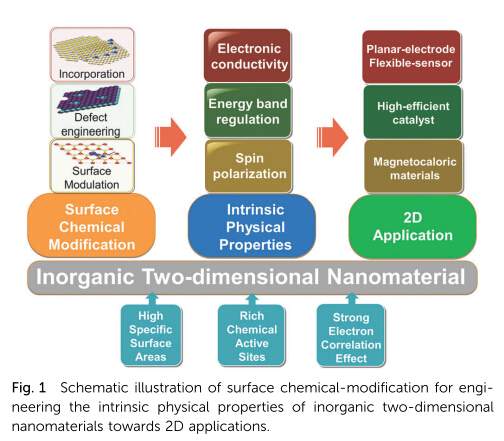 |
 回复此楼
回复此楼» 本帖附件资源列表
-
欢迎监督和反馈:小木虫仅提供交流平台,不对该内容负责。
本内容由用户自主发布,如果其内容涉及到知识产权问题,其责任在于用户本人,如对版权有异议,请联系邮箱:xiaomuchong@tal.com - 附件 1 : Surface_chemical-modification_for_engineering_the_intrinsic_physical_properties_of_inorganic_two-dimensional_nanomaterials.pdf
2014-11-20 08:52:38, 3.78 M
» 收录本帖的淘帖专辑推荐
 经典资源帖 经典资源帖 | 锂电资源共享 | 纳米技术与能源及模拟 | 资源收集 |
| 锂离子电池正极材料 | 文献推荐 | 石墨烯+MoS2等 二维材料 | 动力电源 |
| 新能源材料及技术(小新) | reviews paper | 外语学习 | uicorn3 |
| 纳米材料+光电子学 | Book & Review | 纳米大牛 | 综述专辑 |
| 二维材料 | 纳米 | 文献 | 电化 |
| 某浣的夹子 | paper |
» 猜你喜欢
 无机化学论文润色/翻译怎么收费?
已经有126人回复
无机化学论文润色/翻译怎么收费?
已经有126人回复

» 本主题相关商家推荐: (我也要在这里推广)

» 本主题相关价值贴推荐,对您同样有帮助:
 Chem Soc Rev 11.10新鲜在线重磅综述:催化活性点
已经有212人回复
Chem Soc Rev 11.10新鲜在线重磅综述:催化活性点
已经有212人回复- Chem Soc Rev 11.04 新鲜在线:分子链接的有序纳米阵列—电子及光电子性质
已经有15人回复
- 中科大谢毅组chem soc rev综述 钒氧结构设计及其能源应用相关的电学性能调节
已经有18人回复
60楼2014-11-23 00:01:55