









| 查看: 706 | 回复: 0 | |||
[求助]
相转换,尺寸控制,控制生长,纳米晶,self-seeded uncleation ,热力学稳定性。
|

|
一个老师给的文献,跟我专业不相关,彻底读不懂。 求帮忙,我都快急疯了。 题名 Phase transformation and size tuning in controlled-growth of nanocrystalsvia self-seeded nucleation with preferential thermodynamic stability† 摘要 Controlled growth of nanocrystals (NCs) is produced by self-seeded nucleation with preferential thermodynamic stability. The intermediate reactants undergo in situ phase transformation forming the final products. The growth followed by irreversible phase transformation leads to the complete separation of nucleation and growth, thereby allowing size tuning of the final NCs. Controlled solution chemical synthetic methods are efficient in producing inorganic nanocrystals (NCs) with a wide variety of composition, size, and shape in addition to unique electronic, magnetic and optical emission properties.1–8 Recently, impurity doping has been found to affect the growth of these inorganic NCs.2,9–13 For instance, Liu and co-workers demonstrated that the size reduction down to ten nanometres and phase transformation from cubic to hexagonal in NaYF4 NCs could be rationally tuned by introducing trivalent lanthanide (Ln3+) dopant ions such as Gd3+, Sm3+ and Nd3+, at precisely defined concentrations.2 Similar phenomena concerning size reduction and phase transformation were observed for MF2 (M = Ba, Sr, Ca), ZrO2, and LnF3 NCs by heterovalent Ln3+ and M2+ doping, respectively.9,10,12 Different from decreasing the NCs size by impurity doping, Qiu et al. found that cationic doping with lower valence Ln3+ ions increased the size of the CeO2 NCs.13 However, the mechanism pertaining to the formation of doped NCs is still limited. According to first-principle calculation, Liu et al.2 proposed that the influence of lanthanide doping on the crystal phase and size arose from a strong dependence on the size and dipole polarizability of the substitutional dopant ion. Chen et al. and Qiu et al. considered that size tuning of NCs originated from the transient electric dipole induced by Ln3+ doping, which could modify the diffusion of anions (F− or OH−  from the solution to the grain surface, thereby retarding or accelerating the growth of Ln3+-doped MF2 and CeO2 NCs, respectively.9,13 In addition, a heteronucleation and growth mechanism has been proposed for the formation and size tuning of cubic ZrO2 NCs.12 Despite these efforts, the precise mechanism behind and a dynamic process during the growth of the doped NCs are not fully understood. In this communication, we report controlled-growth of NCs with preferential thermodynamic stability via self-seeded nucleation. The process enables the intermediate reactant to undergo in situ phase transformation forming the final products. We demonstrate that the controlled growth followed by irreversible phase transformation due to the difference of thermodynamic stability between the intermediate reactants and seed nuclei leads to the complete separation of nucleation and growth. It determines the size of the final NCs which strongly depend on the number of seed nuclei. from the solution to the grain surface, thereby retarding or accelerating the growth of Ln3+-doped MF2 and CeO2 NCs, respectively.9,13 In addition, a heteronucleation and growth mechanism has been proposed for the formation and size tuning of cubic ZrO2 NCs.12 Despite these efforts, the precise mechanism behind and a dynamic process during the growth of the doped NCs are not fully understood. In this communication, we report controlled-growth of NCs with preferential thermodynamic stability via self-seeded nucleation. The process enables the intermediate reactant to undergo in situ phase transformation forming the final products. We demonstrate that the controlled growth followed by irreversible phase transformation due to the difference of thermodynamic stability between the intermediate reactants and seed nuclei leads to the complete separation of nucleation and growth. It determines the size of the final NCs which strongly depend on the number of seed nuclei. The principle of temporally separating nucleation and growth or seeded growth is based on the LaMer model.14 Seeded growth allowing nucleation and growth to be separated into two independently controlled steps works well for the synthesis of heterostructured nanocrystals, for example, Au/M (M = Pt, Pd, Rh, Ru, In, Sn, Bi, Cu, Fe, Co, Ni, Zn, etc.) core–shell NCs that would be difficult to nucleate in a homogeneous solution.15–17 Unfortunately, there have been few studies on cases in which the final product itself acts as the “seed” nucleus and ensuing growth is controlled via in situ phase transformation of the reactant. Fig. 1 schematically illustrates the process of in situ phase transformation and corresponding self-seeded controlled-growth of NCs. In Fig. 1(a), A, B and C are the reactants, products and seeds, respectively. The same color of B and C shows that the final products themselves are the “seeds”. ΔG > 0 represents that the phase transformation of the reactant into products undoubtedly occurs during controlled-growth of NCs due to the preferential thermodynamic stability of the seed nuclei under the reaction conditions. As a result, the crystal-size of final products grows bigger as the reactants are depleted via traditional Ostwald ripening. Generally, in the nucleation controlled synthesis, Ostwald ripening is slow and the final NC size is determined by the number of seed nuclei. Hence, the final NC size is a good measure of the nucleation rate,18–21 下面是公式,就是这三个式子让我彻底崩溃的。根本推到不过去嘛 http://image.keyan.cc/data/bcs/2 ... _1412340345_327.png 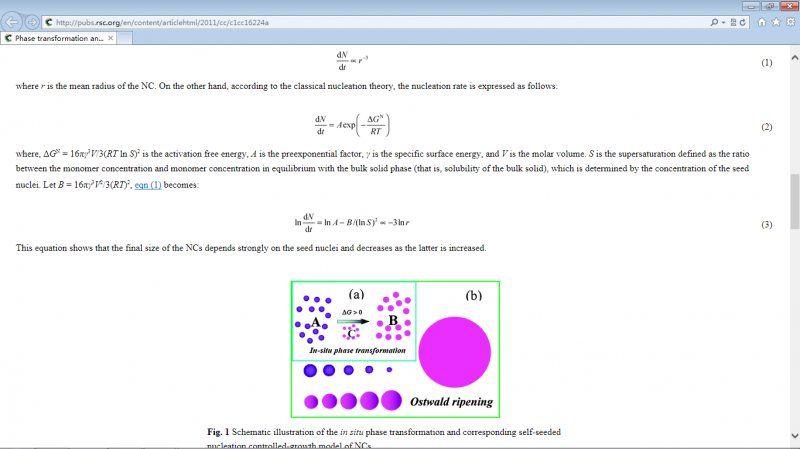 无标题.png 我的币不多,求好心人帮个忙啦。我已经倾其所有了 |
 回复此楼
回复此楼» 猜你喜欢
 招2026年入学上海交通大学博士生,急!!!
已经有1人回复
招2026年入学上海交通大学博士生,急!!!
已经有1人回复
-
理论计算合作
已经有0人回复
-
无机化学论文润色/翻译怎么收费?
已经有172人回复
-
求高校合作
已经有1人回复
-
27级无机化学申博自荐
已经有2人回复
-
Chemdraw免费软件
已经有0人回复
-
单晶结构解析,各类疑难晶体数据处理和答疑
已经有38人回复
-
这个水相反应有没有催化剂促进发生
已经有4人回复
-
Mn Me3TACN
已经有5人回复
-
求助最新的CCDC数据库升级包
已经有0人回复
» 本主题相关商家推荐: (我也要在这里推广)

