









| 查看: 6052 | 回复: 120 | ||||||||||||
| 【奖励】 本帖被评价108次,作者nowitzki_ci增加金币 85.8 个 | ||||||||||||
| 当前只显示满足指定条件的回帖,点击这里查看本话题的所有回帖 | ||||||||||||
nowitzki_ci专家顾问 (著名写手)
|
[资源]
Langmuir最新综述:量子点太阳能电池
|
|||||||||||

|
Quantum Dot Solar Cells: Hole Transfer as a Limiting Factor in Boosting the Photoconversion Efficiency 共10页 引文67篇 请小伙伴们下载后给个好评! Prashant V. Kamat, * Je ff rey A. Christians, and James G. Radich Radiation Laboratory and Department of Chemical & Biomolecular Engineering, University of Notre Dame, Notre Dame, Indiana 46556, United States Semiconductor nanostructures are attractive for designing low-cost solar cells with tunable photoresponse. The recent advances in size- and shape-selective synthesis have enabled the design of quantum dot solar cells with photoconversion e ffi ciencies greater than 5%. To make them competitive with other existing thin fi lm or polycrystalline photovoltaic technologies, it is important to overcome kinetic barriers for charge transfer at semiconductor interfaces. This feature article focuses on the limitations imposed by slow hole transfer in improving solar cell performance and its role in the stability of metal chalcogenide solar cells. Strategies to improve the rate of hole transfer through surface-modi fi ed redox relays o ff er new opportunities to overcome the hole-transfer limitation. The mechanistic and kinetic aspects of hole transfer in quantum dot solar cells (QDSCs), nanowire solar cells (NWSCs), and extremely thin absorber (ETA) solar cells are discussed. Biography Prashant V. Kamat (center) is the Rev. John A. Zahm, C.S.C., Professor of Science in the Department of Chemistry and Biochemistry and Radiation Laboratory and concurrent professor in the Department of Chemical and Biomolecular Engineering. A native of Binaga, India, he earned his M.S. (1974) and Ph.D. degrees (1979) in physical chemistry from Bombay University and carried out his postdoctoral research at Boston University (1979–1981) and the University of Texas at Austin (1981–1983). He joined the Notre Dame faculty in 1983, where for over three decades he has worked to build bridges between physical chemistry and material science by developing advanced nanomaterials for cleaner and more efficient light energy conversion. He has published over 450 scientific papers, which have been well received by the scientific community (35 000+ citations), and has an h index of 103. He is the deputy editor of the Journal of Physical Chemistry Letters, on the advisory board of scientific journals Langmuir, Research on Chemical Intermediates, Journal of Colloid Science, and Applied Electrochemistry and Interface. Professor Kamat was awarded the Langmuir Lectureship award in 2013. In 2011, Science Watch of ISI included him among the top 100 chemists of the decade 2000–2010. He is a Fellow of the Electrochemical Society, American Association for the Advancement of Science (AAAS), and the American Chemical Society (ACS). Biography Jeffrey A. Christians (left) is a Ph.D. candidate in the Department of Chemistry and Chemical Engineering at the University of Notre Dame, where he studies under Prashant Kamat in the Notre Dame Radiation Laboratory. He earned his B.S. in chemistry and chemical engineering from Calvin College in 2010, where he researched single quantum dot biosensors for maltose detection. His current research focuses on hole-transfer processes in extremely thin absorber and perovskite photovoltaics. Biography James G. Radich (right) is a Ph.D. candidate in the Department of Chemical & Biomolecular Engineering at the University of Notre Dame, studying under Prashant Kamat in the Notre Dame Radiation Laboratory. He earned his B.S. and M.S. in chemical engineering from Mississippi State University, after which he spent several years working in a biotechnology research facility. James’ current interests are interfacial nanoscience as it relates to energy conversion and storage applications. 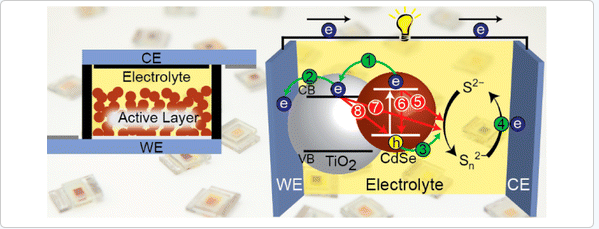 |
 回复此楼
回复此楼» 本帖附件资源列表
-
欢迎监督和反馈:小木虫仅提供交流平台,不对该内容负责。
本内容由用户自主发布,如果其内容涉及到知识产权问题,其责任在于用户本人,如对版权有异议,请联系邮箱:xiaomuchong@tal.com - 附件 1 : la500555w.pdf
2014-05-27 19:40:18, 6.22 M
» 收录本帖的淘帖专辑推荐
 量子点 量子点 | solar cells | vasp | 机械力化学 |
| QDSC | 研究生 | 太阳能电池 | 前沿论文 |
» 猜你喜欢
 修改论文,如何借助其他力量?
已经有4人回复
修改论文,如何借助其他力量?
已经有4人回复
-
中山大学潘越教授课题组2027级推免硕士研究生招生 新增一个专业医学技术名额
已经有21人回复
-
金属材料论文润色/翻译怎么收费?
已经有104人回复
» 本主题相关价值贴推荐,对您同样有帮助:
- (交流)量子点的研究
已经有10人回复
- 最新量子点合成综述
已经有596人回复
- Nature子刊最新综述:胶体量子点发光技术的出现
已经有628人回复
- Chem. Soc. Rev最新综述:量子点纳米异质结构用作太阳能转化
已经有262人回复
- 胶体量子点太阳能电池的最新突破
已经有138人回复
- Acc. Chem. Res. 新综述--量子点的细胞毒性及减小毒性的方法
已经有119人回复
- Chemical Reviews最新综述:多孔高分子材料的设计及制备
已经有306人回复
- CdTe量子点二氧化钛太阳能电池的电解质和对电极选择
已经有7人回复
- 太阳能电池的综述
已经有11人回复
- 求量子点方面的综述
已经有4人回复
- 聚合物太阳能电池最新进展:效率突破10.6%(日本住友化学)
已经有44人回复
- 外量子效率首超100%的量子点太阳能电池
已经有25人回复
- 量子点太阳能电池英文综述
已经有259人回复
- 【求助】有谁知道量子点太阳能电池的原理?
已经有20人回复
- 【专题介绍】CIS量子点及其薄膜太阳能电池
已经有81人回复
nowitzki_ci
专家顾问 (著名写手)
-

专家经验: +139 - MN-EPI: 17
- 应助: 67 (初中生)
- 金币: 21070.8
- 帖子: 2329
- 在线: 1507.1小时
- 虫号: 1035941
45楼2014-06-08 14:50:58
2楼2014-05-27 21:57:51
简单回复
zxf9844楼
2014-05-28 00:51
回复
五星好评 顶一下,感谢分享!
zjjxl5楼
2014-05-28 07:03
回复
五星好评 顶一下,感谢分享!
cqu35557楼
2014-05-28 07:48
回复
五星好评 顶一下,感谢分享!
chonsliu8楼
2014-05-28 08:31
回复
五星好评 顶一下,感谢分享!
1989千年雪9楼
2014-05-28 08:33
回复
五星好评 顶一下,感谢分享!
liukainan10楼
2014-05-28 08:38
回复
五星好评 顶一下,感谢分享!
greenecho11楼
2014-05-28 09:02
回复
五星好评 顶一下,感谢分享!
m06z51112楼
2014-05-28 09:07
回复
五星好评 顶一下,感谢分享!
sdgaotao14楼
2014-05-28 10:16
回复
五星好评 顶一下,感谢分享!
