












| 查看: 1037 | 回复: 14 | ||
| 本帖产生 1 个 翻译EPI ,点击这里进行查看 | ||
| 当前只显示满足指定条件的回帖,点击这里查看本话题的所有回帖 | ||
myong666木虫 (正式写手)
|
[求助]
求助一段文献的翻译,求高手翻译啦。。。
|
|

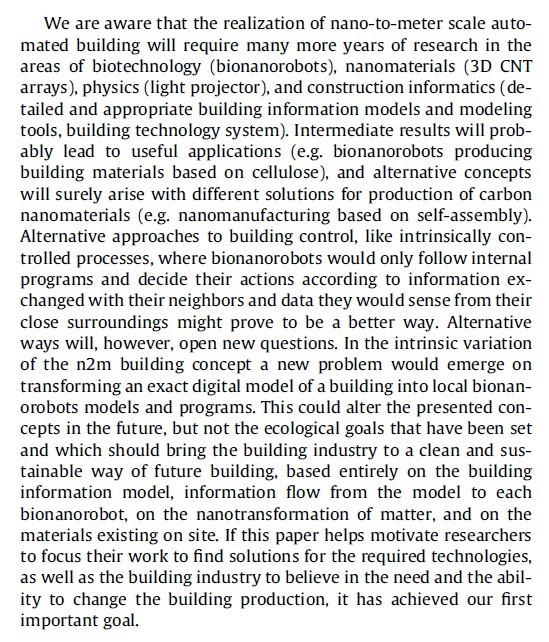 求高手再次帮忙啦。如果翻译得好,另送20-40金币以示感谢。同时,如有人在翻译,麻烦先留言,我好等待。谢谢 |
 回复此楼
回复此楼» 猜你喜欢
 表哥与省会女结婚,父母去帮带孩子被省会女气回家生重病了
已经有12人回复
表哥与省会女结婚,父母去帮带孩子被省会女气回家生重病了
已经有12人回复
-
依托企业入选了国家启明计划青年人才。有无高校可以引进的。
已经有14人回复
-
江汉大学解明教授课题组招博士研究生/博士后
已经有3人回复
-
AI 太可怕了,写基金时,提出想法,直接生成的文字比自己想得深远,还有科学性
已经有11人回复
-
同年申请2项不同项目,第1个项目里不写第2个项目的信息,可以吗
已经有10人回复
-
依托企业入选了国家启明计划青年人才。有无高校可以引进的。
已经有11人回复
yili_90
金虫 (正式写手)
- 翻译EPI: 17
- 应助: 37 (小学生)
- 贵宾: 0.013
- 金币: 3136.5
- 散金: 400
- 红花: 11
- 帖子: 464
- 在线: 117.7小时
- 虫号: 2157293
- 注册: 2012-11-30
- 性别: MM
- 专业: 动物遗传学


10楼2013-05-17 09:59:18
金狮水友
至尊木虫 (著名写手)
- 应助: 9 (幼儿园)
- 金币: 12278.2
- 散金: 50
- 红花: 13
- 沙发: 5
- 帖子: 1686
- 在线: 203小时
- 虫号: 1817809
- 注册: 2012-05-15
- 性别: GG
- 专业: 功能与智能高分子
3楼2013-05-16 16:23:34
myong666
木虫 (正式写手)
- 应助: 85 (初中生)
- 金币: 3664.6
- 散金: 16
- 红花: 4
- 沙发: 1
- 帖子: 596
- 在线: 348.7小时
- 虫号: 937409
- 注册: 2010-01-05
- 性别: GG
- 专业: 有机合成
|
We are aware that the realization of nano-to-meter scale automated building will require many more years of research in the areas of biotechnology (bionanorobots), nanomaterials (3D CNT arrays), physics (light projector), and construction informatics (detailed and appropriate building information models and modeling tools, building technology system). Intermediate results will probably lead to useful applications (e.g. bionanorobots producing building materials based on cellulose), and alternative concepts will surely arise with different solutions for production of carbon nanomaterials (e.g. nanomanufacturing based on self-assembly). Alternative approaches to building control, like intrinsically controlled processes, where bionanorobots would only follow internal programs and decide their actions according to information exchanged with their neighbors and data they would sense from their close surroundings might prove to be a better way. Alternative ways will, however, open new questions. In the intrinsic variation of the n2m building concept a new problem would emerge on transforming an exact digital model of a building into local bionanorobots models and programs. This could alter the presented concepts in the future, but not the ecological goals that have been set and which should bring the building industry to a clean and sustainable way of future building, based entirely on the building information model, information flow from the model to each bionanorobot, on the nanotransformation of matter, and on the materials existing on site. If this paper helps motivate researchers to focus their work to find solutions for the required technologies, as well as the building industry to believe in the need and the ability to change the building production, it has achieved our first important goal. 脰禄脪陋路颅脪毛碌脙潞脙拢卢陆冒卤脪虏禄脢脟脦脢脤芒隆拢 |
4楼2013-05-16 17:07:46
myong666
木虫 (正式写手)
- 应助: 85 (初中生)
- 金币: 3664.6
- 散金: 16
- 红花: 4
- 沙发: 1
- 帖子: 596
- 在线: 348.7小时
- 虫号: 937409
- 注册: 2010-01-05
- 性别: GG
- 专业: 有机合成

5楼2013-05-17 09:37:50