|
|
【答案】应助回帖
★ ★
感谢参与,应助指数 +1
franch: 金币+2, 谢谢回帖交流,, 2013-05-13 21:32:56
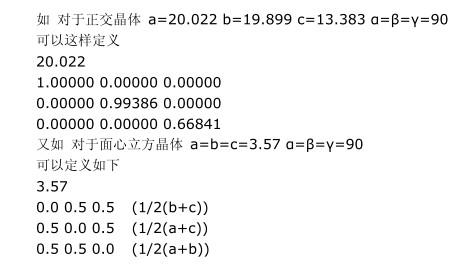
楼主可以参考下PWscf的帮助文件,里面有14种布拉伐格子的原胞基矢的表达式。
ibrav structure celldm(2)-celldm(6)
or: b,c,cosab,cosac,cosbc
0 free
crystal axis provided in input: see card CELL_PARAMETERS
1 cubic P (sc)
v1 = a(1,0,0), v2 = a(0,1,0), v3 = a(0,0,1)
2 cubic F (fcc)
v1 = (a/2)(-1,0,1), v2 = (a/2)(0,1,1), v3 = (a/2)(-1,1,0)
3 cubic I (bcc)
v1 = (a/2)(1,1,1), v2 = (a/2)(-1,1,1), v3 = (a/2)(-1,-1,1)
4 Hexagonal and Trigonal P celldm(3)=c/a
v1 = a(1,0,0), v2 = a(-1/2,sqrt(3)/2,0), v3 = a(0,0,c/a)
5 Trigonal R, 3fold axis c celldm(4)=cos(alpha)
The crystallographic vectors form a three-fold star around
the z-axis, the primitive cell is a simple rhombohedron:
v1 = a(tx,-ty,tz), v2 = a(0,2ty,tz), v3 = a(-tx,-ty,tz)
where c=cos(alpha) is the cosine of the angle alpha between
any pair of crystallographic vectors, tx, ty, tz are:
tx=sqrt((1-c)/2), ty=sqrt((1-c)/6), tz=sqrt((1+2c)/3)
-5 Trigonal R, 3fold axis <111> celldm(4)=cos(alpha)
The crystallographic vectors form a three-fold star around
<111>. Defining a' = a/sqrt(3) :
v1 = a' (u,v,v), v2 = a' (v,u,v), v3 = a' (v,v,u)
where u and v are defined as
u = tz - 2*sqrt(2)*ty, v = tz + sqrt(2)*ty
and tx, ty, tz as for case ibrav=5
6 Tetragonal P (st) celldm(3)=c/a
v1 = a(1,0,0), v2 = a(0,1,0), v3 = a(0,0,c/a)
7 Tetragonal I (bct) celldm(3)=c/a
v1=(a/2)(1,-1,c/a), v2=(a/2)(1,1,c/a), v3=(a/2)(-1,-1,c/a)
8 Orthorhombic P celldm(2)=b/a
celldm(3)=c/a
v1 = (a,0,0), v2 = (0,b,0), v3 = (0,0,c)
9 Orthorhombic base-centered(bco) celldm(2)=b/a
celldm(3)=c/a
v1 = (a/2, b/2,0), v2 = (-a/2,b/2,0), v3 = (0,0,c)
-9 as 9, alternate description
v1 = (a/2,-b/2,0), v2 = (a/2,-b/2,0), v3 = (0,0,c)
10 Orthorhombic face-centered celldm(2)=b/a
celldm(3)=c/a
v1 = (a/2,0,c/2), v2 = (a/2,b/2,0), v3 = (0,b/2,c/2)
11 Orthorhombic body-centered celldm(2)=b/a
celldm(3)=c/a
v1=(a/2,b/2,c/2), v2=(-a/2,b/2,c/2), v3=(-a/2,-b/2,c/2)
12 Monoclinic P, unique axis c celldm(2)=b/a
celldm(3)=c/a,
celldm(4)=cos(ab)
v1=(a,0,0), v2=(b*cos(gamma),b*sin(gamma),0), v3 = (0,0,c)
where gamma is the angle between axis a and b.
-12 Monoclinic P, unique axis b celldm(2)=b/a
celldm(3)=c/a,
celldm(5)=cos(ac)
v1 = (a,0,0), v2 = (0,b,0), v3 = (c*sin(beta),0,c*cos(beta))
where beta is the angle between axis a and c
13 Monoclinic base-centered celldm(2)=b/a
celldm(3)=c/a,
celldm(4)=cos(ab)
v1 = ( a/2, 0, -c/2),
v2 = (b*cos(gamma), b*sin(gamma), 0),
v3 = ( a/2, 0, c/2),
where gamma is the angle between axis a and b
14 Triclinic celldm(2)= b/a,
celldm(3)= c/a,
celldm(4)= cos(bc),
celldm(5)= cos(ac),
celldm(6)= cos(ab)
v1 = (a, 0, 0),
v2 = (b*cos(gamma), b*sin(gamma), 0)
v3 = (c*cos(beta), c*(cos(alpha)-cos(beta)cos(gamma))/sin(gamma),
c*sqrt( 1 + 2*cos(alpha)cos(beta)cos(gamma)
- cos(alpha)^2-cos(beta)^2-cos(gamma)^2 )/sin(gamma) )
where alpha is the angle between axis b and c
beta is the angle between axis a and c
gamma is the angle between axis a and b |
|












 回复此楼
回复此楼
