24小时热门版块排行榜    

查看: 1695  |  回复: 15
当前只显示满足指定条件的回帖,点击这里查看本话题的所有回帖

sungjen

银虫 (著名写手)

[求助] 关于POSCAR中晶矢的定义

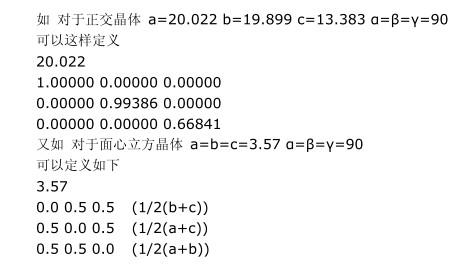
POSCAR里面的三到五行 的晶矢是怎么定义的  就想知道具体是怎么算出来的  哪位帮帮忙吧

1BX8)S@IP4H[EY2@E47[S@T.jpg
回复此楼
希望有一天成为大神
已阅   回复此楼   关注TA 给TA发消息 送TA红花 TA的回帖

liqizuiyang

木虫 (著名写手)

【答案】应助回帖

★ ★
感谢参与,应助指数 +1
franch: 金币+2, 谢谢回帖交流,, 2013-05-13 21:32:56
楼主可以参考下PWscf的帮助文件,里面有14种布拉伐格子的原胞基矢的表达式。

ibrav      structure                   celldm(2)-celldm(6)
                                                        or: b,c,cosab,cosac,cosbc
                     0          free
                         crystal axis provided in input: see card CELL_PARAMETERS
                  
                     1          cubic P (sc)
                         v1 = a(1,0,0),  v2 = a(0,1,0),  v3 = a(0,0,1)
                  
                     2          cubic F (fcc)
                         v1 = (a/2)(-1,0,1),  v2 = (a/2)(0,1,1), v3 = (a/2)(-1,1,0)
                  
                     3          cubic I (bcc)
                         v1 = (a/2)(1,1,1),  v2 = (a/2)(-1,1,1),  v3 = (a/2)(-1,-1,1)
                  
                     4          Hexagonal and Trigonal P        celldm(3)=c/a
                         v1 = a(1,0,0),  v2 = a(-1/2,sqrt(3)/2,0),  v3 = a(0,0,c/a)
                  
                     5          Trigonal R, 3fold axis c        celldm(4)=cos(alpha)
                         The crystallographic vectors form a three-fold star around
                         the z-axis, the primitive cell is a simple rhombohedron:
                         v1 = a(tx,-ty,tz),   v2 = a(0,2ty,tz),   v3 = a(-tx,-ty,tz)
                         where c=cos(alpha) is the cosine of the angle alpha between
                         any pair of crystallographic vectors, tx, ty, tz are:
                           tx=sqrt((1-c)/2), ty=sqrt((1-c)/6), tz=sqrt((1+2c)/3)
                    -5          Trigonal R, 3fold axis <111>    celldm(4)=cos(alpha)
                         The crystallographic vectors form a three-fold star around
                         <111>. Defining a' = a/sqrt(3) :
                         v1 = a' (u,v,v),   v2 = a' (v,u,v),   v3 = a' (v,v,u)
                         where u and v are defined as
                           u = tz - 2*sqrt(2)*ty,  v = tz + sqrt(2)*ty
                         and tx, ty, tz as for case ibrav=5
                  
                     6          Tetragonal P (st)               celldm(3)=c/a
                         v1 = a(1,0,0),  v2 = a(0,1,0),  v3 = a(0,0,c/a)
                  
                     7          Tetragonal I (bct)              celldm(3)=c/a
                         v1=(a/2)(1,-1,c/a),  v2=(a/2)(1,1,c/a),  v3=(a/2)(-1,-1,c/a)
                  
                     8          Orthorhombic P                  celldm(2)=b/a
                                                                celldm(3)=c/a
                         v1 = (a,0,0),  v2 = (0,b,0), v3 = (0,0,c)
                  
                     9          Orthorhombic base-centered(bco) celldm(2)=b/a
                                                                celldm(3)=c/a
                         v1 = (a/2, b/2,0),  v2 = (-a/2,b/2,0),  v3 = (0,0,c)
                    -9          as 9, alternate description
                         v1 = (a/2,-b/2,0),  v2 = (a/2,-b/2,0),  v3 = (0,0,c)
                  
                    10          Orthorhombic face-centered      celldm(2)=b/a
                                                                celldm(3)=c/a
                         v1 = (a/2,0,c/2),  v2 = (a/2,b/2,0),  v3 = (0,b/2,c/2)
                  
                    11          Orthorhombic body-centered      celldm(2)=b/a
                                                                celldm(3)=c/a
                         v1=(a/2,b/2,c/2),  v2=(-a/2,b/2,c/2),  v3=(-a/2,-b/2,c/2)
                  
                    12          Monoclinic P, unique axis c     celldm(2)=b/a
                                                                celldm(3)=c/a,
                                                                celldm(4)=cos(ab)
                         v1=(a,0,0), v2=(b*cos(gamma),b*sin(gamma),0),  v3 = (0,0,c)
                         where gamma is the angle between axis a and b.
                   -12          Monoclinic P, unique axis b     celldm(2)=b/a
                                                                celldm(3)=c/a,
                                                                celldm(5)=cos(ac)
                         v1 = (a,0,0), v2 = (0,b,0), v3 = (c*sin(beta),0,c*cos(beta))
                         where beta is the angle between axis a and c
                  
                    13          Monoclinic base-centered        celldm(2)=b/a
                                                                celldm(3)=c/a,
                                                                celldm(4)=cos(ab)
                         v1 = (  a/2,         0,                -c/2),
                         v2 = (b*cos(gamma), b*sin(gamma), 0),
                         v3 = (  a/2,         0,                  c/2),
                         where gamma is the angle between axis a and b
                  
                    14          Triclinic                       celldm(2)= b/a,
                                                                celldm(3)= c/a,
                                                                celldm(4)= cos(bc),
                                                                celldm(5)= cos(ac),
                                                                celldm(6)= cos(ab)
                         v1 = (a, 0, 0),
                         v2 = (b*cos(gamma), b*sin(gamma), 0)
                         v3 = (c*cos(beta),  c*(cos(alpha)-cos(beta)cos(gamma))/sin(gamma),
                              c*sqrt( 1 + 2*cos(alpha)cos(beta)cos(gamma)
                                        - cos(alpha)^2-cos(beta)^2-cos(gamma)^2 )/sin(gamma) )
                     where alpha is the angle between axis b and c
                            beta is the angle between axis a and c
                           gamma is the angle between axis a and b
9楼2013-05-11 10:23:37
已阅   回复此楼   关注TA 给TA发消息 送TA红花 TA的回帖
查看全部 16 个回答

KalaShayminS

铁杆木虫 (著名写手)

【答案】应助回帖


感谢参与,应助指数 +1
sunyang1988: 金币+1, 谢谢交流 2013-05-10 14:54:21
这个不是算出来的,而是一种习惯。
只要三个晶体矢量的长度以及两两夹角满足 三个长度和三个角度就是合法的晶体矢量,有无穷多种取法。习惯上取最简单的一种,例如正交的就取沿着x/y/z就可以了。

有的晶胞不是素晶胞,而矢量只需要取素晶胞矢量就可以了,例如面心立方。素晶胞的取法可以参考固体物理教材。
2楼2013-05-10 11:22:22
已阅   回复此楼   关注TA 给TA发消息 送TA红花 TA的回帖

hookah

木虫 (正式写手)

哎,这个不多说了,一些基础的动心,建议自己先看看手册,和侯博士的资料吧!
3楼2013-05-10 13:11:16
已阅   回复此楼   关注TA 给TA发消息 送TA红花 TA的回帖

sungjen

银虫 (著名写手)

引用回帖:
3楼: Originally posted by hookah at 2013-05-10 13:11:16
哎,这个不多说了,一些基础的动心,建议自己先看看手册,和侯博士的资料吧!

我都看了啊   看不是太懂
希望有一天成为大神
4楼2013-05-10 14:57:57
已阅   回复此楼   关注TA 给TA发消息 送TA红花 TA的回帖
信息提示
请填处理意见