









| 查看: 3293 | 回复: 44 | ||||
| 当前只显示满足指定条件的回帖,点击这里查看本话题的所有回帖 | ||||
[求助]
PEG羟基改性遇到了麻烦,求大神
|
||||

8臂PEG-OH溶解于无水二氯甲烷,在氮气保护下,加一定量的NaH(有40%矿物油,百灵威)搅拌,但搅拌一个小时左右就交联了,磁子也无法转动,这是什么情况?各位朋友有什么好的建议吗? 3Q~~~~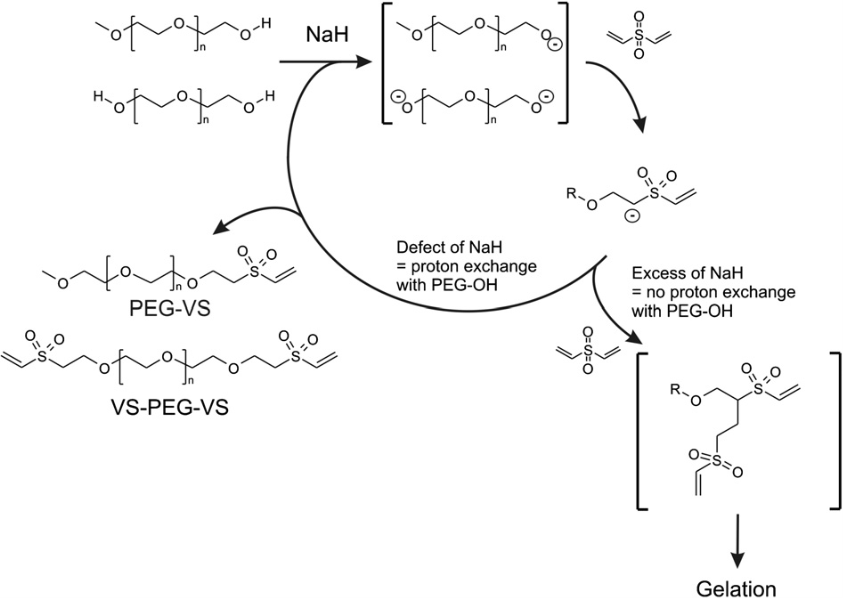 图片1.png [ 来自科研家族 高分子家族 ] |
 回复此楼
回复此楼» 收录本帖的淘帖专辑推荐
 deprotect deprotect | PEG改性 |
» 猜你喜欢
 凝聚青年力量,共筑学术新程,Biofunctional Materials开启青年编委全球招募
已经有18人回复
凝聚青年力量,共筑学术新程,Biofunctional Materials开启青年编委全球招募
已经有18人回复
-
激荡学术火花,赋能青年成长,Biofunctional Materials青年编委招募
已经有18人回复
-
生物力学与组织工程学论文润色/翻译怎么收费?
已经有153人回复
-
激荡青年思想,深耕生物材料,Biofunctional Materials 青年编委招募开启!
已经有7人回复
-
赋能青年学术发声,携手打造前沿特刊,Biofunctional Materials 青年编委全球招募
已经有7人回复
-
院士领衔,ICBMBA生物功能材料与生物医学应用会议诚邀学者加入!
已经有6人回复
-
ICBMBA 2026,生物功能材料与生物医学应用国际会议诚邀参与!
已经有5人回复
-
Interdiscipline 2026,2026国际交叉学大会,多学科诚邀参会,院士领衔,专家云集
已经有5人回复
-
【PhD 招生 | La Trobe University | 有机合成 / 化学生物学 / 多肽化学】
已经有24人回复
-
聊聊生物材料课题从合成到验证的那些事
已经有0人回复
-
【科普】医工交叉漫谈:水凝胶凭什么成为组织修复热门材料?
已经有0人回复
» 本主题相关商家推荐: (我也要在这里推广)

aircraftvip
专家顾问 (正式写手)
-

专家经验: +40 - BM-EPI: 10
- 应助: 232 (大学生)
- 贵宾: 0.06
- 金币: 7345.7
- 散金: 24
- 红花: 28
- 帖子: 987
- 在线: 487.4小时
- 虫号: 1007878
- 注册: 2010-04-28
- 性别: GG
- 专业: 高分子合成化学
- 管辖: 生物材料
【答案】应助回帖
★ ★ ★ ★ ★ ★ ★ ★ ★ ★ ★ ★
fool_proof: 金币+2, 感谢回帖应助~ 2013-03-04 22:35:10
535600954(红舟流星代发): 金币+10, 代扣代发金币 2013-07-31 18:58:18
fool_proof: 金币+2, 感谢回帖应助~ 2013-03-04 22:35:10
535600954(红舟流星代发): 金币+10, 代扣代发金币 2013-07-31 18:58:18
|
这个反应建立在NaH有效拔H的基础上,如果PEG还有大量水分,NaH则优先与水反应生成NaOH和氢气,不管怎么说,你得从头把PEG认真干燥一下,甲苯共沸三次就差不多了。 至于交联的原因,可能很快就有解释了。可以考虑再多加些阻聚剂,如hydroquinone。 Reactivity Profile of divinyl sulfone Divinyl sulphone may react vigorously with strong oxidizing agents. Can react exothermically with reducing agents (such as alkali metals and hydrides) to release gaseous hydrogen or hydrogen sulfide. May react exothermically with both acids and bases. May undergo exothermic polymerization in the presence of various catalysts (such as acids) or initiators. Ref. http://www.chemicalbook.com/Chem ... ty_EN_CB6697608.htm |

 535600954
9楼2013-03-04 21:49:24
红舟流星
荣誉版主 (文坛精英)
志在成为千元户!

- BM-EPI: 4
- 应助: 304 (大学生)
- 贵宾: 24.278
- 金币: 2630
- 散金: 55784
- 红花: 208
- 沙发: 719
- 帖子: 19854
- 在线: 2621小时
- 虫号: 1304427
- 注册: 2011-05-24
- 性别: GG
- 专业: 仿生材料
- 管辖: 材料综合
2楼2013-03-03 21:18:17
aircraftvip
专家顾问 (正式写手)
-
专家经验: +40 - BM-EPI: 10
- 应助: 232 (大学生)
- 贵宾: 0.06
- 金币: 7345.7
- 散金: 24
- 红花: 28
- 帖子: 987
- 在线: 487.4小时
- 虫号: 1007878
- 注册: 2010-04-28
- 性别: GG
- 专业: 高分子合成化学
- 管辖: 生物材料
【答案】应助回帖
★ ★ ★ ★ ★ ★ ★ ★ ★ ★ ★ ★ ★
感谢参与,应助指数 +1
红舟流星: 金币+2, 专家考核, 欢迎来到生物功能材料板块应助交流 2013-03-03 22:59:17
535600954: 金币+1 2013-03-04 19:03:22
535600954: 金币+10, ★有帮助 2013-04-02 10:01:53
感谢参与,应助指数 +1
红舟流星: 金币+2, 专家考核, 欢迎来到生物功能材料板块应助交流 2013-03-03 22:59:17
535600954: 金币+1 2013-03-04 19:03:22
535600954: 金币+10, ★有帮助 2013-04-02 10:01:53
|
PEG除水了吗? 建议严格参照原文献步骤, ··Synthesis of PEG Vinyl Sulfone (PEG-VS). Multiarm PEG-VSs were synthesized by coupling PEG-OHs with an excess of divinyl sulfone (Aldrich, Buchs, Switzerland), in contrast to a previously published synthesis of PEG-VS via PEG-chloroethyl sulfone.11 PEG-OH (ca. 5 g) was either used as received and dissolved directly in 300 mL of dry dichloromethane (previously dried over molecular sieves) or, in some cases, PEG was dried by azeotropic distillation in toluene using a Dean Stark trap before starting the reaction. To the PEG dissolved in dichloromethane, NaH was added under argon, at 5-fold molar excess over OH groups. After hydrogen evolution, divinyl sulfone was added very quickly at 50- to 100-fold molar excess over OH groups. The reaction was carried out at room temperature for 3 days under argon atmosphere with constant stirring. Afterward the reaction solution was neutralized with concentrated acetic acid, filtered through paper until clear, and reduced to a small volume (ca. 10 mL) by rotary evaporation. PEG was precipitated by adding the remaining solution dropwise into ice-cold diethyl ether. The polymer was recovered by filtration, washed with diethyl ether, and dried under vacuum. The dry polymer was then dissolved in 200 mL of deionized water containing ca. 5 g of sodium chloride and extracted three times with 200 mL of dichloromethane. This solution was dried with sodium carbonate, and the volume was again reduced by rotary evaporation. Finally, the product was reprecipitated and thoroughly washed with diethyl ether to remove all remaining divinyl sulfone. The final product was dried under vacuum and stored under argon at −20 °C. Derivatization was confirmed with 1H NMR (CDCl3): 3.6 ppm (PEG backbone), 6.1 ppm (d, 1H, CH2), 6.4 ppm (d, 1H, CH2), and 6.8 ppm (dd, 1H, −SO2CH). The degree of end group conversion, as shown by NMR, was found to range from 95 to 98%. Gel permeation chromatography was used to confirm that the starting material (PEG-OH) and the end-functionalized PEG-VS have identical molecular weight distributions.·· Ref. Synthesis and Physicochemical Characterization of End-Linked Poly(ethylene glycol)-co-peptide Hydrogels Formed by Michael-Type Addition M. P. Lutolf and J. A. Hubbell * http://pubs.acs.org/doi/abs/10.1021/bm025744e |
3楼2013-03-03 22:42:27
4楼2013-03-04 08:49:33