









| 查看: 921 | 回复: 3 | ||
| 本帖产生 1 个 翻译EPI ,点击这里进行查看 | ||
rockinuk铁杆木虫 (职业作家)
|
[求助]
求教化学方面的文章翻译~(简要的解说,非精翻译)- Part 4.
|
|

|
求教化学方面的文章翻译~(简要的解说,非精翻译)- Part 4. 这篇内容是我向 RSC 索取的文件, 发表在 2002年 Chemistry in Britain 的一篇 title 为 Chemistry Encrypted 的论文~ (内容可能涉及生物化学还是分析化学方面~ 具体~我不清楚~) 因为想学这篇内容~ 但没有化学基础及知识背景~ 上来求教化学方面的专家~ 内容一个字一个字的输入进 word, 然后贴上来~ 所谓隔行如隔山~ 术业有专攻~ 这内容我不懂~ 特来请教这方面的专家~ ( 附件我放上 figure 1, figure 2. 及文字档 chemistry encrypted9.doc) 我想知道~图一跟图二主要是在描述什么内容~ 我把文章依段落分成 5 段~ 放上来请专家帮忙解说~ 衷心感谢~ 谢谢~ Invent your own barcode All the coding schemes described herein are afflicted by one handicap or another. Thus while one can only marvel at the baroque elegance of Still’s original coding scheme, he and his colleagues must have sweated blood to get it to work. While less unwieldy, the metallic and optical barcodes, do not, as Still’s scheme does, inextricably link the code to what is on the particle. The digital DNA codes4-6 (see Box) are prone to contamination from templates not intended to be present in the labelling mixture. And so on. In short, there is plenty of room for other ideas. One very simple possibility, suggested by isotope ratios and insect pheromone blends, is to vary rations and insect pheromone blends, is to vary the amounts of just two different substances. This will not lead to very many codes as it stands, but this scheme could be used in the same way that isotope ratios are used to identify the provenance of ancient timbers and samples of cocaine.7,8 There is no reason, either, why different pairs of substances should not be used. Another possibility is to use the alternative configurations, R or S, of an asymmetric centre as the basis for a digital code. It is well known that some complex natural products ca have a significant number of a symmetric centres, and the framework of one of these molecules could be used for coding, with the code residing in a single molecule. Care would be residing in choosing a suitable framework, however, since in some cyclic natural products (eg steroids) ring formation will predispose some asymmetric centres towards one particular configuration. Alternatively, a complex code could be generated by connecting a small number of different monomers in a variety of different ways, in the same manner as branched carbohydrates. Perhaps the scheme with the greatest coding potential, however, is a tiny-dimensional array of several different coloured quantum dots. Fixing four different coloured dots to a 10×10 array, for example, would generate over 2000m patterns. These are just three straightforward examples. I would bet money that there are other miniature barcoding schemes out there waiting to make more jaws drop in astonishment. Acknowledgements: I am grateful to Alan Armstrong for telling me about the Still-Ohlmeyer incident and Michael Natan for telling me about how the metallic barcodes came about. Laurie Peter, Chris Flost and other colleagues in the chemistry department at Batch kindly discussed various aspects of miniature barcodes with me, and Pooja Kumat made helpful comments on the manuscript. 这段致谢词~就不用翻了~谢谢~ figure 1.JPG 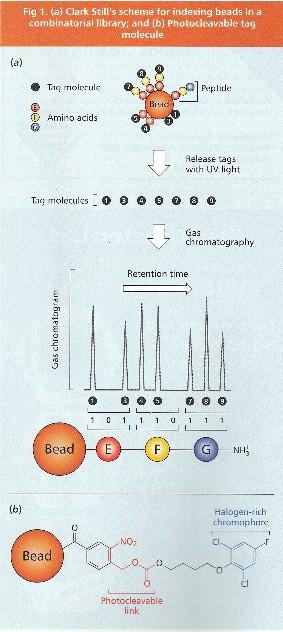 figure 2.JPG 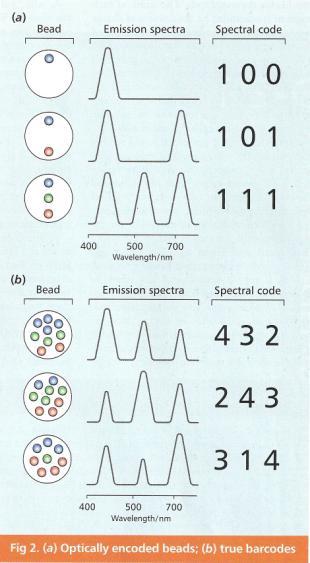 |
 回复此楼
回复此楼» 本帖附件资源列表
-
欢迎监督和反馈:小木虫仅提供交流平台,不对该内容负责。
本内容由用户自主发布,如果其内容涉及到知识产权问题,其责任在于用户本人,如对版权有异议,请联系邮箱:xiaomuchong@tal.com - 附件 1 : chemistryencrypted9.doc
2013-01-24 10:46:08, 40 K
» 猜你喜欢
 申博发邮件
已经有8人回复
申博发邮件
已经有8人回复
-
各位大神,目前国内有哪些比较好用的逆合成软件?
已经有9人回复
-
国社科系统bug了,是不是要放榜了?
已经有7人回复
-
上海工程技术大学激光智能制造课题组|2027级博士研究生招生公告
已经有8人回复
-
上海工程技术大学激光智能制造课题组招收博士研究生
已经有8人回复


2楼2013-01-28 01:54:21
 |
3楼2013-01-28 08:12:11
chemistry412
铜虫 (初入文坛)
- 翻译EPI: 1
- 应助: 0 (幼儿园)
- 金币: 128.6
- 帖子: 46
- 在线: 7.1小时
- 虫号: 257865
- 注册: 2006-06-04
- 性别: MM
- 专业: 无机纳米化学
【答案】应助回帖
★ ★ ★ ★ ★ ★ ★ ★ ★ ★ ★ ★ ★ ★ ★ ★ ★ ★ ★ ★ ★ ★ ★ ★ ★ ★ ★ ★ ★ ★ ★ ★ ★ ★ ★ ★ ★ ★ ★ ★ ★ ★ ★ ★ ★ ★ ★ ★ ★ ★ ★ ★ ...
phu_grassman: 金币+5, thanks for your timie 2013-02-01 21:05:00
rockinuk: 金币+100, 翻译EPI+1, ★★★★★最佳答案 2013-02-03 13:48:17
phu_grassman: 金币+5, thanks for your timie 2013-02-01 21:05:00
rockinuk: 金币+100, 翻译EPI+1, ★★★★★最佳答案 2013-02-03 13:48:17
|
我是学化学的,这里有些生物和别的学科的内容,我翻译的不是很好,水平有限,仅供参考! 发明专属条形码 All the coding schemes described herein are afflicted by one handicap or another. Thus while one can only marvel at the baroque elegance of Still’s original coding scheme, he and his colleagues must have sweated blood to get it to work. While less unwieldy, the metallic and optical barcodes, do not, as Still’s scheme does, inextricably link the code to what is on the particle. The digital DNA codes4-6 (see Box) are prone to contamination from templates not intended to be present in the labelling mixture. And so on. In short, there is plenty of room for other ideas. 这里提及的所有编码方案都会被这个或那个因素困扰,因此只有Still首创的密码方案才能有所成就,为此他和他的同事必须全力以赴地工作。但是,金属和光学条码不象Still的方案那样容易控制,它们像粒子一样并不紧密相连。数字DNA密码4-6容易被模板中未被标记的物质弄混等等。简单说,这种方法并不太可靠。 One very simple possibility, suggested by isotope ratios and insect pheromone blends, is to vary rations and insect pheromone blends, is to vary the amounts of just two different substances. This will not lead to very many codes as it stands, but this scheme could be used in the same way that isotope ratios are used to identify the provenance of ancient timbers and samples of cocaine.7,8 There is no reason, either, why different pairs of substances should not be used. 由同位素丰度和不同种昆虫外激素的混合联想到的一种非常简单的方案:改变同位素的含量和昆虫外激素的种类,也就是说改变两种物质的含量。这并不会形成太多的密码,但是这种方法应该会很有效,就像利用同位素的丰度可以用来鉴定古木的年代和可卡因的含量一样适用。任意两种物质均可。 Another possibility is to use the alternative configurations, R or S, of an asymmetric centre as the basis for a digital code. It is well known that some complex natural products ca have a significant number of a symmetric centres, and the framework of one of these molecules could be used for coding, with the code residing in a single molecule. Care would be residing in choosing a suitable framework, however, since in some cyclic natural products (eg steroids) ring formation will predispose some asymmetric centres towards one particular configuration. Alternatively, a complex code could be generated by connecting a small number of different monomers in a variety of different ways, in the same manner as branched carbohydrates. 另一种可能性就是使用一种不对称中心的不同构型,R或S作为基础或数字密码。众所周知一些复杂的天然产品有数目众多的对称中心,这个或这些分子的框架可以被用来标记—密码就存在于分子的结构之中。当然要慎重选择适合的结构:例如在一些可循环的天然化合物中(如甾族化合物)会有成环反应发生,这会形成分子的不对称中心,改变其结构。或者,可以通过不同方法联合一定数目的不同单体来形成复杂的密码。例如支化型的糖类的形成。 Perhaps the scheme with the greatest coding potential, however, is a tiny-dimensional array of several different coloured quantum dots. Fixing four different coloured dots to a 10×10 array, for example, would generate over 2000m patterns. 也许这种构想是最有前景的编码方式,但是,它是一定数目不同颜色量子点的一种小尺度的排列。假设有四种不同颜色的量子点以10×10方式排列,就可以产生2000种图案。 These are just three straightforward examples. I would bet money that there are other miniature barcoding schemes out there waiting to make more jaws drop in astonishment. 这里介绍的是3种非常简单的例子。我预计以后会出现令人意想不到的微型的条形码设计方案。 |
4楼2013-01-30 17:13:34