









| 查看: 10246 | 回复: 42 | ||||||||||||||||||||||||||||||
xiejf专家顾问 (文学泰斗)
麦麦爸爸爱小牛
|
[交流]
锂电大牛John B. Goodenough在JACS上的前瞻性综述:可充电锂离子电池 已有42人参与
|


|
新出炉的J. Am. Chem. Soc.上刊发了锂电大牛John B. Goodenough撰写的前瞻性综述,题目为The Li-ion Rechargeable Battery: A Perspective。作为几种经典锂电电极材料的发明者,Goodenough工作的重要性不言而喻,本文为Goodenough的第一作者文章,对可充电锂离子电池的现状和未来做了总结。 Abstract Abstract Each cell of a battery stores electrical energy as chemical energy in two electrodes, a reductant (anode) and an oxidant (cathode), separated by an electrolyte that transfers the ionic component of the chemical reaction inside the cell and forces the electronic component outside the battery. The output on discharge is an external electronic current I at a voltage V for a time Δt. The chemical reaction of a rechargeable battery must be reversible on the application of a charging I and V. Critical parameters of a rechargeable battery are safety, the density of energy that can be stored at a specific power input and retrieved at a specific power output, the cycle and shelf life, the storage efficiency, and the cost of fabrication. Conventional ambient-temperature rechargeable batteries have solid electrodes and a liquid electrolyte. The positive electrode (cathode) consists of a host framework into which the mobile (working) cation is inserted reversibly over a finite solid-solution range. The solid-solution range, which is reduced at higher current by the rate of transfer of the working ion across electrode/electrolyte interfaces and within a host, limits the amount of charge per electrode formula unit that can be transferred over the time Δt = Δt(I). Moreover, the difference between the energies of the LUMO and the HOMO of the electrolyte, i.e. the electrolyte window, determines the maximum voltage for a long shelf and cycle life. The maximum stable voltage with an aqueous electrolyte is 1.5 V; the Li-ion rechargeable battery uses an organic electrolyte with a larger window, which increase the density of stored energy for a given Δt. Anode or cathode electrochemical potentials outside the electrolyte window can increase V, but they require formation of a passivating surface layer that must be permeable to Li+ and capable of adapting rapidly to the changing electrode surface area as the electrode changes volume during cycling. A passivating surface layer adds to the impedance of the Li+ transfer across the electrode/electrolyte interface and lowers the cycle life of a battery cell. Moreover, formation of a passivation layer on the anode robs Li from the cathode irreversibly on an initial charge, further lowering the reversible Δt. These problems plus the cost of quality control of manufacturing plague development of Li-ion rechargeable batteries that can compete with the internal combustion engine for powering electric cars and that can provide the needed low-cost storage of electrical energy generated by renewable wind and/or solar energy. Chemists are contributing to incremental improvements of the conventional strategy by (1) investigating and controlling electrode passivation layers, (2) improving the rate of Li+ transfer across electrode/electrolyte interfaces, (3) identifying electrolytes with larger windows while retaining a Li+ conductivity σLi > 10-3 S cm-1, (4) synthesizing electrode morphologies that reduce the size of the active particles while pinning them on current collectors of large surface area accessible by the electrolyte, (5) lowering the cost of cell fabrication, (6) designing displacement-reaction anodes of higher capacity that allow a safe, fast charge, (7) designing alternative cathode hosts. However, new strategies are needed for batteries that go beyond powering hand-held devices. These strategies include (1) the use of electrode hosts with two-electron redox centers, (2) replacing the cathode hosts (a) by materials undergoing displacement reactions, e.g. sulfur, (b) by liquid cathodes that may contain flow-through redox molecules, (c) by catalysts for air cathodes, and /or (3) by the development of a Li+ solid electrolyte separator membrane that allows an organic and aqueous liquid electrolyte on the anode and cathode sides, respectively. Opportunities exist for the chemist to bring together oxide and polymer or graphene chemistry in imaginative morphologies. / 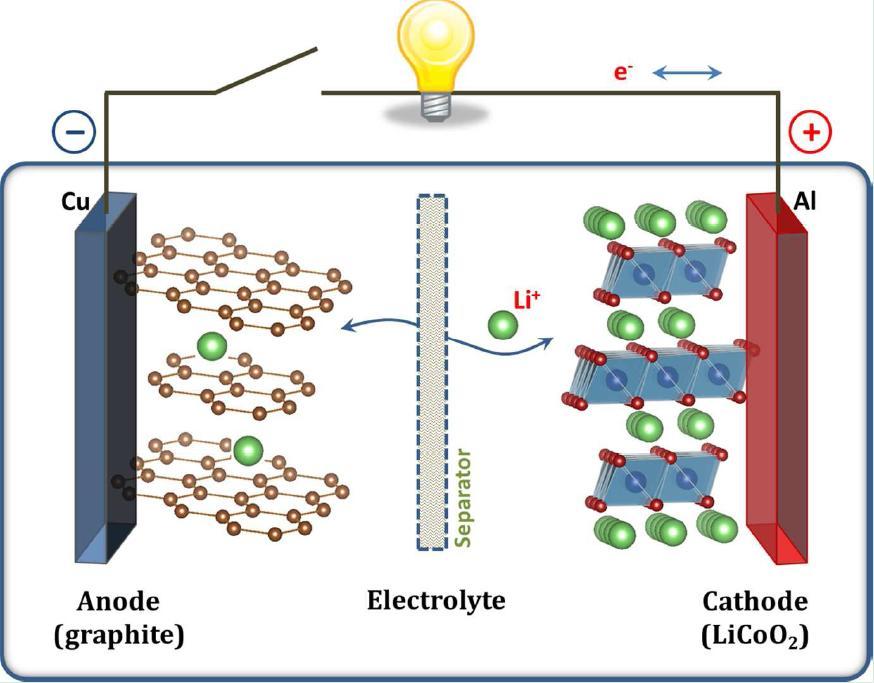 1.JPG [ 来自科研家族 材料家族 ] |
 回复此楼
回复此楼» 本帖附件资源列表
-
欢迎监督和反馈:小木虫仅提供交流平台,不对该内容负责。
本内容由用户自主发布,如果其内容涉及到知识产权问题,其责任在于用户本人,如对版权有异议,请联系邮箱:xiaomuchong@tal.com - 附件 1 : TheLi-ionRechargeableBattery:APerspective.pdf
2013-01-14 17:08:24, 1.18 M
» 收录本帖的淘帖专辑推荐
 锂电资源共享 锂电资源共享 | 纳米技术与能源及模拟 | ....锂电池┆_____ | 资源收集 |
| 文献推荐 | 纳米化学/电化学综述 | 新能源材料及技术(小新) | 材料综述 |
| nano review | 昊天子-锂电材料 | 石墨烯锂电池 | 新能源科学与技术 |
| 晶体制备及测试 | 专业书 | 深度情怀 | 文献 |
| 2012 | 工程机械软件 | 感觉有用的帖子 | 课本 |
| 我的淘帖 | 文章 | 工作 | 待下载 |
| 锂离子电池 |
» 本帖已获得的红花(最新10朵)
 wangf808
» 猜你喜欢
 硼掺杂石墨阴极的电化学阻抗EIS表征与界面阻抗分析
已经有1人回复
硼掺杂石墨阴极的电化学阻抗EIS表征与界面阻抗分析
已经有1人回复
-
招生2027年物理化学专业考核制博士(吉林大学)
已经有29人回复
-
分析化学论文润色/翻译怎么收费?
已经有263人回复
-
【2027级博士申请】双非硕・一作 SCI 3 篇(2篇CEJ 一区 Top)储能方向
已经有15人回复
-
石墨电催化体系反应动力学:污染物浓度与反应速率的关联规律
已经有0人回复
-
海南大学杨金霖老师招收2027级博士生(储能电池方向)
已经有5人回复
-
氮掺杂石墨阴极制备:掺杂量对氧还原活性的调控规律
已经有0人回复
-
电催化CO2还原
已经有1人回复
-
铁基负载石墨催化极板:金属活性位点的催化增效机制
已经有0人回复
-
石墨电催化系统参数匹配原则:水质、电流与极距的协同设计
已经有0人回复
-
锂金属电池求助
已经有0人回复
» 本主题相关商家推荐: (我也要在这里推广)

» 本主题相关价值贴推荐,对您同样有帮助:
- 明天就是John B. Goodenough教授的90岁生日!
已经有67人回复
- John B. Goodenough在Acc. Chem. Res.上的最新综述-现代可充电电池的策略演化
已经有440人回复
- 【资源】锂电池超级大牛J. B. Goodenough的最新JACS文章201103
已经有67人回复
- 【讨论】Prof. John.B.Goodenough的传奇人生
已经有43人回复

 |
2楼2013-01-14 18:57:34
admire1475
铁杆木虫 (正式写手)
知天命的孩子
- 应助: 138 (高中生)
- 金币: 5507.2
- 散金: 11
- 红花: 10
- 帖子: 884
- 在线: 166小时
- 虫号: 466680
- 注册: 2007-11-24
- 性别: GG
- 专业: 无机非金属基复合材料

3楼2013-01-14 19:19:06
顶 |
4楼2013-01-15 09:09:50
5楼2013-01-15 09:14:15
|
|
6楼2013-01-15 09:37:03
| niu |
7楼2013-01-15 10:55:59
lisuyuan
木虫 (正式写手)
- 应助: 15 (小学生)
- 金币: 2241.9
- 帖子: 729
- 在线: 323.1小时
- 虫号: 1452136
- 注册: 2011-10-20
- 专业: 凝聚态物性 II :电子结构
8楼2013-01-15 11:01:00
塞上孤烟
木虫 (小有名气)
- 应助: 17 (小学生)
- 金币: 1692.5
- 散金: 20
- 红花: 9
- 帖子: 118
- 在线: 52.9小时
- 虫号: 1497404
- 注册: 2011-11-18
- 性别: GG
- 专业: 电化学
 非常感谢
非常感谢 9楼2013-01-15 11:09:45
10楼2013-01-15 17:23:35