












| 查看: 1926 | 回复: 47 | ||||||||||
| 【奖励】 本帖被评价37次,作者Fateam增加金币 29.6 个 | ||||||||||
| 当前只显示满足指定条件的回帖,点击这里查看本话题的所有回帖 | ||||||||||
[资源]
酸处理ITO——ACR&Science
|
||||||||||

|
ACRThe Modification of Indium Tin Oxide with Phosphonic Acids: Mechanism of Binding, Tuning of Surface Properties, and Potential for Use in Organic Electronic Applications This Account focuses on our research studying PA binding to ITO, the tunable properties of the resulting surfaces, and subsequent effects on the performance of organic electronic devices.Modification of the functional R-groups on PAs allows us to control and tune the surface energy and work function of the ITO surface.PA modification of ITO has resulted in materials that are more stable and more compatible with subsequently deposited organic materials, an effective work function that can be tuned by over 1 eV, and energy barriers to hole injection (OLED) or hole-harvesting (OPV) that can be well matched to the frontier orbital energies of the organic active layers, leading to better overall device properties. ScienceChlorinated Indium Tin Oxide Electrodes with High Work Function for Organic Device Compatibility In organic light-emitting diodes (OLEDs), a stack of multiple organic layers facilitates charge flow from the low work function [~4.7 electron volts (eV)] of the transparent electrode (tin-doped indium oxide, ITO) to the deep energy levels (~6 eV) of the active light-emitting organic materials. We demonstrate a chlorinated ITO transparent electrode with a work function of >6.1 eV that provides a direct match to the energy levels of the active light-emitting materials in state-of-the art OLEDs. A highly simplified green OLED with a maximum external quantum efficiency (EQE) of 54% and power efficiency of 230 lumens per watt using outcoupling enhancement was demonstrated, as were EQE of 50% and power efficiency of 110 lumens per watt at 10,000 candelas per square meter. 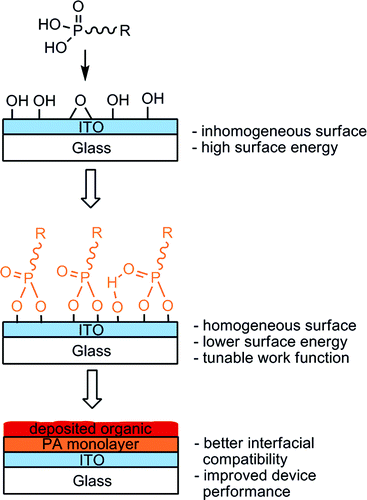 ACR 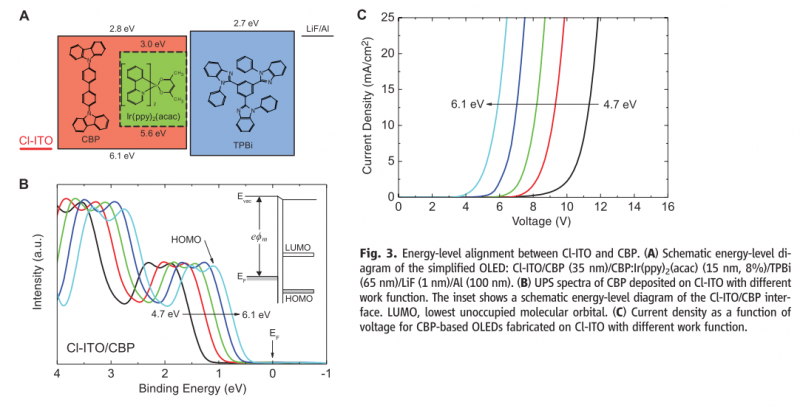 Science [ Last edited by Fateam on 2012-5-8 at 10:41 ] |
 回复此楼
回复此楼» 本帖附件资源列表
-
欢迎监督和反馈:小木虫仅提供交流平台,不对该内容负责。
本内容由用户自主发布,如果其内容涉及到知识产权问题,其责任在于用户本人,如对版权有异议,请联系邮箱:xiaomuchong@tal.com - 附件 1 : ar200119g.pdf
- 附件 2 : Science-2011-Helander-944-7.pdf
2012-05-08 10:29:34, 998.57 K
2012-05-08 10:29:35, 551.8 K
» 收录本帖的淘帖专辑推荐
 先进材料 先进材料 | 有机光伏材料与器件 | 有机光电文献资料 | 有机场效应晶体管及有机太阳能电池 |
| 精华 | 科研实用工具 | 伊丽莎白的好帖子 | Optical |
» 猜你喜欢
 博士读完未来一定会好吗
已经有24人回复
博士读完未来一定会好吗
已经有24人回复
-
导师想让我从独立一作变成了共一第一
已经有9人回复
-
到新单位后,换了新的研究方向,没有团队,持续积累2区以上论文,能申请到面上吗
已经有11人回复
-
读博
已经有4人回复
-
JMPT 期刊投稿流程
已经有4人回复
-
心脉受损
已经有5人回复
-
Springer期刊投稿求助
已经有4人回复
-
小论文投稿
已经有3人回复
-
申请2026年博士
已经有6人回复

» 本主题相关价值贴推荐,对您同样有帮助:
 经济学原理图解———简单易懂!!!【转载】
已经有161人回复
经济学原理图解———简单易懂!!!【转载】
已经有161人回复- 水处理高手进(第七篇)——关于生物除磷
已经有32人回复
- 水处理中英对照论文急求
已经有5人回复
- 酸奶为什么这么粘——随便说说“老酸奶”
已经有13人回复
- 【求助】ITO怎样进行酸处理?
已经有3人回复
- 【求助/交流】有关核酸电泳条件!
已经有4人回复