












| 查看: 5968 | 回复: 15 | |||
| 本帖产生 2 个 模拟EPI ,点击这里进行查看 | |||
| 当前只显示满足指定条件的回帖,点击这里查看本话题的所有回帖 | |||
qphll金虫 (正式写手)
|
[交流]
【分享】尝试lammps中, 分享中... 已有9人参与
|
||

|
Lesson 1 Loop inside Lammps input script 想要尝试在lammps的input script里面做循环, 结果因为一个小问题, 捣鼓了我几个小时, 这才完全通过测试. 分享一下. (1) input script里面的循环块 include tempfile include tempfile2 variable i loop 10 label loopa fix 2 all nvt temp ${mytemp} ${mytemp2} 100.0 run 200 unfix 2 next mytemp next mytemp2 next i jump SELF loopa 这个的SELF是让程序执行到这里, 跳回自己, 然后从标签 loopa开始执行. 当然loopa是随便取的, 你可以用CHN来做label. 另外, 在某些情况下, 如果要让c++ rewind, 那么最好在执行脚本里面这样写: lmp -in script 而不是 lmp < script 否则, 你人品不好的时候, 会出问题, 哈哈. (2) tempfile 和 tempfile2是在同目录下的另外两个文件. tempfile的文件内容是: variable mytemp index 500.0 700.0 900.0 1100.0 1300.0 1500.0 1700.0 1900.0 2100.0 2300.0 注意, 只有一行! 至于lammps能读多长的一行, 我还没有测试. tempfile2的文件内容, 也是一行: variable mytemp2 index 700.0 900.0 1100.0 1300.0 1500.0 1700.0 1900.0 2100.0 2300.0 2500.0 折腾我的问题是, 我原先在这两个tempfile文件中, 数值之间用逗号分隔, 但是事实上, 是需要用空格分隔的. (3) 如果你需要做的循环不是很多, 那么不需要额外准备tempfile 和 tempfile2文件. 而只是需要在 input script中这样做: variable mytemp index 500.0 700.0 900.0 1100.0 1300.0 1500.0 1700.0 1900.0 2100.0 2300.0 #variable mytemp2 index 700.0 900.0 1100.0 1300.0 1500.0 1700.0 1900.0 2100.0 2300.0 2500.0 variable i loop 10 label loopa fix 2 all nvt temp ${mytemp} ${mytemp2} 100.0 run 200 unfix 2 next mytemp next mytemp2 next i jump SELF loopa 当然, 这里不需要原先的这两句 include语句了. 总结一下你需要熟悉的命令: variable, include, jume, next End of Lesson 1. ENJOY. [ Last edited by qphll on 2010-12-3 at 11:54 ] |
 回复此楼
回复此楼» 本帖已获得的红花(最新10朵)
 fly771125
» 猜你喜欢
 退学或坚持读
已经有18人回复
退学或坚持读
已经有18人回复
-
免疫学博士有名额,速联系
已经有13人回复
-
面上基金申报没有其他的参与者成吗
已经有4人回复
-
国家基金申请书模板内插入图片不可调整大小?
已经有8人回复
-
多组分精馏求助
已经有6人回复
-
国家级人才课题组招收2026年入学博士
已经有6人回复

1040720479
新虫 (小有名气)
- 应助: 0 (幼儿园)
- 金币: 222.3
- 散金: 10
- 帖子: 107
- 在线: 24.3小时
- 虫号: 14502896
- 注册: 2019-03-06
- 专业: 防灾工程

16楼2020-12-03 19:59:49
qphll
金虫 (正式写手)
- 模拟EPI: 10
- 应助: 18 (小学生)
- 金币: 2708.7
- 散金: 2294
- 红花: 8
- 帖子: 554
- 在线: 227.1小时
- 虫号: 89654
- 注册: 2005-08-29
- 性别: GG
- 专业: 碳素材料与超硬材料
★ ★ ★ ★ ★ ★ ★ ★ ★ ★ ★ ★ ★ ★ ★ ★ ★ ★ ★ ★
ghcacj(金币+20):谢谢 2010-12-04 17:09:24
ghcacj(金币+20):谢谢 2010-12-04 17:09:24
|
Lesson 2 Reax FF 就不自己翻译成中文了吧, 反正大家都能看明白的. 拼写错误啦, 语法错误啥的, 大家多包涵就是了. 如果核心内容上, 对于原理的理解上有任何错误的, 请指出. Two tests have been carried out for NH3_Graphene_COOH_OH systems. The same initial.dat and ffielf.reax files are used. Timestep is 0.25 fs and initial velocities are generated according to Maxwell-Boltzmann distribution. The only difference is the heating up procedure. Test 1: (a) Minimize the initial structure; (b) Run 200000 steps (50 ps) to equilibrate the system, NVT ensemble with the damping parameter at 10.0; (c) Heat up the system linearly from 500K to 2500K at the rate of 0.005 K/step, NVT ensemble with the damping rate of 10.0. Test 2 (a) Minimize the initial structure; (b) Run 200000 steps (50 ps) to equilibrate the system, NVT ensemble with the damping parameter at 1.0; (c) Divide the temperature range of (500, 2500) into 5 blocks, and heat up the system linearly in each block and continuously between blocks. The rate is still 0.005 K/step, NVT ensemble with the damping rate of 1.0. Here are the results and figures. Figure 1 Temperature vs. simulation time, part(b), NVT ensemble. The temperature damping parameter is 1.0 for test 1 and 10.0 for test 2. Generally, temperature can fluctuate wildly if the damping parameter is too small, while on the other hand, too large damping parameter will take a very long time to equilibrate the whole system. I may do more tests to get the optimized value for this temperature damping parameter. Figure 1 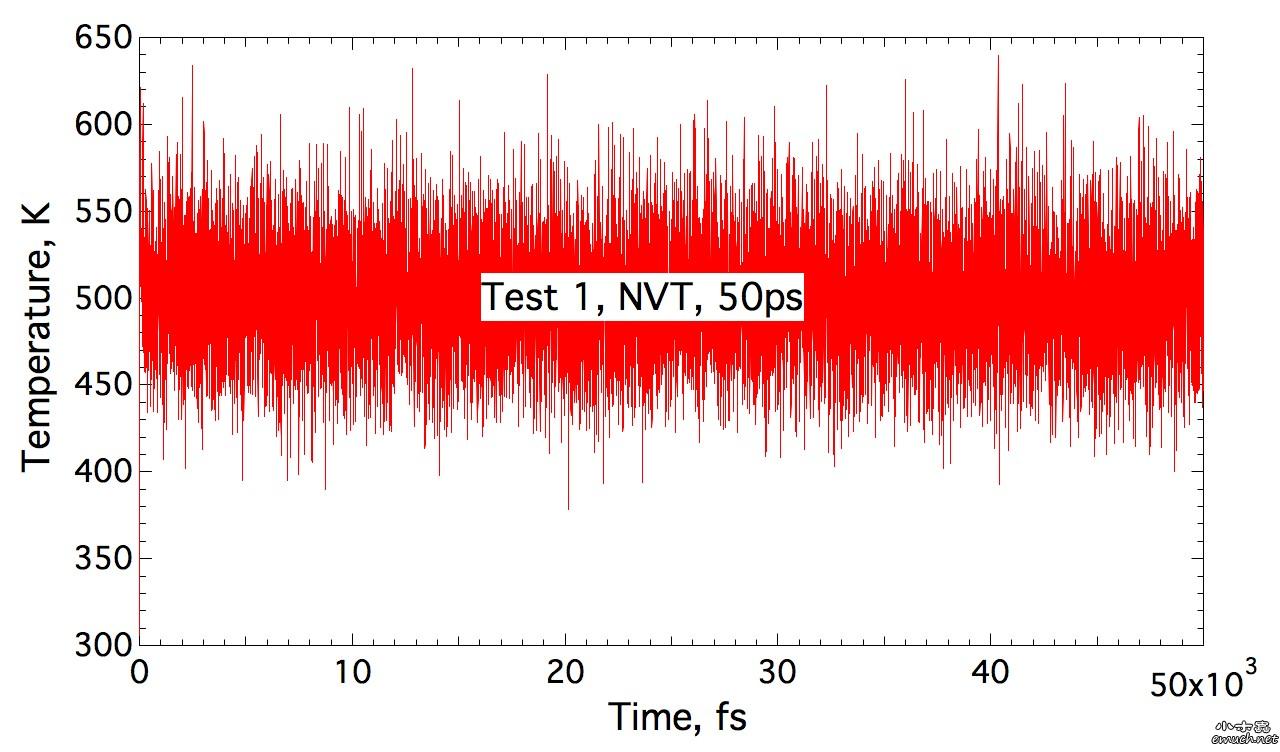 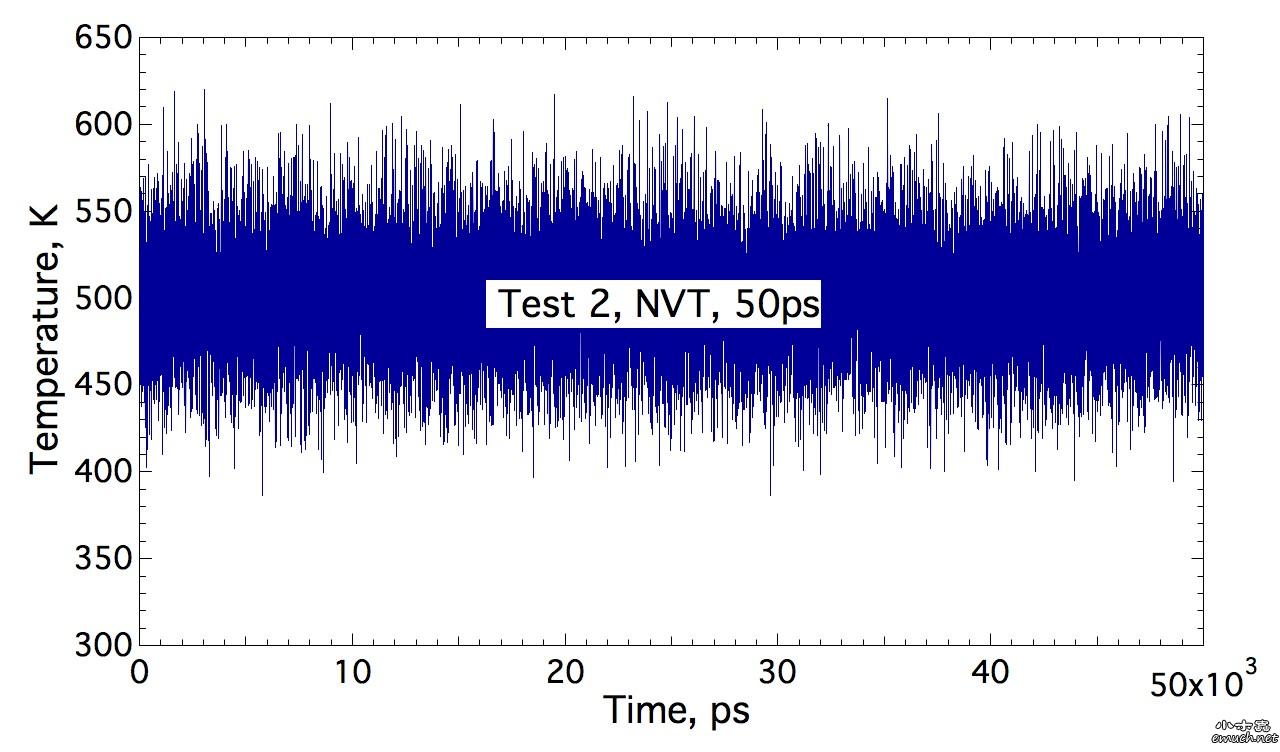 Figure 1. Temperature vs. simulation time, the NVT ensemble at step (b). 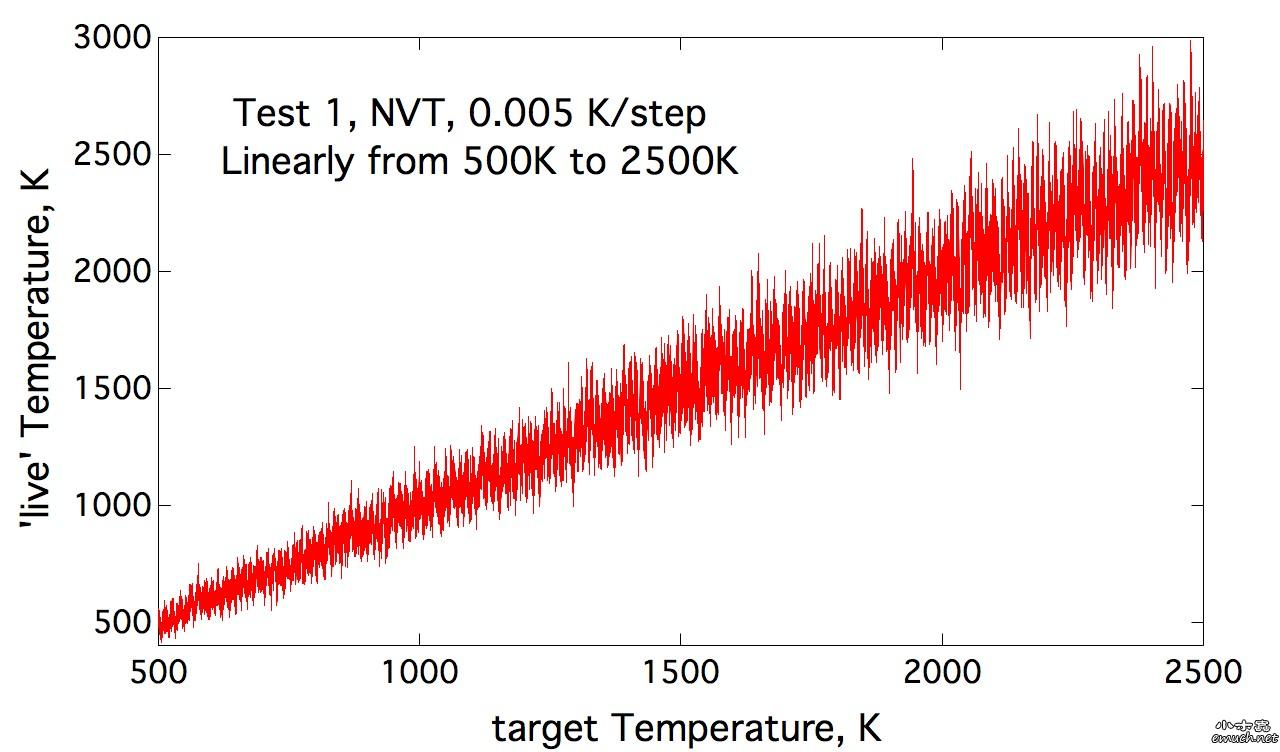 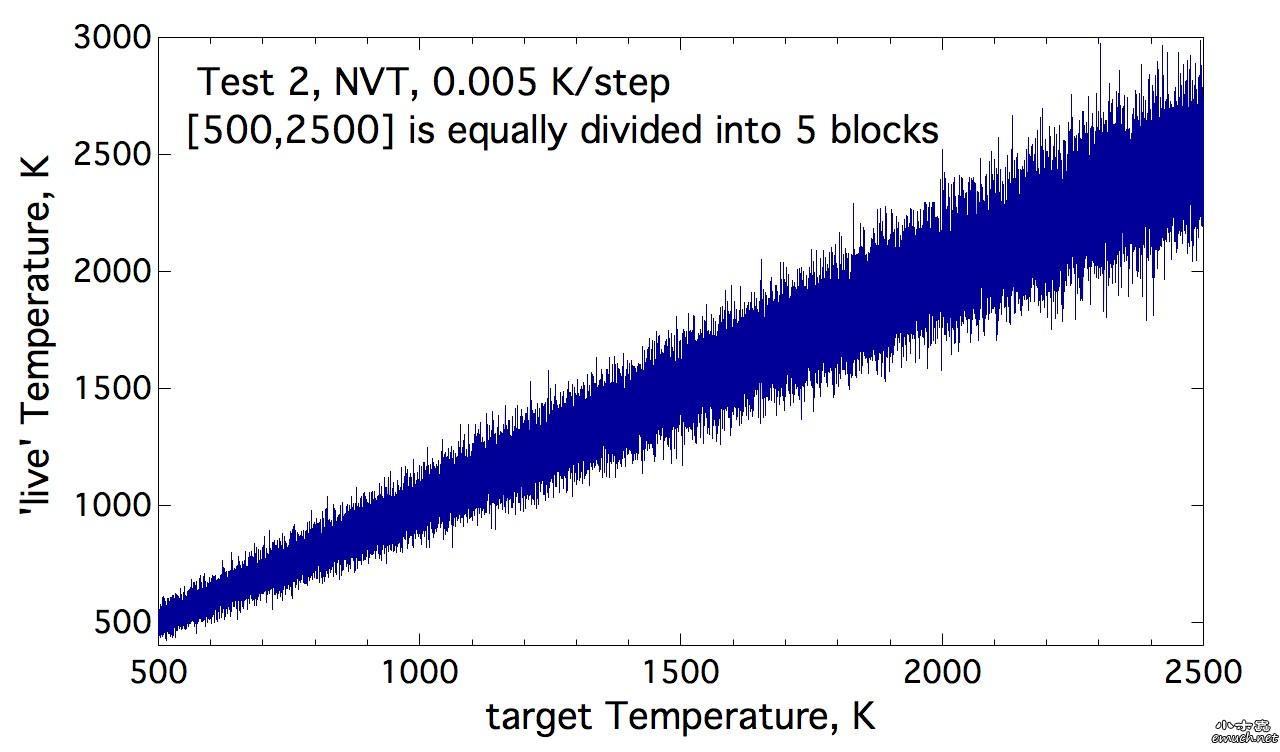 Figure 2. ‘live’ Temperature vs. target Temperature, part (c), NVT ensemble.  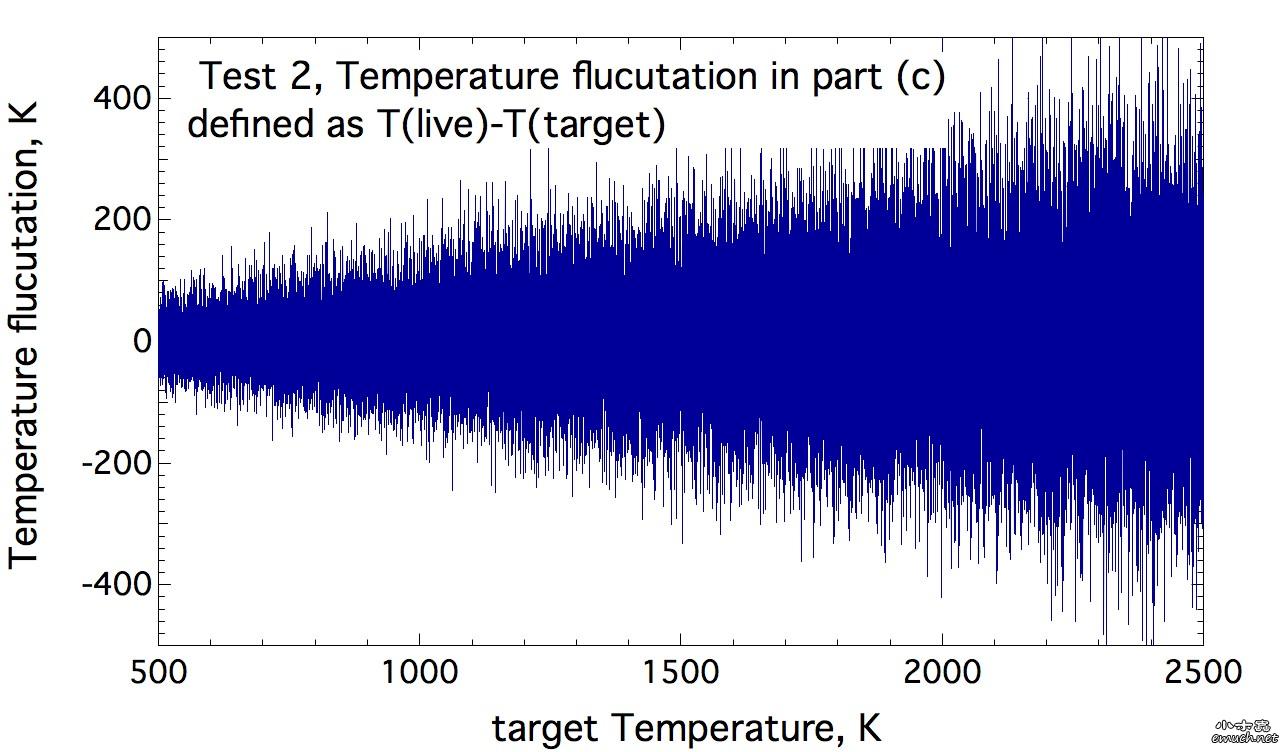 Figure 3. Temperature fluctuation vs. target Temperature. The reason for the blocks in test 2 is that, I was planning to do some NVE between each NVT iteration, hoping that could bring forth the better control over the system temperature. So in the Lammps input script, part (c) is being taken care of by the following commands: Test 1: fix 2 all nvt temp 500.0 2500.0 10.0 run 400000 Test 2: variable mytemp index 500.0, 900.0, 1300.0, 1700.0, 2100.0 variable mytemp2 index 900.0, 1300.0, 1700.0, 2100.0, 2500.0 label loopa variable i loop 5 fix 2 all nvt temp ${mytemp} ${mytemp2} 1.0 run 80000 unfix 2 next mytemp next mytemp2 next i jump in.reaxff loopa There are two other issues here. One is that I realize the temperature of first step of part (c) is not exactly 500.0K. This is because the NVT of part (b) cannot bring in 500.0K as the temperature of its final output. Does it mean that part (b) is actually not necessary? The other is that I am not sure I completely understand the philosophy of temperature programmed reaction method. Here are my thoughts of the whole process: Minimization is necessary to make sure you don't have any overlaps. Then when you add temperature (give your atoms velocities) your system won't blow up. Once the temperature (atomic velocity) has been assigned, you first should use a thermostat to equilibrate the system. This can be a Berendsen or a Langevin, depending on what you want to do, as these have a random term in them and this helps to equilibrate faster. But if you want to measure dynamics at a constant temperature, you should use NVE. However, you want to alter the temperature and measure (or follow) the dynamics, so in this I would use a Nose-Hoover thermostat (fix temp/nvt). That is why I break the whole process into three parts as I describe previously: (1) Use minimization to minimize the structure (from my test run, it seemed that the initial structure is already pretty close to a local minimum, as the search stopped after 169 steps or so); (2) Use a thermostat (Berendsen or Langevin) to equilibrate the temperature. You could also use a Nose-Hoover here as well and I think it would be ok. The Berendsen or Langevin thermostat would likely get you there faster. (3) Use a thermostat to ramp up the temperature from 500 K to 2500 K. Here I would use a Nose-Hoover thermostat since I have a pretty small system. So if I use a Berendsen or a Langevin thermostat, I would have to use a large damping parameter here and the results likely would not be realistic. If I use a small damping parameter, the results would be better for the dynamics but the temperature control would not be very good. So a Nose-Hoover with a reasonable damping parameter is probably the best. That is what I use in part (c): fix 2 all nvt temp 500.0 2500.0 10.0 Of course I then need to find that reasonable damping parameter. If we could manually do several iterations at the very beginning of part (C), let’s see what happens there: (a) Image 1, t=0, T(target)=500K, we assign the atomic velocities at 500K. With atomic positions and force field, we know the forces on each atom and thus the acceleration. Do one iteration by Verlet algorithm to go to step 2. (b) Image 2, t= 0.25fs, T(target)=500.005K, from (a) we get the velocities at this step 2, new coordinates, new forces and new accelerations. The real temperature can be calculated at this step and rescaling (of atomic velocities) is applied by Nose-Hoover algorithm to bring the real temperature to the target temperature 500.005K. Use the rescaled velocities to go a step further to image 3. (c) Keep doing this time integration and controlling over temperature to do the temperature ramp up steadily along the way. By increasing temperature slowly and steadily, each atom possess more total energy (potential and kinetic), and make it possible to overcome the energy barriers such as bonds, angles, and even Pi-Pi interaction, and thus old-bond breaking and new-bond forming is more and more possible along the way. Also, from this point of view, there is no advantage of dividing the temperature range into several block. THE MOST SERIOUS PROBLEM is: From Figure 3, we can see large fluctuation at high temperature. Is that acceptable? If not, how can we bring down the fluctuation? |
2楼2010-12-04 15:07:09
sg18408926
至尊木虫 (著名写手)
- 应助: 0 (幼儿园)
- 金币: 10945.9
- 散金: 246
- 红花: 1
- 帖子: 1075
- 在线: 431.4小时
- 虫号: 727956
- 注册: 2009-03-21
- 性别: GG
- 专业: 凝聚态物性 II :电子结构
3楼2010-12-04 17:27:08
qphll
金虫 (正式写手)
- 模拟EPI: 10
- 应助: 18 (小学生)
- 金币: 2708.7
- 散金: 2294
- 红花: 8
- 帖子: 554
- 在线: 227.1小时
- 虫号: 89654
- 注册: 2005-08-29
- 性别: GG
- 专业: 碳素材料与超硬材料
★ ★ ★ ★ ★ ★ ★ ★ ★ ★ ★ ★ ★ ★ ★ ★ ★ ★ ★ ★
ghcacj(金币+20):谢谢 2010-12-10 10:40:58
ghcacj(金币+20):谢谢 2010-12-10 10:40:58
|
I am sharing some other test output with you. reax FF, Lammps, Temperature Programmed Reax MD (1) The NVT damping parameter of Lammps The tests were carried out for 10 different values of that damping coefficients. I find that changing that parameter could not bring forth better control of temperature during the whole damping process. The flucutation is reduced a little bit at some value. But generally I would say there is no pointing of doing this type of parameter optimizaiton. (2) Heating rate With a same timestep of 0.25 fs, I tried the different heating rate from 500K to 2500K, namely, 0.01 K/step, 0.05K/step and 1 K/step. From the attached temperature flucutation plots, I observed (a) changing the rate from 0.005 K/step to 0.01 K/step or 0.05 K/step does not change much of the temperature flucutation. Does is mean that we could heat up the system faster? Or we do have very good reason in using the heating rate of 0.005 K/step? (b) at lower rate (0.005 K/step, 0.01 K/step and 0.05 K/step), it is not easy to control the temperature flucutation. But at 1 K/step, compared with the other three rates, the fluctuation looks smooth for [900K, 1800K]. It may comes from fewer statistic points, but is it worthy of trying different heating rates for low temperature, median temperature and high temperature? 0.01 K/step  0.05 K/step 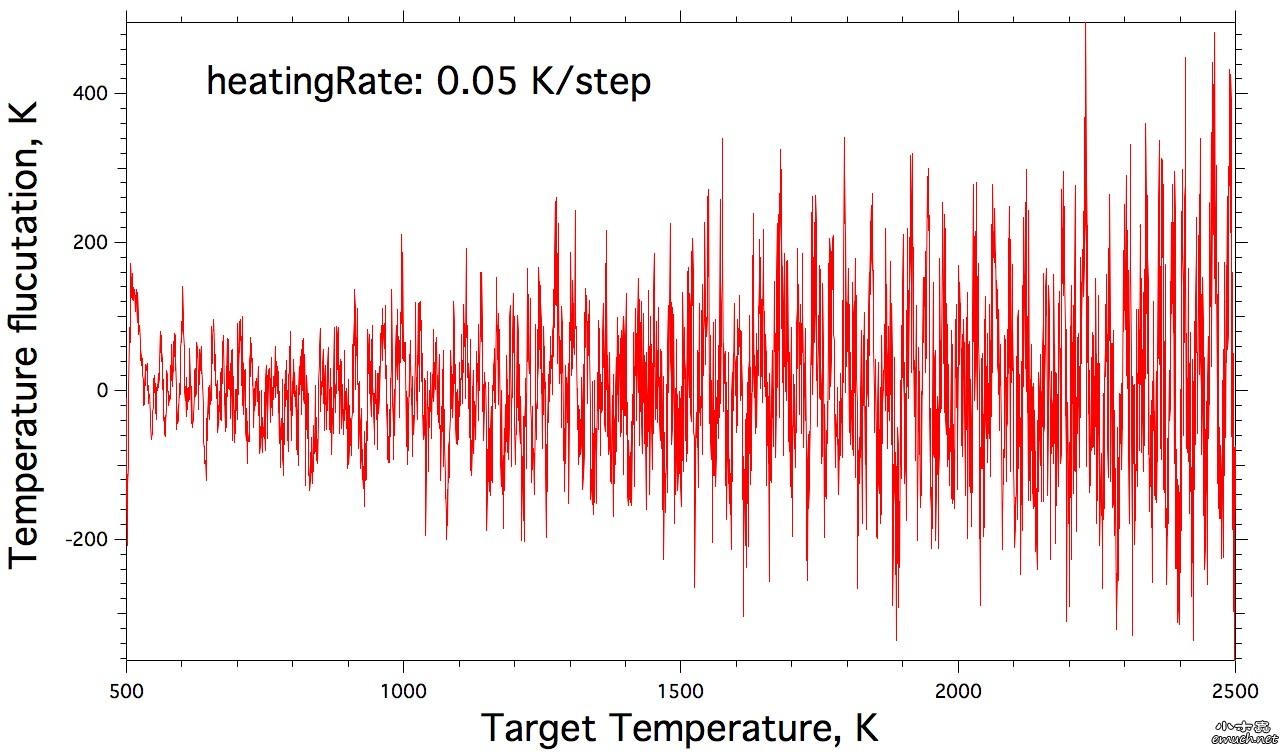 1 K/step  I do not think those tests are going to change anything about the TPRD procedures. They are just my thoughts when I am collecting the outputs. |
4楼2010-12-07 23:19:38