









| 查看: 476 | 回复: 0 | |||
[交流]
复合材料层合板损伤预测-文献分享
|


|
Bruyneel M, Naito T, Urushiyama Y, et al. Predictive simulations of damage propagation in laminated composite materials and structures with SAMCEF[J]. Sae Technical Papers, 2015, 2015. Composite materials have been used successfully in the aerospace industry for many years due to their light weight and high mechanical performances. At the opposite, the amount of carbon fiber reinforced plastics (CFRP) used in the automotive industry is still limited to very specific applications and still not really appears as a reliable solution as far as structural heavily loaded components are concerned. However, vehicle manufacturers and tier suppliers are facing the challenge of consistently maintaining high quality endproduct with safety constraints while designing lightweight structures with fuel economy concerns. Carbon fiber-reinforced plastics, because of their high strength to density ratio, represent a serious alternative to classical metallic approach but generate the need to completely redefine the design and sizing methodology of the structural parts. Indeed, composites exhibit complex material behaviors, especially when the assumption of linearity cannot be done anymore. Moreover, composite materials and structures have complex failure modes, which must be well controlled in the sizing process. In this context, predictive simulation tools can be a helpful companion to the physical tests. In order to propose predictive simulation tools, it is important to use material models able to represent the different modes of degradation of the plies forming the laminated composite structure. Although delamination is a very important mode of failure, intra-laminar failure modes can’t be ignored. Inter- and intra-laminar damage modes are studied in this paper, and progressive damages impacting delamination, matrix cracking, fibers breaking, and de-cohesion between fibers and matrix are considered. 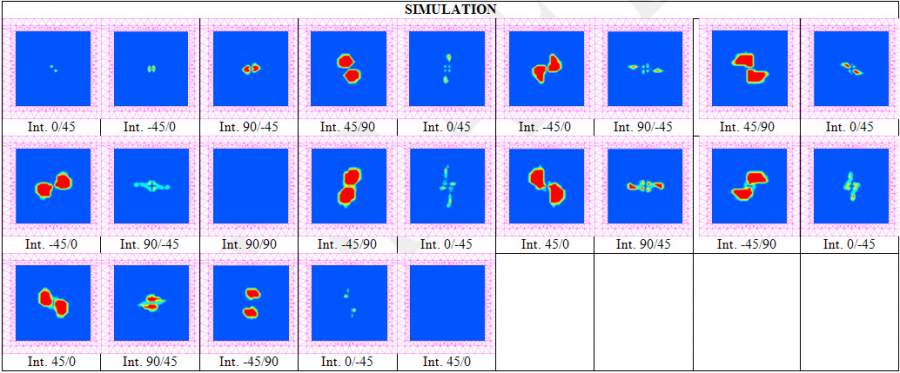 3.jpg |
 回复此楼
回复此楼» 猜你喜欢
 土木考研调剂-08开头和计算机专业+V:18173116706
已经有0人回复
土木考研调剂-08开头和计算机专业+V:18173116706
已经有0人回复
-
【广州】仲恺农业工程学院城乡建设学院土木水利专业硕士招大量调剂,线上复试
已经有0人回复
-
建筑环境与结构工程论文润色/翻译怎么收费?
已经有148人回复
-
【广州】仲恺农业工程学院城乡建设学院土木水利专业硕士招大量调剂,线上复试
已经有0人回复
-
广西大学土木博士招生
已经有5人回复
-
E口2026重点国际合作项目
已经有2人回复
-
2027 博士自荐
已经有2人回复
-
学术人生就像一场马拉松,不松懈、不放弃!祝愿所有为学术梦想而打拼的人都能如愿!
已经有441人回复
-
哈尔滨工业大学博士申请考核制9月29日截止
已经有14人回复
-
哈尔滨工业大学博士申请考核制延长至10月7日截止
已经有0人回复
» 本主题相关商家推荐: (我也要在这里推广)
