









| 查看: 1200 | 回复: 3 | ||
[求助]
有没有关于乙二醇与乙酸酯化反应相关的文章,我不会检索啊,求助
|

|
有没有关于乙二醇与乙酸酯化反应相关的文章,我不会检索啊,求助 @阿努 发自小木虫IOS客户端 |
 回复此楼
回复此楼» 猜你喜欢
 现代”学阀”该如何界定
已经有14人回复
现代”学阀”该如何界定
已经有14人回复
-
求合成方法
已经有8人回复
-
师弟论文见刊大半年才想起来申请专利,还能抢救一下吗?
已经有4人回复
-
上海工程技术大学 激光智能制造课题组 2027级博士研究生招生
已经有5人回复
-
课题组招2027级博士 上海工程技术大学 激光智能制造方向
已经有5人回复
-
有机合成以后会不会被AI改变?做科研的虫友怎么看
已经有8人回复
-
我的奶奶
已经有3人回复
一直向前走走
主管区长 (文坛精英)

- LS-EPI: 162
- 应助: 295 (大学生)
- 贵宾: 16.855
- 金币: 112712
- 散金: 30911
- 红花: 604
- 沙发: 1478
- 帖子: 24148
- 在线: 3981.5小时
- 虫号: 3833907
- 注册: 2015-04-26
- 专业: 图书馆、情报与文献学其他
- 管辖: 文献求助区


2楼2017-03-08 22:43:37
一直向前走走
主管区长 (文坛精英)
- LS-EPI: 162
- 应助: 295 (大学生)
- 贵宾: 16.855
- 金币: 112712
- 散金: 30911
- 红花: 604
- 沙发: 1478
- 帖子: 24148
- 在线: 3981.5小时
- 虫号: 3833907
- 注册: 2015-04-26
- 专业: 图书馆、情报与文献学其他
- 管辖: 文献求助区
3楼2017-03-08 22:46:07
一直向前走走
主管区长 (文坛精英)
- LS-EPI: 162
- 应助: 295 (大学生)
- 贵宾: 16.855
- 金币: 112712
- 散金: 30911
- 红花: 604
- 沙发: 1478
- 帖子: 24148
- 在线: 3981.5小时
- 虫号: 3833907
- 注册: 2015-04-26
- 专业: 图书馆、情报与文献学其他
- 管辖: 文献求助区
【答案】应助回帖
★ ★ ★ ★ ★
绝望晨曦(lazy锦溪代发): 金币+5 2017-03-18 22:30:50
绝望晨曦(lazy锦溪代发): 金币+5 2017-03-18 22:30:50
|
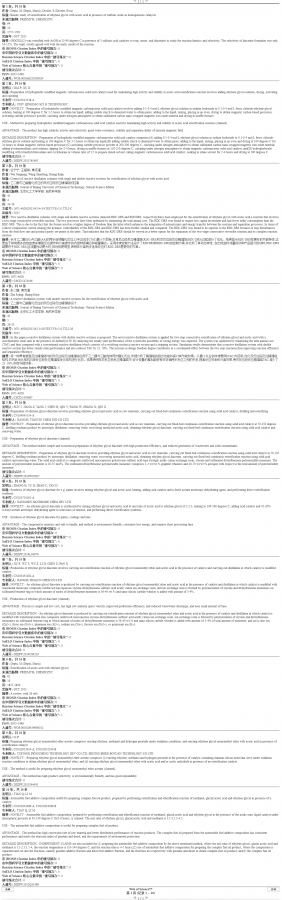
第 1 条,共 10 条 作者: Depta, M (Depta, Marta); Dresler, E (Dresler, Ewa) 标题: Kinetic study of esterification of ethylene glycol with acetic acid in presence of sulfonic acids as homogeneous catalysts 来源出版物: PRZEMYSL CHEMICZNY 卷: 94 期: 10 页: 1757-1761 出版年: OCT 2015 摘要: (HOCH2)(2) was esterified with AcOH at 25-90 degrees C in presence of 3 sulfonic acid catalysts to resp. mono- and diacetates to study the reaction kinetics and selectivity. The selectivity of diacetate formation was only 10-15%. The exptl. results agreed well with the math. model of the reaction. 在 BIOSIS Citation Index 中的被引频次: 0 在中国科学引文数据库中的被引频次: 0 Russian Science Citation Index 中的 "被引频次": 0 SciELO Citation Index 中的 "被引频次": 0 Web of Science 核心合集中的 "被引频次": 0 被引频次合计: 0 ISSN: 0033-2496 入藏号: WOS:000366232000024 第 2 条,共 10 条 发明人: DAI P; XU D 标题: Preparation of hydrophobic modified magnetic carbonaceous solid acid catalyst used for maintaining high activity and stability in acetic acid esterification reaction involves adding ethylene glycol solution, drying, activating and calcining 专利号: CN105013538-A 专利权人: UNIV QINGDAO SCI & TECHNOLOGY 摘要: NOVELTY - Preparation of hydrophobic modified magnetic carbonaceous solid acid catalyst involves adding 0.1-0.4 mol/L ethylene glycol solution in sodium hydroxide to 0.1-0.4 mol/L ferric chloride-ethylene glycol solution, heating at 100 degrees C for 3-5 hours to obtain tan liquid, adding soluble starch to deionized water to obtain paste, adding to the liquid, mixing, placing in an oven, drying to obtain magnetic carbon-based precursor, activating carbide precursor powder, calcining under nitrogen atmosphere to obtain sulfonated carbon nano-wrapped magnetic iron oxide material and drying in muffle furnace. USE - Method for preparing hydrophobic modified magnetic carbonaceous solid acid catalyst used for maintaining high activity and stability in acetic acid esterification reaction (claimed). ADVANTAGE - The product has high catalytic activity and selectivity, good water resistance, stability and separation ability of external magnetic field. DETAILED DESCRIPTION - Preparation of hydrophobic modified magnetic carbonaceous solid acid catalyst comprises  A) adding 0.1-0.4 mol/L ethylene glycol solution in sodium hydroxide to 0.1-0.4 mol/L ferric chloride-ethylene glycol solution and heating at 100 degrees C for 3-5 hours to obtain tan liquid;(B) adding soluble starch to deionized water to obtain paste, adding to the liquid, mixing, placing in an oven and drying at 100 degrees C for 24 hours to obtain magnetic carbon-based precursor;(C) activating carbide precursor powder at 200-300 degrees C, calcining under nitrogen atmosphere to obtain sulfonated carbon nano-wrapped magnetic iron oxide material, adding p-toluenesulfonic acid solution, dipping for 2-4 hours, drying in muffle furnace at 150-250 degrees C, calcining under nitrogen atmosphere to obtain magnetic carbonaceous solid acid catalyst; and(D) hydrophobically modifying with trimethylchlorosilane and cyclohexane at volume ratio of 1:5 to prepare mixed solvent, taking magnetic carbonaceous solid acid catalyst, soaking in silane solvent for 2-4 hours and drying at 100 degrees C. A) adding 0.1-0.4 mol/L ethylene glycol solution in sodium hydroxide to 0.1-0.4 mol/L ferric chloride-ethylene glycol solution and heating at 100 degrees C for 3-5 hours to obtain tan liquid;(B) adding soluble starch to deionized water to obtain paste, adding to the liquid, mixing, placing in an oven and drying at 100 degrees C for 24 hours to obtain magnetic carbon-based precursor;(C) activating carbide precursor powder at 200-300 degrees C, calcining under nitrogen atmosphere to obtain sulfonated carbon nano-wrapped magnetic iron oxide material, adding p-toluenesulfonic acid solution, dipping for 2-4 hours, drying in muffle furnace at 150-250 degrees C, calcining under nitrogen atmosphere to obtain magnetic carbonaceous solid acid catalyst; and(D) hydrophobically modifying with trimethylchlorosilane and cyclohexane at volume ratio of 1:5 to prepare mixed solvent, taking magnetic carbonaceous solid acid catalyst, soaking in silane solvent for 2-4 hours and drying at 100 degrees C.被引频次合计: 0 入藏号: DIIDW:201576549J 第 3 条,共 10 条 作者: 位宁宁; 王韶锋; 黄克谨 作者: Wei Ningning; Wang Shaofeng; Huang Kejin 标题: Control of reactive distillation columns with single and double reactive sections for esterification of ethylene glycol with acetic acid 标题: 乙二醇与乙酸酯化反应的双反应段反应精馏塔的控制 来源出版物: Journal of Beijing University of Chemical Technology. Natural Science Edition 来源出版物: 北京化工大学学报. 自然科学版 卷: 42 期: 4 页: 34-39 文献号: 1671-4628(2015)42:4<34:YECYYS>2.0.TX;2-C 出版年: 2015 摘要: Two reactive distillation columns with single and double reactive sections (denoted RDC-SRS and RDCDRS, respectively)have been employed for the esterification of ethylene glycol with acetic acid,a reaction that involves a two-stage consecutive reversible reaction. The two processes have been optimized by minimizing the total annual cost. The RDC-DRS was found to require less capital investment and had lower utility consumption than the RDC-SRS. This is due to the fact that the former involves a higher degree of freedom than the latter,which enhances the integration of internal mass and energy transfer between the reaction and separation processes. In terms of a direct composition control strategy,the dynamic controllability of the RDC-SRS and RDC-DRS has been further studied and compared. The RDC-DRS was found to be superior to the RDC-SRS because of step disturbances from the feed flow rate and product purity set-points in the latter. That indicates that the RDC-DRS should be viewed as a better option for the separation of the two-stage consecutive reversible reaction and its complex reaction mixture. 摘要: 针对乙二醇(EG)与乙酸(AA)的两步连续酯化反应,以年总成本(TAC)最小为目标,对单反应段反应精馏塔(RDC-SRS)和双反应段反应精馏塔(RDC-DRS)过程进行了优化。结果显示RDC-DRS有更好的节能特性,这是由于其有更多的自由度来增强反应操作和分离操作的内部物质耦合和能量耦合。采用浓度控制方法设计了RDCSRS和RDC-DRS的控制方案,并比较了其动态特性; 在出现进料流量扰动和产品组分扰动时,RDC-DRS都要好于RDC-SRS,且流量扰动更大时,其优势更明显,表明在分离两步连续反应时,RDC-DRS是更好的方案。 在 BIOSIS Citation Index 中的被引频次: 0 在中国科学引文数据库中的被引频次: 0 Russian Science Citation Index 中的 "被引频次": 0 SciELO Citation Index 中的 "被引频次": 0 Web of Science 核心合集中的 "被引频次": 0 被引频次合计: 0 ISSN: 1671-4628 入藏号: CSCD:5474166 第 4 条,共 10 条 作者: 朱二静; 黄克谨 作者: Zhu Erjing; Huang Kejin 标题: A reactive distillation system with double reactive sections for the esterification of ethylene glycol with acetic acid 标题: 乙二醇与乙酸酯化反应的双反应段反应精馏塔设计 来源出版物: Journal of Beijing University of Chemical Technology. Natural Science Edition 来源出版物: 北京化工大学学报. 自然科学版 卷: 42 期: 1 页: 26-33 文献号: 1671-4628(2015)42:1<26:YECYYS>2.0.TX;2-M 出版年: 2015 摘要: In this paper,a reactive distillation system with double reactive sections is proposed. The novel reactive distillation system is applied for two-step consecutive esterification of ethylene glycol and acetic acid with a stoichiometric mole ratio in the presence of Amberlyst 36. By analyzing the steady state performance of the system,the possibility of saving energy was explored. The system was optimized by minimizing the total annual cost (TAC) and then compared with a conventional reactive distillation,which consists of a rectifying section,a reactive section and a stripping section. Simulation results demonstrate that a reactive distillation system with double reactive section has better steady-state performance and also reduces TAC by 23. 58%. The increase in design freedom degree contributes to a coordinated effect between the two step reactions,thus improving reaction efficiency and separation efficiency. 摘要: 将一种具有新型反应精馏结构的双反应段反应精馏塔应用于乙二醇与乙酸连续两步酯化反应,详细分析了精馏塔的稳态性能并探讨其节能效果。以最小化总的年度费用(TAC)为目标,优化双反应段反应精馏塔结构,并将此优化结构与单反应段反应精馏塔优化结构进行比较。结果表明在双反应段反应精馏塔中,设计变量的增加能够有效协调两步反应之间的关系,提高反应效率和分离效果,使双反应段反应精馏塔TAC 减少了23. 58%,实现节能效果。 在 BIOSIS Citation Index 中的被引频次: 0 在中国科学引文数据库中的被引频次: 0 Russian Science Citation Index 中的 "被引频次": 0 SciELO Citation Index 中的 "被引频次": 0 Web of Science 核心合集中的 "被引频次": 0 被引频次合计: 0 ISSN: 1671-4628 入藏号: CSCD:5339687 第 5 条,共 10 条 发明人: SUN J; JIANG Z; YANG J; CHEN R; QIN Y; WANG W; ZHANG X; QIN X 标题: Preparation of ethylene glycol diacetate involves providing ethylene glycol and acetic acid as raw materials, carrying out fixed-bed continuous esterification reaction using solid acid catalyst, distilling and esterifying 专利号: CN104045554-A 专利权人: JIANGSU TIANYIN CHEM IND CO LTD 摘要: NOVELTY - Preparation of ethylene glycol diacetate involves providing ethylene glycol and acetic acid as raw materials, carrying out fixed-bed continuous esterification reaction using solid acid catalyst at 70-150 degrees C, distilling resultant product by azeotropic distillation, removing water, recovering unreacted acetic acid, obtaining ethylene glycol diacetate, carrying out fixed-bed continuous esterification reaction using solid acid catalyst and removing water. USE - Preparation of ethylene glycol diacetate (claimed). ADVANTAGE - The method enables simple and economical preparation of ethylene glycol diacetate with high production efficiency, and reduced generation of wastewater and solid contaminants. DETAILED DESCRIPTION - Preparation of ethylene glycol diacetate involves providing ethylene glycol and acetic acid as raw materials, carrying out fixed-bed continuous esterification reaction using solid acid catalyst at 70-150 degrees C, distilling resultant product by azeotropic distillation, removing water, recovering unreacted acetic acid, obtaining ethylene glycol diacetate, carrying out fixed-bed continuous esterification reaction using solid acid catalyst and removing water. The solid acid catalyst is composite reinforced macroporous polystyrene sulfonic acid-type strongly acidic cation-exchange resin, styrene and sulfonated divinylbenzene polymerizable monomer. The amount of polymerizable monomer is 20-35 mol%. The sulfonated divinylbenzene polymerizable monomer comprises 1-3 wt/wt.% graphite whiskers and 40-70 wt/wt.% porogen with respect to the total amount of polymerizable monomer. 被引频次合计: 0 入藏号: DIIDW:2014W05827 第 6 条,共 10 条 发明人: ZHANG H; YU D; ZHAO C; TAN D 标题: Synthesis of ethylene glycol diacetate for e.g. paints involves mixing ethylene glycol and acetic acid, heating, adding acid catalyst and n-butyl acetate azeotropic dehydrating agent, and performing direct esterification synthesis 专利号: CN103724195-A 专利权人: JIANGMEN HANDSOME CHEM DEV LTD 摘要: NOVELTY - An ethylene glycol diacetate is synthesized by mixing ethylene glycol and acetic acid at mol ratio of acetic acid to ethylene glycol of 2.2-3, heating to 100-160 degrees C, adding acid catalyst and 10-20% n-butyl acetate azeotropic dehydrating agent to total mass of mixture, and performing direct esterification synthesis. USE - Synthesis of ethylene glycol diacetate for paints, coatings and inks. ADVANTAGE - The compound is nontoxic and safe to handle, and method is environment-friendly, consumes less energy, and requires short processing time. 在 BIOSIS Citation Index 中的被引频次: 0 在中国科学引文数据库中的被引频次: 0 Russian Science Citation Index 中的 "被引频次": 0 SciELO Citation Index 中的 "被引频次": 0 Web of Science 核心合集中的 "被引频次": 0 被引频次合计: 0 入藏号: DIIDW:2014L04979 第 7 条,共 10 条 发明人: XU F; WU Y; WU Z; LI D; CHEN Z; PAN X 标题: Production of ethylene glycol diacetate involves carrying out esterification reaction of ethylene glycol monomethyl ether and acetic acid in the presence of catalyst and carrying out distillation in which catalyst is modified catalyst 专利号: CN103435481-A 专利权人: JIANGSU HUALUN CHEM CO LTD 摘要: NOVELTY - An ethylene glycol diacetate is produced by carrying out esterification reaction of ethylene glycol monomethyl ether and acetic acid in the presence of catalyst and distillation in which catalyst is modified with transitional metal ions composite reinforced macroporous styrene-divinylbenzene sulfonic acid acidic cation ion exchange resin, and ion exchange resin is formed by polymerization of styrene and divinylbenzene monomers on sulfonated benzene ring in which amount of moles of divinylbenzene monomer is 36-40 wt.% and nano-silicon carbide whisker is added with amount of 3-4%. USE - Production of ethylene glycol diacetate (claimed). ADVANTAGE - Process is simple and low cost, has high raw material space velocity, improved production efficiency, and reduced wastewater discharge, and uses small amount of base. DETAILED DESCRIPTION - An ethylene glycol diacetate is produced by carrying out esterification reaction of ethylene glycol monomethyl ether and acetic acid in the presence of catalyst and distillation in which catalyst is modified with transitional metal ions composite reinforced macroporous styrene-divinylbenzene sulfonic acid acidic cation ion exchange resin, ion exchange resin is formed by polymerization of styrene and divinylbenzene monomers on sulfonated benzene ring in which amount of moles of divinylbenzene monomer is 36-40 wt.% and nano-silicon carbide whisker is added with amount of 3-4% of total amount of monomer, and ion is zinc ion (Zn2+), ferric ion (Fe3+), aluminum ion (Al3+), sodium ion (Na+), ferrous ion (Fe2+), or potassium ion (K+). 在 BIOSIS Citation Index 中的被引频次: 0 在中国科学引文数据库中的被引频次: 0 Russian Science Citation Index 中的 "被引频次": 0 SciELO Citation Index 中的 "被引频次": 0 Web of Science 核心合集中的 "被引频次": 0 被引频次合计: 0 入藏号: DIIDW:2014C69219 第 8 条,共 10 条 作者: Depta, M (Depta, Marta) 标题: Esterification of acetic acid with ethylene glycol 来源出版物: PRZEMYSL CHEMICZNY 卷: 92 期: 10 页: 1827-1829 出版年: OCT 2013 摘要: A review, with 26 refs. 在 BIOSIS Citation Index 中的被引频次: 0 在中国科学引文数据库中的被引频次: 0 Russian Science Citation Index 中的 "被引频次": 0 SciELO Citation Index 中的 "被引频次": 0 Web of Science 核心合集中的 "被引频次": 1 被引频次合计: 1 ISSN: 0033-2496 入藏号: WOS:000328439900012 第 9 条,共 10 条 发明人: LI P 标题: Preparing ethylene glycol monomethyl ether acetate comprises reacting ethylene, methanol and hydrogen peroxide under oxidation conditions, and reacting ethylene glycol monomethyl ether with acetic acid in presence of esterification catalyst 专利号: CN102952014-A; CN102952014-B 专利权人: YUEYANG PENGCHENG TECHNOLOGY DEV CO LTD; BEIJING BEIKE BOYUAN TECHNOLOGY CO LTD 摘要: NOVELTY - Preparing ethylene glycol monomethyl ether acetate comprises (i) reacting ethylene, methanol and hydrogen peroxide in the presence of catalyst containing titanium-silicon molecular sieve under oxidation reaction conditions to obtain ethylene glycol monomethyl ether; and (ii) reacting ethylene glycol monomethyl ether with acetic acid and/or acetic anhydride in presence of an esterification catalyst. USE - The method is useful for preparing ethylene glycol monomethyl ether acetate (claimed). ADVANTAGE - The method has high product selectivity, is environmentally friendly, and has good repeatability. 被引频次合计: 0 入藏号: DIIDW:2013J44450 第 10 条,共 10 条 发明人: TIAN Q; LI M 标题: Automobile fuel additive composition useful for preparing complex fuel oil product, prepared by performing esterification and etherification reaction of methanol, glacial acetic acid and ethylene glycol in presence of a catalyst 专利号: CN102634389-A; CN102634389-B 专利权人: TIAN Q; LI M 摘要: NOVELTY - Automobile fuel additive composition, prepared by performing esterification and etherification reaction of methanol, glacial acetic acid and ethylene glycol in the presence of the acidic ionic liquid catalyst under atmospheric pressure at 65-140 degrees C for2-8 hours, is claimed. The mol ratio of ethylene glycol, glacial acetic acid and methanol is 1:1-3:1.5-4.5. USE - The automobile fuel additive composition is useful for preparing complex fuel oil product. ADVANTAGE - The method has high conversion rate of raw material and better distribution performance of reaction products. The complex fuel oil prepared from the automobile fuel additive composition has consistent performance and meets the emission index of gasoline and diesel, and the requirements of environment protection. DETAILED DESCRIPTION - INDEPENDENT CLAIMS are also included for 1) preparing the automobile fuel additive composition by the above mentioned method, where the mol ratio of ethylene glycol, glacial acetic acid and methanol is 1:1-2.5:1.5-4, the reaction temperature is 110-140 degrees C, and the reaction time is 4-7 hours;(2) use of automobile fuel additive composition for preparing the complex fuel oil product, where the composition is separated and cut into the fractions, namely gasoline additive fraction and diesel fuel additive fraction, and the fractions are respectively with gasoline and diesel to obtain complex fuel oil product; and(3) the complex fuel oil product.在 BIOSIS Citation Index 中的被引频次: 0 在中国科学引文数据库中的被引频次: 0 Russian Science Citation Index 中的 "被引频次": 0 SciELO Citation Index 中的 "被引频次": 0 Web of Science 核心合集中的 "被引频次": 0 被引频次合计: 0 入藏号: DIIDW:2012Q14189 |
4楼2017-03-08 22:47:08