









| 查看: 1658 | 回复: 4 | ||
| 【奖励】 本帖被评价3次,作者bio-polymer增加金币 3 个 | ||
| 当前主题已经存档。 | ||
| 当前只显示满足指定条件的回帖,点击这里查看本话题的所有回帖 | ||
[资源]
《Encyclopedia of Analytical Chemistry》
|
||

|
Encyclopedia of Analytical Chemistry: Applications, Theory, and Instrumentation By Robert A. Meyers 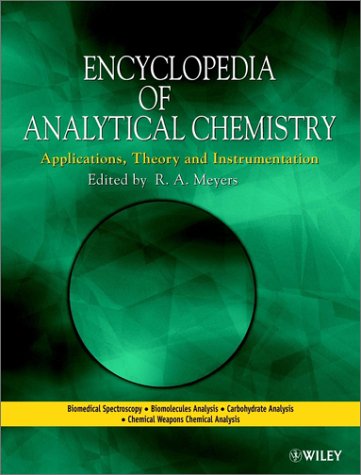 Publisher: Wiley Number Of Pages: 14344 Publication Date: 2001-01-09 ISBN-10 / ASIN: 0471976709 ISBN-13 / EAN: 9780471976707 Binding: Hardcover The highly acclaimed Encyclopedia of Analytical Chemistry provides a much needed professional level reference work for the 21st Century. Encyclopedia of Analytical Chemistry is the most comprehensive analytical chemistry reference available, covering all aspects from theory and instrumentation through applications and techniques. The chemistry and techniques are described as performed in the laboratory (environmental, clinical, QC, research, university), in the field or by remote sensing. The level of detail is similar to that of a lab protocol and together with the cited references, will support the analysis of complex inorganic, organic and biological structures by academic and industrial researchers. Encyclopedia of Analytical Chemistry also enables preparation of procedures, protocols and "cookbooks" by managers and staff of laboratories. Encyclopedia of Analytical Chemistry comprises over 600 articles, arranged alphabetically by topic, in approximately 14000 pages, in 15 volumes. Features: * Outstanding authorship and the highest calibre editors * Excellence of peer-review * Article Summaries * Over 6500 illustrations, many in colour * Extensive cross-referencing to facilitate navigation between articles * Extensive bibliographies with up-to-date references Encyclopedia of Analytical Chemistry is the essential cross-disciplinary reference work for all analytical chemists in academia and industry. All fields of chemical research are covered: analytical, organic, physical, polymer, inorganic biomedical, environmental, pharmaceutical, industrial, petroleum, forensics and food science. Summary: Monumental Chemistry Reference: Practical & Detailed. Rating: 5 analytical chemistry has undergone a considerable amount of change in the equipment and procedures used. Generally analytical chemistry is concerned with the detection and identification of atoms, ions or radicals that of which a substance is composed, the compounds they form, and the proportions of these compounds that are present in a given substance. The editors define analytical chemistry as the measurement, characterization and mapping of chemical species or systems varying from (1) the components of life, such as proteins, carbohydrates, nucleic acids, clinical samples, biomedical spectroscopy, forensics; (2) threats and safeguards to life as in chemical weapons agents, pesticides, environment, industrial hygiene and forensics; (3) life critical or enhancing analyses, such as food and pharmaceuticals; and (4) analyses required by industry, such as coatings, particle size, polymers, rubbers, metals, pulp and paper, process, petroleum and surfaces. The techniques utilized span the in-situ analysis of soil, water, waste, air and the human body, to laboratory analyses, remote sensing and stellar spectroscopy. This major reference work, an epoch in a practical and summary statement of basic methods and procedures in many material sciences, will become a foremost location for baseline descriptions of chief features of analytical chemistry. The contributors to Encyclopedia of Analytical Chemistry: Applications, Theory and Instrumentation included over 800 authors, more than 600 peer reviewers, 42 Section Editors and 13 distinguished Board Members and Advisors worked on the production of the Encyclopedia of Analytical Chemistry: Applications, Theory and Instrumentation for more than three years. Their objective was to prepare the largest, most comprehensive compendium of analytical chemistry ever. Indeed, this work has twice the bulk and breadth of any other such compendium, such that a chemist (organic, polymer, inorganic, biochemist, molecular biologist as well as, of course, an analytical chemist), or a physicist or engineer (environmental, industrial or materials) can find all the essential information required to analyze any analyte in any matrix for any purpose or application, interpret the results and also to gain a thorough knowledge of the theory and instrumentation utilized. http://rapidshare.com/files/166703316/EnAnCh.part1.rar http://rapidshare.com/files/166708538/EnAnCh.part2.rar |
 回复此楼
回复此楼» 猜你喜欢
 售SCI一区T0P文章,我:8O.55.1.O.54,科目全,可伽急
已经有4人回复
售SCI一区T0P文章,我:8O.55.1.O.54,科目全,可伽急
已经有4人回复
-
面上没中,邀请各位路过的虫友分析一下分数
已经有7人回复
-
哈尔滨工业大学韩晓军教授课题组招收2027年硕士推免生及博士研究生
已经有3人回复
-
找导师
已经有8人回复
-
国社科又开始会评了,不知道这次命运如何
已经有14人回复
-
麻烦专家们看看评委们的意见(F口面上)
已经有13人回复
-
科研人应该花精力去思考如何解决问题,而不是去凝练问题
已经有14人回复
-
要骂人了,新模版改版就是要淡化问题凝练这种虚的东西,结果有个评委还在说凝练得不够
已经有17人回复
-
学科评审组评审是指会评吗?
已经有5人回复
-
小白求助 投论文要求的highlights应该如何写
已经有4人回复

4楼2009-08-11 19:03:09