













| 查看: 490 | 回复: 0 | ||
yuzhaoxiao新虫 (初入文坛)
|
[求助]
酶和底物荧光滴定问题
|

|
大侠们,我要测定酶(蛋白)和底物的亲和力,别人文章里用的是荧光滴定的方法,有些地方我不明白,底物是定量的,酶的范围是0.5-2uM,然后通过测定发现最大光吸收值对应的酶摩尔量,这个所用的酶范围我该怎么准备?具体文献以图片形式见下图,求各位大神帮帮忙 Fluorescence Titration Experiments. Equilibrium fluorescence titration was conducted using a model FL3-21 Fluorolog-3 spectrofluorometer (Edison, NJ). All measurements were carried out in 100 mM PIPES (pH 7) at 25 °C. The excitation wavelength was 360 nm (5 nm slit width), and the emission wavelength was 440 nm (1 nm slit width). Experiments were carried out as previously described (7). Briefly, in a typical experiment, 1 íL aliquots of 3 mM NADH were added to a 3 mL solution of 0.5-2 íM protein. The fluorescence intensity was recorded as an average of 60 readings (2 s). Dilution of protein was kept to a minimum (<1%). Data could not be fit to a simple hyperbolic function.Instead, data were fit to the following quadratic equation (eq 1): 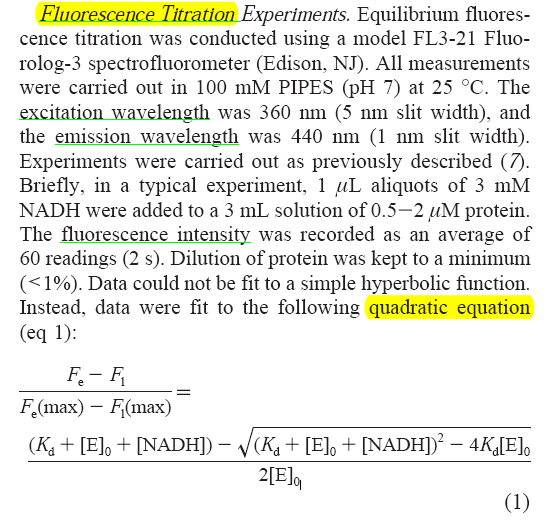 第一部分 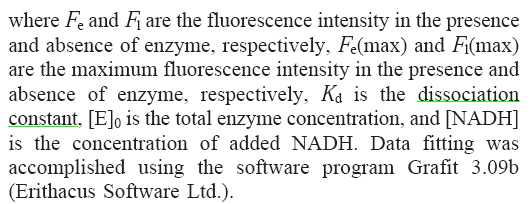 第二部分 |
 回复此楼
回复此楼» 猜你喜欢
 材料科学与工程求调剂
已经有5人回复
材料科学与工程求调剂
已经有5人回复
-
一志愿北京化工大学材料与化工(085600)296求调剂
已经有17人回复
-
考研调剂
已经有7人回复
-
343求调剂085601
已经有3人回复
-
08工科求调剂286
已经有3人回复
-
337求调剂
已经有3人回复
-
329求调剂,一志愿西北工业大学,材料工程(085601)
已经有10人回复
-
291求调剂
已经有6人回复
-
299求调剂
已经有10人回复
-
面上5B能上会吗?
已经有4人回复


 6
6
