






| 查看: 6951 | 回复: 100 | ||||||
| 【奖励】 本帖被评价91次,作者sunkaka增加金币 73.4 个 | ||||||
| 当前只显示满足指定条件的回帖,点击这里查看本话题的所有回帖 | ||||||
[资源]
Chem. Soc. Rev最新二维材料量子点综述:Quantum dots from 2D materials
|
||||||

|
Chem. Soc. Rev最新二维材料量子点综述:Quantum dots from 2D materials 全文24页,190篇参考文献 (Chem. Soc. Rev., 2016, DOI: 10.1039/C5CS00811E) Quantum dots derived from two-dimensional materials and their applications for catalysis and energy 作者为 Xuewan Wang, Gengzhi Sun, Nan Li and Peng Chen* 二维材料(如石墨烯、过渡金属二硫化物、碳化氮、氮化硼和二维黑磷晶体)衍生的量子点,作为新型的独特零维材料,正在被各领域所认知和发现。这些量子点具有新颖的光、催化、电子、化学和电化学特性,而且在成像、传感、癌症治疗、光电子、显示、催化和能源等众多领域展现了巨大的应用潜力。在这篇论文中,我们主要综述了二维材料衍生的量子点的制备方法以及性质,此外还强调了这些量子点在电催化、光催化、超级电容器、电池和光伏领域的应用潜力。 Quantum dots (QDs) derived from the atomically-thin two-dimensional (2D) sheets (graphene, transition metal dichalcogenide, graphitic carbon nitride, hexagonal boron nitride, and phosphorene) are emerging extraordinary zero-dimensional materials. Covering a broad spectrum of interesting optical, catalytic, electronic, chemical and electrochemical properties, these 2D-QDs promise a wide range of novel applications including imaging, sensing, cancer therapy, optoelectronics, display, catalysis, and energy. In this article, we discuss the synthesis methods and the properties of these 2D-QDs and emphasize their applications in electrocatalysis, photocatalysis, supercapacitors, batteries, and photovoltaics. 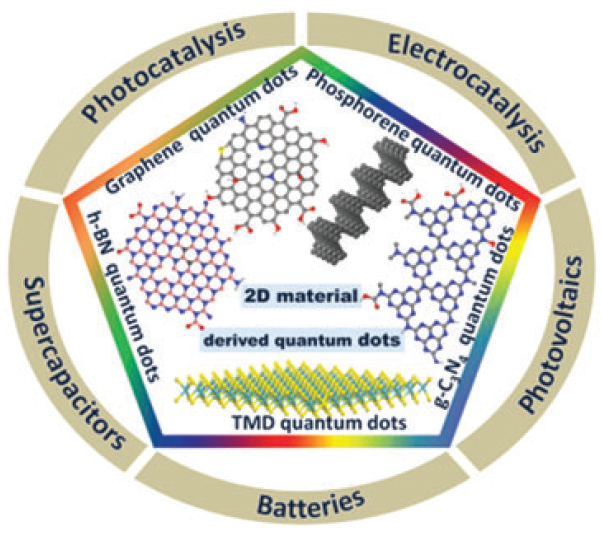 11.png |
 回复此楼
回复此楼» 本帖附件资源列表
-
欢迎监督和反馈:小木虫仅提供交流平台,不对该内容负责。
本内容由用户自主发布,如果其内容涉及到知识产权问题,其责任在于用户本人,如对版权有异议,请联系邮箱:xiaomuchong@tal.com - 附件 1 : c5cs00811e.pdf
2016-02-20 14:29:58, 5.41 M
» 收录本帖的淘帖专辑推荐
 精华网帖收集 精华网帖收集 | 科技前线 | 材料物理与化学 | 量子点催化 |
» 猜你喜欢
 投稿Elsevier的杂志(返修),总是在选择OA和subscription界面被踢皮球
已经有6人回复
投稿Elsevier的杂志(返修),总是在选择OA和subscription界面被踢皮球
已经有6人回复
-
中科院杭州医学所招收博士生一名(生物分析化学、药物递送)
已经有4人回复
-
求个博导看看
已经有18人回复
-
自荐读博
已经有6人回复
-
青基代表作,AAAI之类的A会的special track在国内认可度高吗?还是归为workshop之流?
已经有3人回复
-
上海工程技术大学【激光智能制造】课题组招收硕士
已经有6人回复
-
上海工程技术大学张培磊教授团队招收博士生
已经有4人回复
-
临港实验室与上科大联培博士招生1名
已经有9人回复
-
写了一篇“相变储能技术在冷库中应用”的论文,论文内容以实验为主,投什么期刊合适?
已经有6人回复
» 本主题相关商家推荐: (我也要在这里推广)


2楼2016-02-20 17:45:16