









| 查看: 306 | 回复: 1 | ||
| 【奖励】 本帖被评价1次,作者bio-polymer增加金币 1 个 | ||
| 当前主题已经存档。 | ||
[资源]
《Liquid Crystals》
|
||

|
Liquid Crystals By S. Chandrasekhar 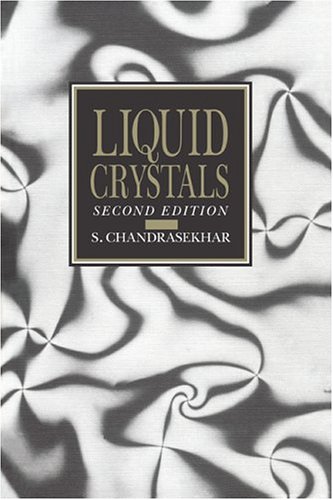 Publisher: Cambridge University Press Number Of Pages: 476 Publication Date: 1993-01-29 ISBN-10 / ASIN: 052142741X ISBN-13 / EAN: 9780521427418 Binding: Paperback This new and greatly revised edition of Professor Chandrasekhar's classic book Liquid Crystals (1977) presents a systematic and self-contained treatment of the physics of the different types of thermotropic liquid crystals--the three classical types, nematic, cholosteric and smectic, composed of rod-shaped molecules, and the newly discovered discotic type composed of disc-shaped molecules. The coverage includes a description of the structures of these four main types and their polymorphic modifications, their thermodynamical, optical and mechanical properties and their behavior under external fields. The basic principles underlying the major applications of liquid crystals in display technology (for example, the twisted and super-twisted nematic devices, the surface stabilized ferroelectric device, etc.) and in thermography are also discussed. Summary: Elegantly Written, A Little Behind Rating: 4 First, S. Chandrasekhar is not THE S. Chandrasekhar, Nobel Astrophysicist, nonetheless, his classic book on liquid crystals is elegantly written, bringing to the reader's attention such beautiful words as "imbricated" (to describe nematic liquid crystal molecular positional and orientational order) and "disinclinations" (crystal defects). These words bring out the historical development of liquid crystals, which states of matter became well-known only after their use in notebook computers, mobile phones, and now in flat-panel televisions. Because of the latter, the chapters on cholesteric and smectic liquid crystals (which constitute major portions of the book) are not that interesting to persons in the display business. The science and theory development is well-expostulated, particularly the early dipole moment models, which makes the book the classic that it is. However, taken from fluid dynamics, the use of the comma subscript to denote partial differentiation in the continuum theory chapter, while certainly saving space and symbols, detracts from the meaning of the equations and forces the reader to squint to look for the commas, and I may be dense, but I still can't understand the comma after a parentheses-enclosed expression. I sometimes suspect that "insiders" like to use such terrible notation, yes partly to help in some equation flows, but also in an attempt to "exclusivise" their field so that "outsiders" have difficulty understanding it. While lack of comprehension may be a result of my own limitations, I contend that books should communicate, not obfuscate. Fluid dynamics is notorious for voluminous equations with zillions of coefficients, the end result of which is little advancement of the field and not much furtherance of physical understanding. No wonder someone once said, "the only two things I just can't understand are quantum mechanics and fluid dynamics." Chandrasekhar's treatment is science-based, but not as deeply as de Gennes & Prost, but, because written in 1977 and updated in 1992, it is a little behind the times for those who are interested in today's LCD technology. http://rapidshare.com/files/1511 ... ity_Press.djvu.html [ Last edited by mengbaiyang on 2008-10-14 at 11:53 ] |
 回复此楼
回复此楼» 猜你喜欢
 西北工业大学材料学院电化学传感与催化课题组招收2027年推免研究生、博士生、博士后
已经有5人回复
西北工业大学材料学院电化学传感与催化课题组招收2027年推免研究生、博士生、博士后
已经有5人回复
-
国社科系统bug了,是不是要放榜了?
已经有3人回复
-
售SCI一区文章,我:8.O.551.O.5.4,科目全,可伽急
已经有3人回复
-
售SCI文章,我:8O.5.5.1O.54,科目全,可十急
已经有3人回复
-
售SCI文章,我:8O.5.5.1O.54,科目全,可十急
已经有3人回复
-
售SCI一区T0P文章,我:8.O55.1.O.54,科目全,可十急
已经有4人回复
-
售SCI一区T0P文章,我:8.O.55.1.O.54,科目齐全,可+急
已经有4人回复
-
售SCI一区文章,我:8.O.55.1.O.54,科目齐全,可伽急
已经有6人回复
-
售SCI一区文章,我:8O5.5.1.O5.4,科目全,可伽急
已经有4人回复
-
售一区SCI文章T0P,我:8O.551.O54,科目全,可十急
已经有4人回复
2楼2008-10-06 16:46:54
