








| 查看: 595 | 回复: 1 | ||
[求助]
求助一段英文资料的翻译!谢谢~
|

|
The overall structure of aromatase The structure of aromatase consists of 12 major α-helices (A to L) and 10 β-strands (1 to 10) distributed into one major and three minor sheets, and follows the characteristic cytochrome P450 fold (Fig. 1a). The major β-sheet is a mixed four-stranded sheet that begins near the N terminus (β1:83–88 and β2:93–97) but ends in two strands from the C-terminal half of the polypeptide chain (β3:373–376 and β6:393–396). The N-terminal residues 47–50 make one backbone hydrogen bond with β1 and add an extra β-strand-like element to this sheet in aromatase. Each of the three minor sheets consists of two antiparallel strands scattered over the polypeptide chain (sheet2: β4:381–383 and β5:386–388; sheet3: β8:473–475 and β9:479–481; sheet4: β7:458–461 and β10:491–494). Of the 12 major helices, I (293–324), F (210–227), G (242–267), H (278–287), C (138–152), D (155–174), E (187–205), J (326–341), K (354–366) and L (440–455) are similar to those found in most of the cytochrome P450s. Helices A′ (57–68), A (69–80), B′ (100–109), B (119–126), G′ (232–236), H′ (271– 274), J′ (346–349), K′ (398–404) and K″ (414–418) are one to four turns long and have more variability among P450s. The residues in aromatase involved in haem coordination are Arg 115, Trp 141, Arg 145, Arg 375 and Arg 435. 由于生物基础差,术语都不了解,还请各位专业人士帮忙,谢谢各位~ 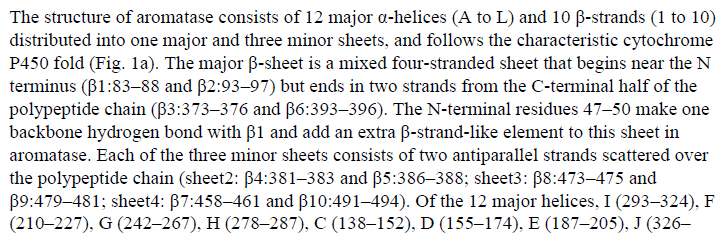 1.jpg  2.jpg |
 回复此楼
回复此楼» 猜你喜欢
 浙江师范大学是怎么坑我的
已经有5人回复
浙江师范大学是怎么坑我的
已经有5人回复
-
面上有专家说实验设备不是我们单位的
已经有8人回复
-
科研求助
已经有4人回复
-
博士去二本高校当辅导员,如何调整心态?
已经有11人回复
-
江苏省自然基金 什么时候出结果
已经有6人回复
-
闲聊
已经有3人回复
2楼2015-12-07 09:35:57