









| 查看: 1438 | 回复: 14 | ||||
| 【奖励】 本帖被评价14次,作者胖虎不二增加金币 11.2 个 | ||||
[资源]
Polyolefis 50 years after Ziegler and Natta.
|
||||

|
PREFACE Fifty years after the Nobel Prize was awarded to Karl Ziegler and Giulio Natta in 1963, the polymerization of olefins by metallorganic catalysts has grown to one of the most fascinating areas in academic and industrial polymer science and now has the largest use in polymer production. Ziegler had discovered 10 years earlier that a mixture of transition metal compounds, especially titanium chlorides and aluminum alkyls, was able to polymerize ethene by an insertion reaction. This spectacular milestone was expanded a year later when Natta prepared and characterized isotactic polypropylene and introduced stereospecific polymerization. In contrast to the high-pressure ethene polymerization invented in 1935 by ICI (Imperial Chemical Industries, Great Britain), the catalyzed olefin polymerization requires only low pressure and low temperature. Today, more than 130 million tons of polyolefins are produced worldwide per year, the major part with the help of Ziegler–Natta catalysts. Polyolefins have changed the world! They are not only the polymers with the highest production volume, but they also show an unbroken production increase. Containing only carbon and hydrogen atoms, polyolefins are sustainable materials, light in weight, and offer a wide variety of properties. The production requires only easily available and nontoxic monomers and proceeds with almost no losses or side reactions. After their end of use, polyolefins can easily be recycled through mechanical procedures to simple articles, by pyrolysis to gas and oil, or by incineration to energy. In recent decades, new generations of catalysts with higher activities and stereospecificities and modern production processes have been invented to produce a great variety of polyolefins ranging from high density polyethylene (HDPE) to linear low density polyethylene (LLDPE), high melting polypropylene, high modulus polyolefin fibers, ethene–propene rubber (EPR), ethene–propene–diene monomer rubber (EPDM). The chromium-based Phillips catalysts opened the field of gas phase polymerization for HDPE. New supported Ziegler–Natta catalysts make it possible to increase the activity, to control the morphology, and for polypropylene to increase the isotacticity by adding different kinds of donors. A great development in this research field was the discovery of metallocene and other transition metal complexes activated by methylaluminoxane. These catalystsare up to 10 times more active than Ziegler–Natta catalysts, are soluble in hydrocarbons, show only one type of active site (single site catalysts), and can easily be modified in their chemical structure. These properties make it possible to predict the properties of the resulting polyolefins very accurately from the knowledge of the structure of the catalyst, and thus to control molecular weight and distribution, comonomer content, and tacticity by careful selection of the appropriate reactor conditions. The single site character of metallocene-based catalysts leads to a better understanding of the mechanism of olefin polymerization and to the introduction of other bulky cocatalysts. The different chapters in this book deal with the development of olefin polymerization 50 years after the pioneering work of Ziegler and Natta. Academic and industrial developments of ethene and propene polymerizations are presented, including short biographies of Ziegler and Natta, research on Phillips catalysts, kinetic and active site measurements, and polyolefin characterization. Review chapters also describe the latest results of olefin homo-, living-, and copolymerizations by metallocene and other single site catalysts, such as the synthesis of ansa metallocenes, supported iron catalysts, syndiotactic polypropylene, long chain branched polyolefins, and cyclic and functional copolymers. Remarkable progress has been achieved in the synthesis of polyolefin nanocomposites by an in-situ polymerization process using clay, layered silicates, carbon fibers, and carbon nanotubes as fillers. 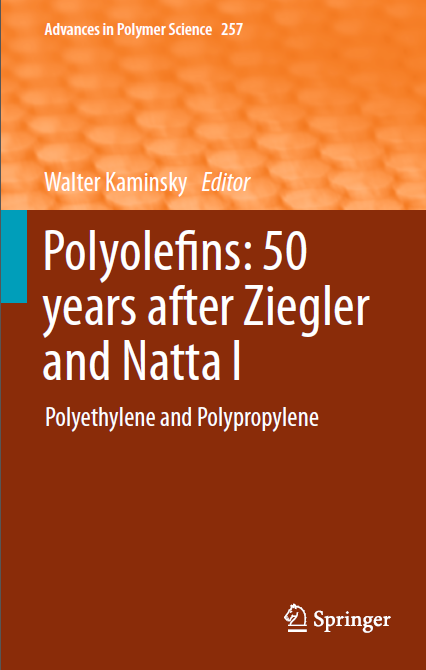 1.png |
 回复此楼
回复此楼» 本帖附件资源列表
-
欢迎监督和反馈:小木虫仅提供交流平台,不对该内容负责。
本内容由用户自主发布,如果其内容涉及到知识产权问题,其责任在于用户本人,如对版权有异议,请联系邮箱:xiaomuchong@tal.com - 附件 1 : Polyolefins_50_years_after_Ziegler_and_Natta_II.pdf
- 附件 2 : Polyolefis_50_years_after_Ziegler_and_Natta.pdf
2015-10-21 13:37:37, 10.34 M
2015-10-21 13:37:44, 11.89 M
» 收录本帖的淘帖专辑推荐
 功能塑料 功能塑料 | 聚烯烃乐活大拼盘 |
» 猜你喜欢
 郑州大学申博
已经有6人回复
郑州大学申博
已经有6人回复
-
40+中年人失业后,还能找到好工作吗?
已经有18人回复
-
人工智能虚构史料、伪造文献频现,多家期刊声明抵制
已经有5人回复
-
CsPbI2Br全无机钙钛矿SEM图像异常分析
已经有8人回复
-
申请科研项目纯靠实力能成功吗?
已经有12人回复
7楼2015-10-24 10:32:46
14楼2018-03-08 11:06:26
简单回复
wlctcl2楼
2015-10-21 15:06
回复
五星好评 顶一下,感谢分享!
muxinjin3楼
2015-10-21 16:51
回复
五星好评 顶一下,感谢分享!
yzj19724楼
2015-10-22 01:47
回复
五星好评 顶一下,感谢分享!
lwg35楼
2015-10-23 11:14
回复
五星好评 顶一下,感谢分享!
2015-10-23 23:23
回复
五星好评 顶一下,感谢分享!
Pureland8楼
2015-10-24 15:08
回复
五星好评 顶一下,感谢分享!
南方嘉木8969楼
2015-10-25 06:49
回复
五星好评 顶一下,感谢分享!
wanbaokang10楼
2015-12-08 14:01
回复
五星好评 顶一下,感谢分享!
polyle11楼
2015-12-15 11:26
回复
五星好评 顶一下,感谢分享!
smxywqd12楼
2016-01-09 11:02
回复
五星好评 谢谢分享啊
bigfoot13楼
2018-01-09 19:39
回复
五星好评 顶一下,感谢分享!
planck122915楼
2018-04-18 20:07
回复
五星好评 顶一下,感谢分享!