









| 查看: 3352 | 回复: 67 | ||
| 当前只显示满足指定条件的回帖,点击这里查看本话题的所有回帖 | ||
[资源]
Chemistry of the Element
|
||

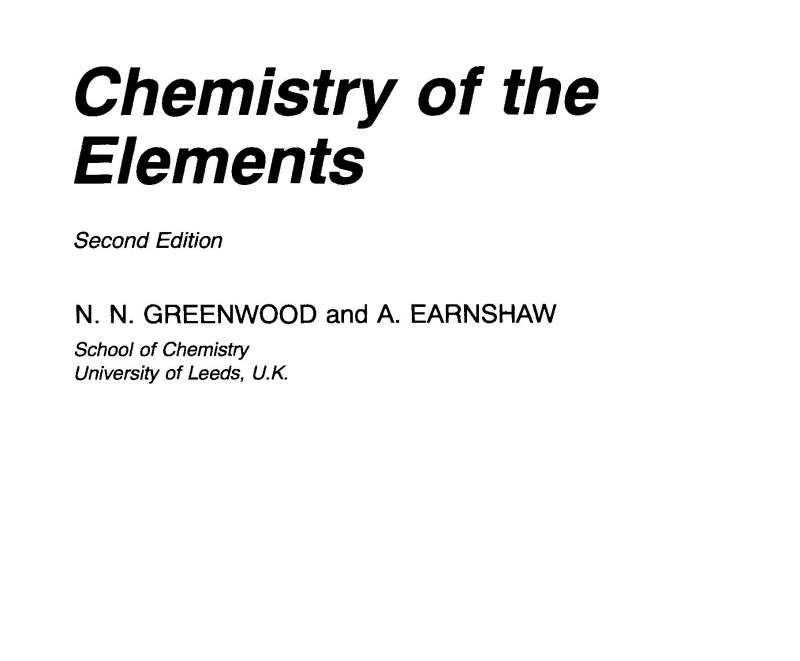 When this book first appeared in 1984 it rapidly established itself as one of the foremost textbooks and references on the subject. It was enthusiastically adopted by both students and teachers and has already been translated into several European and Asian languages. The novel featues which it adopted (see Preface to the First Edition) were clearly much appreciated and we have been pressed for some time now to bring out a second edition. Accordingly we have completely revised and updated the text and have incorporated over 2000 new literature references to work which has appeared since the first edition was published. In addition, innumerable modifications and extensions incorporating recent advances have been made throughout the text and, indeed, no single page has been left unaltered. However, by judicious editing we have ensured that all the features which made the first edition so attractive to its readers have been retained. The main plan of the book has been left unchanged except that the general section on organometal- lic chemistry has been removed from Chapter 8 (Carbon) and has been incorporated, together with a summary of other aspects of coordination chemistry, in a restyled Chapter 19. However, the chemistry of even the simplest elements has been considerably enriched during the past few years, sometimes by quite dramatic advances. Thus the chemistry of the alkali metals has a complexity that, was undreamt of one or two decades ago and lithium, for example, is now known in at least 20 coordination geometries having coordination numbers from 1 to 12. Compounds of alkali metal anions and even electfides are known. Likewise, there is expanding interest in the organometallic chemistry of the heavier congeners of magnesium, particularly those with bulky ligands. Boron continues to amaze and confound, and its cluster chemistry continues to expand, as does sulfur-nitrogen chemistry, het- eropolyacid chemistry, bioinorganic aspects of the chemistry of many of the elements, lower-valent lanthanide element chemistry, and so on through each of the chapters, up to the synthesis and char- acterization of the heaviest trans-actinide element, Z = 112. It is salutory to reflect that there are now 49 more elements known than the 63 known to Mendeleev when he devised the periodic table of the elements. A further indication of the rapid advances that have occurred in the chemistry of the elements during the past 15 years can be gauged from the several completely new sections which have been added to review work in what were previously both nonexistent and unsuspected areas. These include (a) coordination compounds of dihapto-dihydrogen, (b) the fullerenes and their many derivatives, (c) the metcars, and (d) high-temperature oxide superconductors. We hope that this new edition of Chemistry of the Elements will continue to stimulate and inform its readers, and that they will experience something of the excitement and fascination which we ourselves feel for this burgeoning subject. We should also like to thank our many correspondents who have kept us informed of their work and the School of Chemistry in the University of Leeds for providing us with facilities. N. N. Greenwood A. Earnshaw August, 1997 |
 回复此楼
回复此楼» 本帖附件资源列表
-
欢迎监督和反馈:小木虫仅提供交流平台,不对该内容负责。
本内容由用户自主发布,如果其内容涉及到知识产权问题,其责任在于用户本人,如对版权有异议,请联系邮箱:xiaomuchong@tal.com - 附件 1 : Chemistry_of_the_Elements_2nd_edition_1997.djvu
2015-09-14 21:51:56, 21.32 M
» 猜你喜欢
 PDMS膜在溶液中的离子透过率
已经有0人回复
PDMS膜在溶液中的离子透过率
已经有0人回复
-
攒人品 论文祈福
已经有139人回复
-
有机高分子材料论文润色/翻译怎么收费?
已经有67人回复
-
science advances的AAAS系统上返修
已经有0人回复
-
science advances的AAAS系统上返修问题
已经有4人回复
-
LDPE黑十字为什么那么大
已经有0人回复
-
西南交通大学医学院2027年接收推荐免试攻读研究生(含直博生)
已经有159人回复
-
西南交通大学医学院2027年接收推荐免试攻读研究生(含直博生)
已经有159人回复
-
西南交通大学医学院2027年接收推荐免试攻读研究生(含直博生)
已经有157人回复
-
西南交通大学医学院2027年接收推荐免试攻读研究生(含直博生)
已经有152人回复
-
博士申请
已经有14人回复

60楼2016-12-03 20:27:39
简单回复
2015-09-15 05:37
回复
五星好评 顶一下,感谢分享!
2015-09-15 08:09
回复
五星好评 顶一下,感谢分享!
muxinjin4楼
2015-09-15 08:34
回复
五星好评 顶一下,感谢分享!
jzhang035楼
2015-09-15 09:35
回复
五星好评 顶一下,感谢分享!
lwg36楼
2015-09-15 10:15
回复
五星好评 顶一下,感谢分享!
lchq19577楼
2015-09-15 12:30
回复
五星好评 顶一下,感谢分享!
2015-09-15 22:30
回复
五星好评 顶一下,感谢分享!
aust_jhe9楼
2015-09-16 06:42
回复
五星好评 顶一下,感谢分享!
Quan.10楼
2015-09-16 06:49
回复
五星好评 顶一下,感谢分享!
polymersdu11楼
2015-09-16 07:55
回复
五星好评 顶一下,感谢分享!
bioxo12楼
2015-09-16 08:14
回复
五星好评 顶一下,感谢分享!
zcx22313楼
2015-09-16 08:46
回复
五星好评 顶一下,感谢分享!
一维UA14楼
2015-09-16 08:50
回复
五星好评 顶一下,感谢分享!