









| 查看: 702 | 回复: 0 | ||
[交流]
Fission track thermochronology and its tectonic applications
|

|
Fission track thermochronology and its tectonic applications Dumitru and graduate students Fission track thermochronology is a geochronologic method that yields the time when rock rose through the 2 to 5 km depth window or ~80°-120°C (for apatite). This low-temperature thermochronometer allows us to collect data at the regional scale to study time-space patterns of mountain building and their uplift or on detailed scales to understand the slip history of faults in the brittle crust. The best studies utilizing low temperature thermochronology involve careful integration of field-based structural studies and balanced cross-sections with laboratory-collected thermochronology data. Transects of ten or more samples are keyed to detailed structural cross-sections. Because the thermal histories of samples in a specific transect must be linked, such data arrrays provide a solid measure of the cooling history of the structural section sampled. The Fission Track Laboratory at Stanford has applied these approaches in a variety of tectonic settings, including reconstructing time-space patterns of extension across the Basin and Range province, analyzing margin-wide shortening across the San Andreas fault system, reconstructing mountain-building in China during the India-Asia collision, and analyzing exhumation of high-pressure rocks within the Franciscan subduction complex. This work has been funded by a series of grants from the NSF Tectonics Division including EAR9417939, EAR-9725371, EAR-029854 and EAR-0809226. (U-Th)/He thermochonology is a more recently developed and highly complimentary method for dating exhumation from even shallower depths (~40-85°C) intervals. The (U-Th)/He laboratory resides in our Noble Gas Laboratory. The two methods paired together provide a powerful means of solving many tectonic questions about the P-T path of the upper 10 km of the crust. This laboratory was initially funded through NSF's Instrumentation Division. 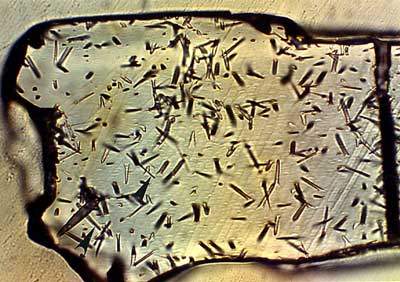 Fissiontrackapatite.jpg Photomicrograph of etched fission tracks in an apatite crystal. The tracks are trails of destruction in the crystal lattice formed by particles emitted during spontaneous fission of 238U. The number of tracks is proportional to the cooling age as well as to the U content of the apatite. Track lengths (initially ~ 17 microns in length) are proportional to the cooling rate as tracks anneal and close during slow cooling. How the method works for normal faults: 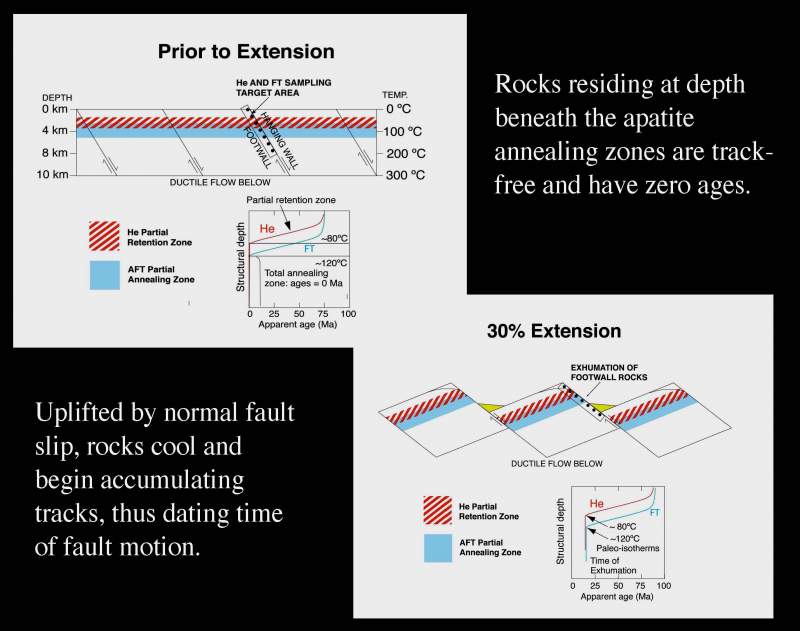 FTcoolfault (1).jpg 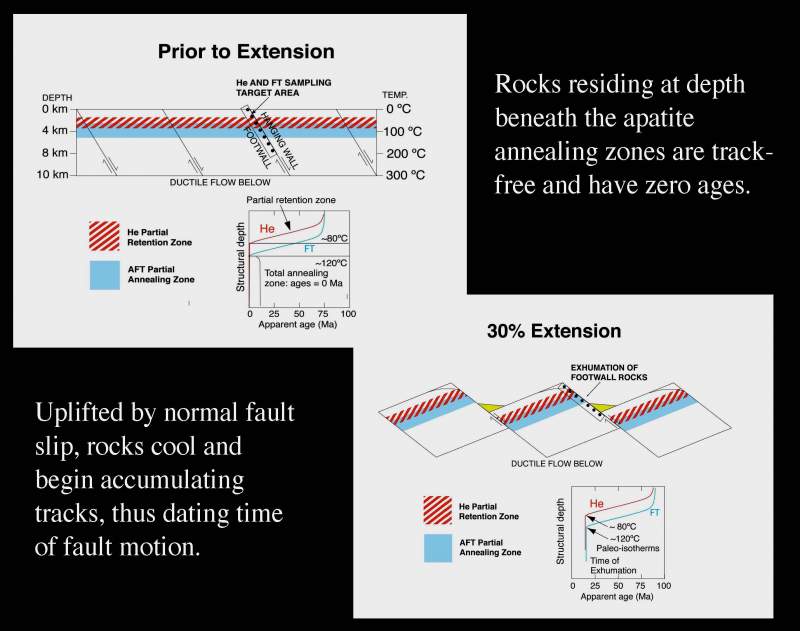 FTcoolfault.jpg Application of the method to faulting in the Wassuk Range, NV from Surpless et al. (2002). 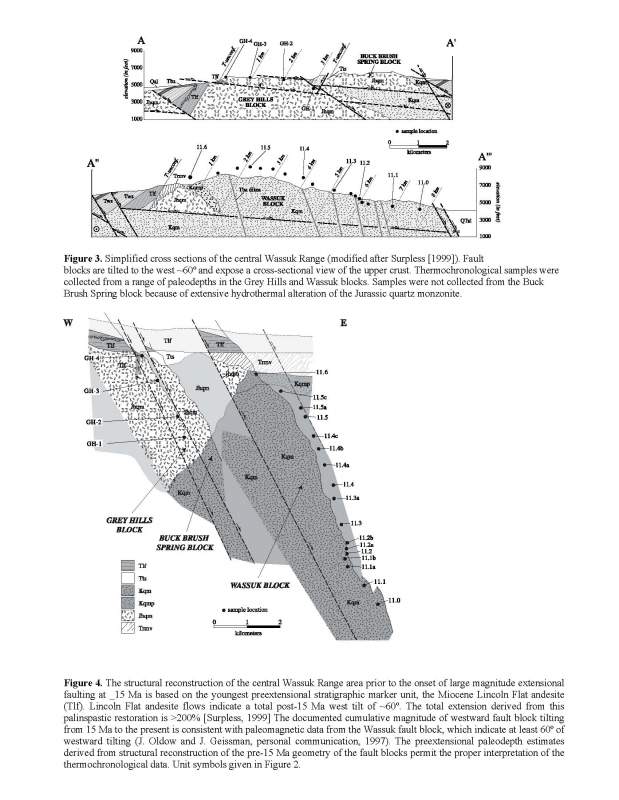 RestorationWassuk.jpg Cross-section of a polished and etched apatite crystal showing schematic tracks that intersect the polished surface of the grain and confined tracks that cross cracks or tracks in the subsurface of the grain. The length of these confined tracks are measured and statistically they determine the cooling rate of the sample through the apatite partial annealing zone. This data provides information and a robust analysis as to what an obtained fission track "age" means. Fission track mineral separation and sample preparation Our mineral separation and sample preparation facilities, intended primarily for Stanford faculty, staff, students and visitors, include rock crusher, rock grinder, Gemeni table, sieves, Ro-tap, drying ovens, fume hoods, Frantz electrodynamic separators, LMT and MEI apparatus (heavy liquid density separations), binocular microscopes, etc. For further information, contact Trevor Dumitru. Fission track sample preparation facilities include epoxy and teflon grain mounting, slide grinding wheels, slide polishing wheels, fume hoods. All other specialized fission track sample preparation facilities are also available. Please contact Trevor Dumitru (tdumitru@stanford.edu). Fission track microscope facilities: We have a Zeiss Axioskop microscope specially configured for FT work; 32.5x. 125x, 250x, 625x, and 1250x magnifications; transmitted and reflected light; objectives designed for use without cover-slips; no polarized light capability. The microscope is fitted with a drawing tube and computerized digitizing system which permits measurements of track lengths with an accuracy of 0.15 microns. The microscope is also fitted with a computer-automated stage system which permits locating and relocating objects with an accuracy of 3 microns. For further information, contact Trevor Dumitru. Some recent publications and theses including some in the pipeline (2015): Miller, E.L., Akinin, V.V., Dumitru, T.A., Gottlieb, E.S., Grove, M., Meisling, K. and Seward, G., (submitted to Tectonophysics 2015), Structural geology and thermochronology of Wrangel Island, East Siberian Shelf, Arctic Russia 2008 Fosdick, J.C, and Colgan, Miocene extension in the East Range, Nevada: A two-stage history of normal faulting in the northern Basin and Range: Geological Society of America Bulletin, v. 120(9-10), p. 1198-1213. doi:10.1130/B26201.1. 2008 Colgan, J.P., Shuster, D.L., and Reiners, P.W., Two-phase Neogene extension of the northwestern Basin and Range recorded in a single thermochronology sample: Geology, v. 36(8), p. 631-634, doi:10.1130/G24897A.1. 2011 Egger, A.E and Miller, E.L., Evolution of the northwestern margin of the Basin and Range: The geology and extensional history of the Warner Range and environs, northeastern California, Geosphere, doi: 10.1130/GS620.1. Publications 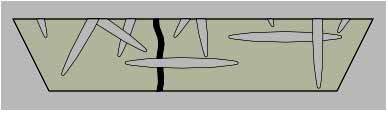 trackincrack.jpg 2006 Colgan, J.P., T.A. Dumitru, E.L. Miller, and P.W. Reiners, Cenozoic tectonic evolution of the Basin and Range Province in northwestern Nevada, American Journal of Science, v. 306, p. 616-654. 2006 Colgan, J.P., T.A. Dumitru, M. McWilliams, and E.L. Miller, Timing of Cenozoic volcanism and Basin and Range extension in northwestern Nevada: New constraints from the northern Pine Forest Range, Geological Society of America Bulletin, v. 118, p. 126-139. 2004 Colgan, J.P., T.A. Dumitru, and E.L. Miller, Diachroneity of Basin and Range extension and Yellowstone hotspot volcanism in northwestern Nevada, Geology, v. 32, p. 121-124. 2003 Egger, A. E., Dumitru, T.A., Miller, E.L., Savage, C.F.I. and Wooden, J.L., , Timing and nature of Tertiary plutonism and extension in the Grouse Creek Mountains, Utah, in, Ernst et al., ed., The Thompson Volume-The Lithosphere of Western North America and its Geophysical Characterization, International Geology Review, v. 45, p. 497-532. 2003 Stockli, D.F., T.A. Dumitru, M.O. McWilliams, and K.A. Farley, Cenozoic tectonic evolution of the White Mountains, California and Nevada, Geological Society of America Bulletin, v. 115, p. 788-816. 2003 Stockli, D.F., T.A. Dumitru, M.O. McWilliams, and K.A. Farley, Cenozoic tectonic evolution of the White Mountains, California and Nevada, Geological Society of America Bulletin, v. 115, p. 788-816. 2002 Surpless, B.E., D.F. Stockli, T.A. Dumitru, and E.L. Miller, Elizabeth L., Two-phase westward encroachment of Basin and Range extension into the northern Sierra Nevada, Tectonics, v. 21, no. 1, 10.1029/2000TC001257. 2002 Moore, T.E. T.A. Dumitru, K.E. Adams, S.N. Witebsky, and A.G. Harris, Origin of the Lisburne Hills-Herald Arch structural belt: Stratigraphic, structural, and fission-track evidence from the Cape Lisburne area, northwestern Alaska, in Tectonic Evolution of the Bering Shelf–Chukchi Sea–Arctic Margin and Adjacent Landmasses, Geological Society of America Special Paper 360, edited by E.L. Miller, A. Grantz, and S.L. Klemperer, p. 77-109. 2002 Moore, T.E. T.A. Dumitru, K.E. Adams, S.N. Witebsky, and A.G. Harris, Origin of the Lisburne Hills-Herald Arch structural belt: Stratigraphic, structural, and fission-track evidence from the Cape Lisburne area, northwestern Alaska, in Tectonic Evolution of the Bering Shelf–Chukchi Sea–Arctic Margin and Adjacent Landmasses, Geological Society of America Special Paper 360, edited by E.L. Miller, A. Grantz, and S.L. Klemperer, p. 77-109. 2002 D.F. Stockli, B.E. Surpless, T.A. Dumitru, and Farley, K.A., Thermochronologic constraints on the timing and magnitude of Miocene and Pliocene extension in the central Wassuk Range, western Nevada, Tectonics, v. 21, no. 4, 10.1029/2001TC001295. 2002 Surpless, B.E., D.F. Stockli, T.A. Dumitru, and E.L. Miller, Elizabeth L., Two-phase westward encroachment of Basin and Range extension into the northern Sierra Nevada, Tectonics, v. 21, no. 1, 10.1029/2000TC001257. 2002 D.F. Stockli, B.E. Surpless, T.A. Dumitru, and Farley, K.A., Thermochronologic constraints on the timing and magnitude of Miocene and Pliocene extension in the central Wassuk Range, western Nevada, Tectonics, v. 21, no. 4, 10.1029/2001TC001295. 1999 Miller, E.L., Dumitru, T.A., Brown, R.W., and Gans, P.B., Rapid Miocene slip on the Snake Range-Deep Creek Range fault system, east-central Nevada: GSA Bulletin, v. 111, p. 886-905. 1998 Dumitru, T.A., Fission-track geochronology, in Dating and Earthquakes: Review of Quaternary Geochronology and its Application to Paleoseismology, edited by J.M. Sowers, J.S. Noller, and W.R. Lettis, U.S. Nuclear Regulatory Commission report NUREG/CR 5562, p. 2 221 – 2-257. 1997 House, M.A., B.P. Wernicke, K.A. Farley, and T.A. Dumitru, Cenozoic thermal evolution of the central Sierra Nevada, California, from (U-Th)/He thermochronometry, Earth and Planetary Science Letters, v. 151, p. 167-179. 1995 Dumitru, T.A., E.L. Miller, P.B. O'Sullivan, J.M. Amato, K.A. Hannula, A.C. Calvert, and P.B. Gans, Cretaceous to Recent extension in the Bering Strait region, Alaska, Tectonics, v. 14, p. 549-563. 1993 Dumitru, T.A., A new computer-automated microscope stage system for fission-track analysis, Nuclear Tracks and Radiation Measurements, v. 21, p. 575-580. 1991 Dumitru, T.A., P.B. Gans, D.A. Foster, and E.L. Miller, Refrigeration of the western Cordilleran lithosphere during Laramide shallow-angle subduction, Geology, v. 19, p. 1145-1148. 1990 Dumitru, T.A., Subnormal Cenozoic geothermal gradients in the extinct Sierra Nevada magmatic arc: Consequences of Laramide and post-Laramide shallow-angle subduction, Journal of Geophysical Research, v. 95, p. 4925-4942. 1989 Dumitru, T.A., Constraints on uplift in the Franciscan subduction complex from apatite fission track analysis, Tectonics, v. 8, p. 197-220. 1988 Dumitru, T.A., Subnormal geothermal gradients in the Great Valley forearc basin, California, during Franciscan subduction: A fission track study, Tectonics, v. 7, p. 1201-1221. |
 回复此楼
回复此楼


 200
200