









| 查看: 694 | 回复: 2 | ||
[求助]
跪求几个关于XRD与TEM表征的问题 已有1人参与
|

|
论文投稿后审稿人提出几个XRD和TEM表征方面的专业性问题,麻烦大神们帮我看看,到底怎么回答或者改进的更好? 自己这方面的知识比较匮乏,也没有找到很有帮助的资料,拜托大家了,感激不尽!  1. Ordinary XRD detects reflections from the planes parallel to the interface. Thus, the lattice spacing corresponding to any diffraction peak should be that between the lattice planes parallel to the interface. However, the authors present a lattice spacing of 0.31 nm (in Fig. 1) between the planes perpendicular to the interface, in order to support that the observed peak comes from (102) planes. In addition, (102) is a notation for the crystal plane, not for the direction. 2. It would be very difficult to obtain a single-crystalline film on an amorphous layer. The existence of a single XRD peak does not necessarily means that the film is grain boundary-free, completely single-crystalline. It may have multiple in-plane orientations. Once the film has a single out-of-plane orientation, the two states will reveal the same XRD pattern because an ordinary theta-2theta scan does not detect in-plane orientations. Have you ever seen any plane-view TEM image of the film?. 3. Consider, as an extreme case, that the annealed film has many grains. Some grains are (102)-oriented with their surfaces parallel to the (102) planes of your sample, but many others are amorphous. Even in this case, we will have only a single XRD peak corresponding to the (102) reflection. The authors will have to present a plane-view image of the film in order to support their arguments and eliminate any doubts previously aroused by other reviewers. 非常感谢!  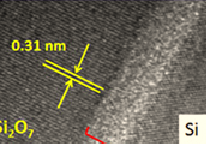 图片.png |
 回复此楼
回复此楼» 猜你喜欢
 修改论文,如何借助其他力量?
已经有4人回复
修改论文,如何借助其他力量?
已经有4人回复
-
中山大学潘越教授课题组2027级推免硕士研究生招生 新增一个专业医学技术名额
已经有21人回复
-
无机化学论文润色/翻译怎么收费?
已经有136人回复


2楼2015-08-11 23:28:01
3楼2015-08-12 10:01:31