












| 查看: 8179 | 回复: 146 | |||||||||||||||||
| 【奖励】 本帖被评价132次,作者罗马里奥增加金币 104 个 | |||||||||||||||||
| 当前只显示满足指定条件的回帖,点击这里查看本话题的所有回帖 | |||||||||||||||||
[资源]
夏幼男最新science重磅大作——具有亚纳米厚壳且可控晶面的铂空心纳米牢笼
|
|||||||||||||||||

|
纳米合成大师——乔治亚理工的夏幼男教授——刚刚在science上发表了一篇名为“Platinum-based nanocages with subnanometer-thick walls and well-defined, controllable facets”的文章。该文章通过硬模板以及后续模板腐蚀的方法,制备出了形貌均一的纳米牢笼Pt,制备的空心牢笼具有亚纳米厚的外壳,并且暴露的晶面具有灵活的可调性。 低消耗的催化剂应该具有高度分散的活性位点原子以及可控的表面结构用于优化催化活性和选择性。夏幼男团队通过用把铂沉积到钯纳米晶的表面,然后通过后续腐蚀钯模板, 制备出了形貌较好而且尺寸均一的Pt空心纳米牢笼。理论计算表明最外层Pd的腐蚀移除导致了空位的形成,进而诱导纳米空心牢笼的生成。该团队进而分别用Pd纳米立方体和正八面体作为模板,可以得到Pt立方和正八面体纳米牢笼,这些纳米晶电催化氧还原的活性比商业Pt-C电极更高。 期刊: Science 24 July 2015: Vol. 349 no. 6246 pp. 412-416 DOI: 10.1126/science.aab0801 题目: Platinum-based nanocages with subnanometer-thick walls and well-defined, controllable facets 作者: Lei Zhang1,2, Luke T. Roling3, Xue Wang1,2, Madeline Vara4, Miaofang Chi5, Jingyue Liu6, Sang-Il Choi1, Jinho Park4, Jeffrey A. Herron3, Zhaoxiong Xie2, Manos Mavrikakis3, Younan Xia1,4,7,* 摘要: A cost-effective catalyst should have a high dispersion of the active atoms, together with a controllable surface structure for the optimization of activity, selectivity, or both. We fabricated nanocages by depositing a few atomic layers of platinum (Pt) as conformal shells on palladium (Pd) nanocrystals with well-defined facets and then etching away the Pd templates. Density functional theory calculations suggest that the etching is initiated via a mechanism that involves the formation of vacancies through the removal of Pd atoms incorporated into the outermost layer during the deposition of Pt. With the use of Pd nanoscale cubes and octahedra as templates, we obtained Pt cubic and octahedral nanocages enclosed by {100} and {111} facets, respectively, which exhibited distinctive catalytic activities toward oxygen reduction. 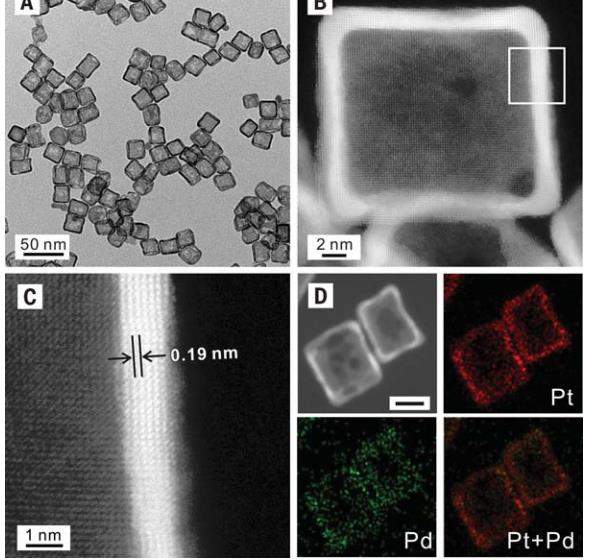 1.jpg 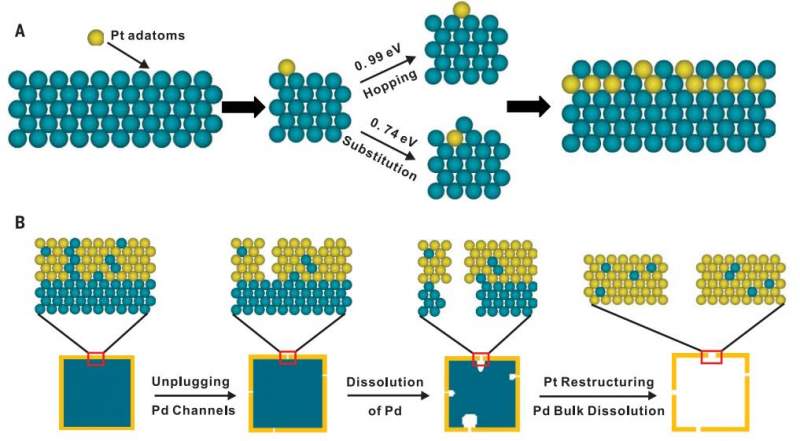 2.jpg [ Last edited by 罗马里奥 on 2015-7-24 at 21:07 ] |
 回复此楼
回复此楼» 本帖附件资源列表
-
欢迎监督和反馈:小木虫仅提供交流平台,不对该内容负责。
本内容由用户自主发布,如果其内容涉及到知识产权问题,其责任在于用户本人,如对版权有异议,请联系邮箱:xiaomuchong@tal.com - 附件 1 : Nano-2015-Science-2015-Zhang-412-6-Platinum-based_nanocages_with_subnanometer-thick_walls_and_well-defined,_controllable_facets.pdf
2015-07-24 09:31:20, 578.46 K
» 收录本帖的淘帖专辑推荐
 纳米技术与能源及模拟 纳米技术与能源及模拟 | 先进材料 | Nature Science Cell | 电化学电源、电源管理 |
| 研究生资料 | MOF的未来 | 宇宙超级无敌霹雳囧死人不偿命纳米材料(石 | 纳米大牛 |
| 材料物理与化学 | 生物医药技术 | 感觉有用的帖子 | 材料淘贴收录 |
| 纳米材料 | 文献zy | 氧化物界面与表面 |
» 本帖已获得的红花(最新10朵)
 sundan4330
» 猜你喜欢
 金属材料论文润色/翻译怎么收费?
已经有295人回复
金属材料论文润色/翻译怎么收费?
已经有295人回复

» 本主题相关商家推荐: (我也要在这里推广)


130楼2015-09-02 11:22:48