









| 查看: 6358 | 回复: 96 | |||||||
| 【奖励】 本帖被评价86次,作者sciencejoy增加金币 68 个 | |||||||
[资源]
A Course in Theoretical Physics 理论物理课程
|
|||||||

|
A Course in Theoretical Physics 理论物理课程 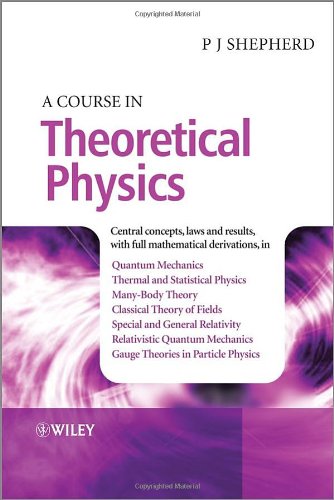 I NONRELATIVISTIC QUANTUM MECHANICS 1 1 Basic Concepts of Quantum Mechanics 3 1.1 Probability interpretation of the wave function 3 1.2 States of definite energy and states of definite momentum 4 1.3 Observables and operators 5 1.4 Examples of operators 5 1.5 The time-dependent Schr¨odinger equation 6 1.6 Stationary states and the time-independent Schr¨odinger equation 7 1.7 Eigenvalue spectra and the results of measurements 8 1.8 Hermitian operators 8 1.9 Expectation values of observables 10 1.10 Commuting observables and simultaneous observability 10 1.11 Noncommuting observables and the uncertainty principle 11 1.12 Time dependence of expectation values 12 1.13 The probability-current density 12 1.14 The general form of wave functions 12 1.15 Angular momentum 15 1.16 Particle in a three-dimensional spherically symmetric potential 17 1.17 The hydrogen-like atom 18 2 Representation Theory 23 2.1 Dirac representation of quantum mechanical states 23 2.2 Completeness and closure 27 2.3 Changes of representation 28 2.4 Representation of operators 29 2.5 Hermitian operators 31 2.6 Products of operators 31 2.7 Formal theory of angular momentum 32 3 Approximation Methods 39 3.1 Time-independent perturbation theory for nondegenerate states 39 3.2 Time-independent perturbation theory for degenerate states 44 3.3 The variational method 50 3.4 Time-dependent perturbation theory 54 4 Scattering Theory 63 4.1 Evolution operators and Møller operators 63 4.2 The scattering operator and scattering matrix 66 4.3 The Green operator and T operator 70 4.4 The stationary scattering states 76 4.5 The optical theorem 83 4.6 The Born series and Born approximation 85 4.7 Spherically symmetric potentials and the method of partial waves 87 4.8 The partial-wave scattering states 92 II THERMAL AND STATISTICAL PHYSICS 97 5 Fundamentals of Thermodynamics 99 5.1 The nature of thermodynamics 99 5.2 Walls and constraints 99 5.3 Energy 100 5.4 Microstates 100 5.5 Thermodynamic observables and thermal fluctuations 100 5.6 Thermodynamic degrees of freedom 102 5.7 Thermal contact and thermal equilibrium 103 5.8 The zeroth law of thermodynamics 104 5.9 Temperature 104 5.10 The International Practical Temperature Scale 107 5.11 Equations of state 107 5.12 Isotherms 108 5.13 Processes 109 5.13.1 Nondissipative work 109 5.13.2 Dissipative work 111 5.13.3 Heat flow 112 5.14 Internal energy and heat 112 5.14.1 Joule’s experiments and internal energy 112 5.14.2 Heat 113 5.15 Partial derivatives 115 5.16 Heat capacity and specific heat 116 5.16.1 Constant-volume heat capacity 117 5.16.2 Constant-pressure heat capacity 117 5.17 Applications of the first law to ideal gases 118 5.18 Difference of constant-pressure and constant-volume heat capacities 119 5.19 Nondissipative-compression/expansion adiabat of an ideal gas 120 6 Quantum States and Temperature 125 6.1 Quantum states 125 6.2 Effects of interactions 128 6.3 Statistical meaning of temperature 130 6.4 The Boltzmann distribution 134 7 Microstate Probabilities and Entropy 141 7.1 Definition of general entropy 141 7.2 Law of increase of entropy 142 7.3 Equilibrium entropy S 144 7.4 Additivity of the entropy 146 7.5 Statistical–mechanical description of the three types of energy transfer 147 8 The Ideal Monatomic Gas 151 8.1 Quantum states of a particle in a three-dimensional box 151 8.2 The velocity-component distribution and internal energy 153 8.3 The speed distribution 156 8.4 The equation of state 158 8.5 Mean free path and thermal conductivity 160 9 Applications of Classical Thermodynamics 163 9.1 Entropy statement of the second law of thermodynamics 163 9.2 Temperature statement of the second law of thermodynamics 164 9.3 Summary of the basic relations 166 9.4 Heat engines and the heat-engine statement of the second law of thermodynamics 167 9.5 Refrigerators and heat pumps 169 9.6 Example of a Carnot cycle 170 9.7 The third law of thermodynamics 172 9.8 Entropy-change calculations 174 10 Thermodynamic Potentials and Derivatives 177 10.1 Thermodynamic potentials 177 10.2 The Maxwell relations 179 10.3 Calculation of thermodynamic derivatives 180 11 Matter Transfer and Phase Diagrams 183 11.1 The chemical potential 183 11.2 Direction of matter flow 184 11.3 Isotherms and phase diagrams 184 11.4 The Euler relation 187 11.5 The Gibbs–Duhem relation 188 11.6 Slopes of coexistence lines in phase diagrams 188 12 Fermi–Dirac and Bose–Einstein Statistics 191 12.1 The Gibbs grand canonical probability distribution 191 12.2 Systems of noninteracting particles 193 12.3 Indistinguishability of identical particles 194 12.4 The Fermi–Dirac and Bose–Einstein distributions 195 12.5 The entropies of noninteracting fermions and bosons 197 III MANY-BODY THEORY 199 13 Quantum Mechanics and Low-Temperature Thermodynamics of Many-Particle Systems 201 13.1 Introduction 201 13.2 Systems of noninteracting particles 201 13.2.1 Bose systems 202 13.2.2 Fermi systems 204 13.3 Systems of interacting particles 209 13.4 Systems of interacting fermions (the Fermi liquid) 211 13.5 The Landau theory of the normal Fermi liquid 214 13.6 Collective excitations of a Fermi liquid 221 13.6.1 Zero sound in a neutral Fermi gas with repulsive interactions 221 13.6.2 Plasma oscillations in a charged Fermi liquid 221 13.7 Phonons and other excitations 223 13.7.1 Phonons in crystals 223 13.7.2 Phonons in liquid helium-4 232 13.7.3 Magnons in solids 233 13.7.4 Polarons and excitons 233 14 Second Quantization 235 14.1 The occupation-number representation 235 14.2 Particle-field operators 246 15 Gas of Interacting Electrons 251 15.1 Hamiltonian of an electron gas 251 16 Superconductivity 261 16.1 Superconductors 261 16.2 The theory of Bardeen, Cooper and Schrieffer 262 16.2.1 Cooper pairs 267 16.2.2 Calculation of the ground-state energy 269 16.2.3 First excited states 277 16.2.4 Thermodynamics of superconductors 280 IV CLASSICAL FIELD THEORY AND RELATIVITY 287 17 The Classical Theory of Fields 289 17.1 Mathematical preliminaries 289 17.1.1 Behavior of fields under coordinate transformations 289 17.1.2 Properties of the rotation matrix 293 17.1.3 Proof that a “dot product” is a scalar 295 17.1.4 A lemma on determinants 297 17.1.5 Proof that the “cross product” of two vectors is a “pseudovector” 298 17.1.6 Useful index relations 299 17.1.7 Use of index relations to prove vector identities 300 17.1.8 General definition of tensors of arbitrary rank 301 17.2 Introduction to Einsteinian relativity 302 17.2.1 Intervals 302 17.2.2 Timelike and spacelike intervals 304 17.2.3 The light cone 304 17.2.4 Variational principle for free motion 305 17.2.5 The Lorentz transformation 305 17.2.6 Length contraction and time dilation 307 17.2.7 Transformation of velocities 308 17.2.8 Four-tensors 308 17.2.9 Integration in four-space 314 17.2.10 Integral theorems 316 17.2.11 Four-velocity and four-acceleration 317 17.3 Principle of least action 318 17.3.1 Free particle 318 17.3.2 Three-space formulation 318 17.3.3 Momentum and energy of a free particle 319 17.3.4 Four-space formulation 321 17.4 Motion of a particle in a given electromagnetic field 325 17.4.1 Equations of motion of a charge in an electromagnetic field 326 17.4.2 Gauge invariance 328 17.4.3 Four-space derivation of the equations of motion 329 17.4.4 Lorentz transformation of the electromagnetic field 332 17.4.5 Lorentz invariants constructed from the electromagnetic field 334 17.4.6 The first pair of Maxwell equations 335 17.5 Dynamics of the electromagnetic field 337 17.5.1 The four-current and the second pair of Maxwell equations 338 17.5.2 Energy density and energy flux density of the electromagnetic field 342 17.6 The energy–momentum tensor 345 17.6.1 Energy–momentum tensor of the electromagnetic field 350 17.6.2 Energy–momentum tensor of particles 353 17.6.3 Energy–momentum tensor of continuous media 355 18 General Relativity 361 18.1 Introduction 361 18.2 Space–time metrics 362 18.3 Curvilinear coordinates 364 18.4 Products of tensors 365 18.5 Contraction of tensors 366 18.6 The unit tensor 366 18.7 Line element 366 18.8 Tensor inverses 366 18.9 Raising and lowering of indices 367 18.10 Integration in curved space–time 367 18.11 Covariant differentiation 369 18.12 Parallel transport of vectors 370 18.13 Curvature 374 18.14 The Einstein field equations 376 18.15 Equation of motion of a particle in a gravitational field 381 18.16 Newton’s law of gravity 383 V RELATIVISTIC QUANTUM MECHANICS AND GAUGE THEORIES 385 19 Relativistic Quantum Mechanics 387 19.1 The Dirac equation 387 19.2 Lorentz and rotational covariance of the Dirac equation 391 19.3 The current four-vector 398 19.4 Compact form of the Dirac equation 400 19.5 Dirac wave function of a free particle 401 19.6 Motion of an electron in an electromagnetic field 405 19.7 Behavior of spinors under spatial inversion 408 19.8 Unitarity properties of the spinor-transformation matrices 409 19.9 Proof that the four-current is a four-vector 411 19.10 Interpretation of the negative-energy states 412 19.11 Charge conjugation 413 19.12 Time reversal 414 19.13 PCT symmetry 417 19.14 Models of the weak interaction 422 20 Gauge Theories of Quark and Lepton Interactions 427 20.1 Global phase invariance 427 20.2 Local phase invariance? 427 20.3 Other global phase invariances 429 20.4 SU(2) local phase invariance (a non-abelian gauge theory) 433 20.5 The “gauging” of color SU(3) (quantum chromodynamics) 436 20.6 The weak interaction 436 20.7 The Higgs mechanism 439 20.8 The fermion masses 448 Appendices 451 A.1 Proof that the scattering states |φ+ ≡ Ω+|φ exist for all states |φ in the Hilbert space H 451 A.2 The scattering matrix in momentum space 452 A.3 Calculation of the free Green function r|G0(z)|r 454 Supplementary Reading 457 Index 459[ Last edited by sciencejoy on 2015-3-9 at 22:08 ] |
 回复此楼
回复此楼» 本帖附件资源列表
-
欢迎监督和反馈:小木虫仅提供交流平台,不对该内容负责。
本内容由用户自主发布,如果其内容涉及到知识产权问题,其责任在于用户本人,如对版权有异议,请联系邮箱:xiaomuchong@tal.com - 附件 1 : A_Course_in_Theoretical_Physics_2013.pdf
2015-03-07 21:41:33, 6.94 M
» 收录本帖的淘帖专辑推荐
 物理专辑 物理专辑 | 软件 程序拟合等 | nice | 待下载 |
» 猜你喜欢
 OpenAI又攻克数学难题了,离AI做有机合成还有多远?
已经有6人回复
OpenAI又攻克数学难题了,离AI做有机合成还有多远?
已经有6人回复
-
售SCI一区T0P文章,我:8.O.55.1.O.5.4,科目全,可+急
已经有10人回复
-
售SCI一区文章,我:8O5.5.1.O5.4,科目全,可伽急
已经有9人回复
-
售SCI一区T0P文章,我:8.O55.1.O.54,科目全,可十急
已经有8人回复
-
售SCI文章,我:8O.5.5.1O.54,科目全,可十急
已经有7人回复
-
售SCI文章,我:8O5.5.1.O.54,科目齐全,可+急
已经有9人回复
-
售SCI文章,我:8O.5.5.1O.54,科目全,可十急
已经有8人回复
-
售SCI-T0P文章,我:8O.5.5.1.O.54,科目齐全,可+急
已经有8人回复
-
售SCI一区T0P文章,我:8O.55.1.O.5.4,科目齐全,可+急
已经有7人回复
-
售SCI一区T0P文章,我:8.O55.1.O.54,科目全,可十急
已经有7人回复
» 本主题相关价值贴推荐,对您同样有帮助:
- An introduction to thermodynamics and statistical mechanics
已经有37人回复
- 土壤物理学原理(英文书籍) Principles of Soil Physics
已经有127人回复
- 复旦大学quantum espresso培训及其它
已经有33人回复
- Postdoctoral position in theoretical physics/biophysics (France)
已经有0人回复
- 投稿到Communications in Theoretical Physics
已经有5人回复
- Optical properties of solids
已经有320人回复
- Ultracold Quantum Fields[H.T.C.Stoof,K.B.Gubbels,D.B.M.Dickerscheid]
已经有11人回复

26楼2015-03-12 08:07:26
33楼2015-03-13 23:38:37
45楼2015-04-15 15:51:19
简单回复
shujj2楼
2015-03-08 10:34
回复
五星好评 顶一下,感谢分享!
wwwzg3楼
2015-03-08 10:47
回复
五星好评 顶一下,感谢分享!
kuangpan4楼
2015-03-08 17:41
回复
五星好评 顶一下,感谢分享!
ha16685楼
2015-03-09 02:28
回复
五星好评 顶一下,感谢分享!
2015-03-09 02:41
回复
五星好评 顶一下,感谢分享!
Quan.7楼
2015-03-09 06:13
回复
五星好评 顶一下,感谢分享!
Quan.8楼
2015-03-09 06:17
回复
顶一下,感谢分享!
吠陀9楼
2015-03-09 07:03
回复
五星好评 顶一下,感谢分享!
wjy201110楼
2015-03-09 08:40
回复
五星好评 顶一下,感谢分享!
jzhousd11楼
2015-03-09 08:52
回复
五星好评 顶一下,感谢分享!
chxiong838112楼
2015-03-09 09:21
回复
五星好评 顶一下,感谢分享!
lishucai13楼
2015-03-09 18:12
回复
五星好评 顶一下,感谢分享!
有歌无词14楼
2015-03-10 08:31
回复
五星好评 顶一下,感谢分享!
xieyue120315楼
2015-03-10 11:12
回复
五星好评 顶一下,感谢分享!
wenhsien16楼
2015-03-10 12:28
回复
五星好评 顶一下,感谢分享!
mse37717楼
2015-03-10 12:39
回复
五星好评 顶一下,感谢分享!
wsz1018楼
2015-03-11 06:56
回复
三星好评 
baiplf19楼
2015-03-11 07:18
回复
五星好评 顶一下,感谢分享!
zym100320楼
2015-03-11 08:34
回复
五星好评 顶一下,感谢分享!
amongseas21楼
2015-03-11 08:45
回复
五星好评 顶一下,感谢分享!
草根豆腐倌22楼
2015-03-11 17:00
回复
五星好评 顶一下,感谢分享!
fingerlake23楼
2015-03-11 20:23
回复
五星好评 顶一下,感谢分享!
tangchao200824楼
2015-03-11 23:15
回复
五星好评 顶一下,感谢分享!
wanglc25楼
2015-03-12 07:50
回复
五星好评 顶一下,感谢分享!
znphoon_ok27楼
2015-03-12 08:11
回复
五星好评 顶一下,感谢分享!
beimu100928楼
2015-03-12 11:04
回复
五星好评 顶一下,感谢分享!
supervb29楼
2015-03-12 12:10
回复
五星好评 顶一下,感谢分享!
keda30楼
2015-03-12 12:47
回复
五星好评 顶一下,感谢分享!
spriing201231楼
2015-03-13 18:47
回复
五星好评 顶一下,感谢分享!
nihaoweiming32楼
2015-03-13 22:38
回复
五星好评 顶一下,感谢分享!
a459127734楼
2015-03-14 07:18
回复
五星好评 顶一下,感谢分享!
xshk35楼
2015-03-14 07:46
回复
五星好评 顶一下,感谢分享!
chenmuqing36楼
2015-03-14 20:26
回复
五星好评 顶一下,感谢分享!
wangwenju37楼
2015-03-14 21:24
回复
五星好评 顶一下,感谢分享!
forumts38楼
2015-03-14 21:35
回复
五星好评
懒青蛙吐泡泡39楼
2015-03-15 14:31
回复
五星好评 顶一下,感谢分享!
hpc199340楼
2015-03-27 19:13
回复
一般 顶一下,感谢分享!
wanlingyun41楼
2015-03-28 20:47
回复
五星好评 顶一下,感谢分享!
cuils11111142楼
2015-03-30 13:06
回复
五星好评 顶一下,感谢分享!
gaozhe12343楼
2015-03-30 17:24
回复
五星好评 顶一下,感谢分享!
gloryshine44楼
2015-04-12 21:00
回复
五星好评 顶一下,感谢分享!
fenggaol46楼
2015-04-15 16:43
回复
五星好评 顶一下,感谢分享!
jacob宝47楼
2015-04-16 20:32
回复
五星好评 顶一下,感谢分享!
meizhen112248楼
2015-04-25 19:48
回复
五星好评 顶一下,感谢分享!
likun4649楼
2015-06-19 08:53
回复
五星好评 顶一下,感谢分享!
shi.jieliu50楼
2015-06-21 23:19
回复
五星好评 顶一下,感谢分享!