









| 查看: 11847 | 回复: 274 | ||
| 当前只显示满足指定条件的回帖,点击这里查看本话题的所有回帖 | ||
[资源]
Springer英文专著:先进功能材料(Advanced Functional Materials)
|
||

Advanced Functional Materials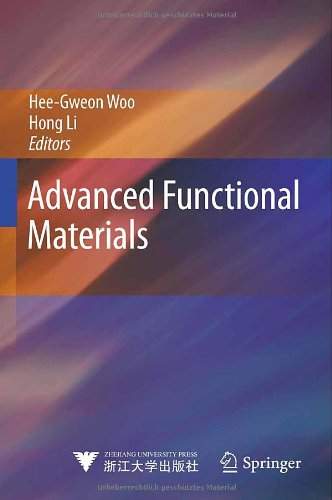 Author(s): Hee-Gweon Woo, Hong Li Publisher: Springer Year: 2011 Edition: 2011 Language: English Pages: 240 With recent developments in the polymer, ceramic, sensor, and fuel cell technology, a range of novel materials have been manufactured for advanced, compact, and electronic industry. Polymers, silicon, energy materials have received much attention in recent years. "Advanced Functional Materials" gives the most recent research results on polymer, fine ceramics, sensor, and green fuel cells. The content of this book, mainly based on the authors' recent research results, covers a broad spectrum including: the advanced inorganic-organic-hybrid polymeric materials, high functional sensor, and microbial fuel cells. The book is suitable for the researchers working in the areas of polymer, nanotechnology, ceramic engineering, engineering thermoplastic, energy and power engineering, chemical engineering and materials, etc. Hee-Gweon Woo is a professor at the Department of Chemistry, Chonnam National University, the Republic of Korea. Hong Li is a professor at the Institute of Polymer Chemistry, Nankai University, China. Table of contents : Cover......Page 1 Advanced Functional Materials......Page 4 ISBN 978-3-642-19076-6......Page 5 Preface......Page 6 Table of Contents......Page 10 1.1 Introduction......Page 14 1.2 Aromatic Polyimides......Page 15 1.2.1 Polyimides......Page 16 1.2.2 Classification......Page 17 1.2.3 Aromatic Polyimides......Page 18 1.2.4 Synthesis of Aromatic Polyimides......Page 19 1.2.5 Properties of Aromatic Polyimides......Page 20 1.2.6 Applications for Aromatic Polyimides......Page 21 1.3 Aliphatic Polyimides......Page 22 1.3.1 Monomers for Fully Aliphatic Polyimides......Page 23 1.3.2 Synthesis of Fully Aliphatic Polyimides......Page 24 1.3.3 Structural Confirmation of Fully Aliphatic Polyimides......Page 25 1.3.4 Properties of Fully Aliphatic Polyimides......Page 27 1.4.1 Semi-conducting Polyimides......Page 30 1.4.2 Polyimides as Plastic Substrate for the Flexible OLED......Page 32 1.5 Polyimide-Based Nanohybrids......Page 33 1.6.1 Polyetheretherketon (PEEK)......Page 35 1.6.2 Polysulphone (PSU)......Page 36 1.6.3 Polysulfides......Page 38 1.6.4 Polycarbonates (PC)......Page 39 1.6.5 Polyamides (PA)......Page 40 1.6.7 Poly(Phenylene Oxides)[3]......Page 42 1.6.8 Polynorbornene (PNB)......Page 43 1.7 Summary......Page 44 References......Page 45 2.1 Introduction......Page 50 2.2 Synthesis of Biodegradable Polymers by Polycondensation......Page 51 2.2.1 General Polycondensation Technique......Page 52 2.2.2 Post Polycondensation Technique......Page 53 2.2.3 Chain-Extension Technique......Page 54 2.3.1 Monomers......Page 55 2.3.2 Polymerization with Metal Catalysts......Page 56 2.3.2.1 Cationic Ring-Opening Polymerization......Page 57 2.3.2.2 Anionic Polymerization......Page 58 2.3.2.3 Coordination-Insertion Ring-Opening Polymerization......Page 60 2.3.3 Polymerization Using Metal-Free Organic Catalysts......Page 68 2.3.4 Enzyme-Catalyzed Ring-Opening Polymerization......Page 73 References......Page 74 3.1 Introduction......Page 78 3.2 Group 14 Inorganic Polymers: Polysilanes, Polygermanes, Polystannanes, and their Copolymers......Page 79 3.2.1.1 Si-Si Dehydrocatenation with High Linear Selectivity of Hydrosilanes to Polysilanes......Page 80 3.2.1.2 Dehydrocatenation of 1,1 Dihydrotetraphenylsilole and 1,1- Dihydrotetraphenylgermole to Electroluminescent Polymers for OLED Application......Page 83 3.2.1.3 Si-Si/Si-O Dehydrocatenation of Hydrosilane with Alcohol to Poly(alkoxysilane)s as Sol-Gel Precursor......Page 87 3.2.1.4 Si-N/B-N Dehydrocatenation of Poly(hydrosilane)s using Polyborazine as Cross-Linking Reagent......Page 88 3.2.2 Redistributive Catenation of Group 14 Hydrides to Polymers......Page 90 3.2.2.1 Desilanative Catenation of Multisilylmethanes to Oligomers......Page 91 3.2.2.2 Redistributive Catenation of Bis(silyl)phenylenes to Hyperbranched Polymers......Page 94 3.2.2.4 Redistributive Catenation of Hydrostannanes to Highly Branched Polystannanes......Page 96 3.2.3 Exhaustive Hydrosilylation, Hydrogermylation and Hydrostannylation of Group 14 Hydrides on Vinyl Derivatives......Page 98 3.3 Group 13 Inorganic Polymers: Polyborazines......Page 102 3.4 Group 15 Inorganic Polymers: Polyphosphazenes......Page 104 3.5 Group 16 Inorganic Polymers: Polysulfur and Poly(sulfur nitride)......Page 105 References......Page 106 4.1 Introduction......Page 116 4.2.1 Si-C-B-N Ceramics via Hydroboration from Borazine Derivatives and Trivinylcyclotrisilazane......Page 118 4.2.2 SiC/MoSi2 Ceramic Composites Prepared by Polymer Pyrolysis......Page 124 4.2.2.2 Characterization of Specimens......Page 125 4.2.3 Ti-B-N Composite from a Hybrid Precursor of Polyborazine and TiH2......Page 130 4.2.3.2 Characteristics of Preceramic Composites......Page 131 4.2.4 Al-B-N Nanocomposite from Polyborazine and Al Metal......Page 133 4.2.4.2 Characterization of Metal Preceramic Composite......Page 134 4.2.5 Al-Cr-Phosphates as Low Temperature Curable Binders......Page 137 4.2.5.1 Preparation of Samples......Page 138 4.2.5.2 Characteristics of Specimens......Page 139 4.3.1 Preparation of Carbon Fiber Reinforced BN Matrix Composite......Page 143 4.3.1.1 Preparation of BN Precursor Oligomers......Page 144 4.3.1.2 Fabrication of Composite......Page 145 4.3.2.2 Characterization of Boron-Nitride Films......Page 150 4.3.3 Fabrication of SiC-Based Ceramic Microstructures......Page 153 4.3.3.1 Macroporous SiC-Based Ceramics......Page 154 4.3.3.2 Mesoporous SiC-Based Ceramics......Page 157 4.3.3.4 Non-porous Ceramic Patterning via Soft Lithography......Page 160 4.3.3.5 Porous SiC-Based Ceramic Channels for Microreactor......Page 161 4.4 Summary......Page 163 References......Page 165 5.1 Introduction......Page 170 5.2.1.1 Etching Mechanism......Page 171 5.2.1.3 Anodization Parameters......Page 173 5.2.1.4.1 Substrate Properties......Page 175 5.2.1.4.3 Thickness......Page 176 5.2.1.4.5 Optical Properties and Bench Setup......Page 177 5.2.1.5.1 Oxidation......Page 178 5.2.1.5.2 Surface-Derivatization (Hydrosilylation)......Page 179 5.2.1.6.2 Properties of Multilayer Structures......Page 181 5.2.1.7 Encodings of Porous Silicon......Page 184 5.2.2.1 Detection of Chemical Nerve Agent Gases......Page 186 5.2.2.2 Detection of VOCs (Volatile Organic Compounds)......Page 193 5.2.3 Biological Sensing Application of Porous Silicon......Page 195 5.3 Summary......Page 202 References......Page 203 6.1 Introduction......Page 208 6.2.1 MFC Components......Page 209 6.2.2 Two-Chambered MFCs......Page 210 6.2.3 Single-Chambered MFCs......Page 211 6.2.4 Up-Flow Mode MFCs......Page 212 6.2.5 Stacked MFCs......Page 213 6.3.1 Electrode Materials......Page 214 6.3.2 Cathodic Catalysts......Page 215 6.4.1 Parameters Defining the Performance of MFCs......Page 217 6.4.2 Effects of Conditions When Operating MFCs......Page 219 6.4.2.1 Effect of Electrode Material......Page 220 6.4.2.2 Effect of Proton Exchange Membrane......Page 221 6.4.2.3 Effect of pH Buffer and ElectrolyteProton-......Page 222 6.4.2.4 Operating Conditions in the Anodic Chamber......Page 223 6.4.2.5 Operating Conditions in the Cathodic Chamber......Page 224 6.5 Metabolism in Microbial Fuel Cells......Page 225 6.6 Applications......Page 226 References......Page 228 Index......Page 234 |
 回复此楼
回复此楼» 本帖附件资源列表
-
欢迎监督和反馈:小木虫仅提供交流平台,不对该内容负责。
本内容由用户自主发布,如果其内容涉及到知识产权问题,其责任在于用户本人,如对版权有异议,请联系邮箱:xiaomuchong@tal.com - 附件 1 : Advanced_Functional_Materials.pdf
2014-12-29 12:34:32, 4.47 M
» 本帖已获得的红花(最新10朵)
 avealin
» 猜你喜欢
 40+中年人失业后,还能找到好工作吗?
已经有15人回复
40+中年人失业后,还能找到好工作吗?
已经有15人回复
-
二审4个多月了还是Awaiting Reviewer Scores
已经有5人回复
-
申请科研项目纯靠实力能成功吗?
已经有12人回复
-
用NBS溴化时溶剂除了CCl4外还有什么
已经有6人回复
-
极限拉扯,如何抉择
已经有15人回复
-
OpenAI又攻克数学难题了,离AI做有机合成还有多远?
已经有13人回复
-
课题组会帮你通过考核么?
已经有7人回复
-
售一区SCI文章T0P,我:8O.551.O54,科目全,可十急
已经有9人回复
-
售SCI一区T0P文章,我:8.O.55.1.O.5.4,科目全,可+急
已经有10人回复
-
售SCI一区T0P文章,我:8O.55.1.O.5.4,科目齐全,可+急
已经有7人回复
» 本主题相关商家推荐: (我也要在这里推广)

102楼2015-01-03 15:44:31
简单回复
甲木秋2楼
2014-12-29 14:21
回复
五星好评 顶一下,感谢分享!
2014-12-29 14:33
回复
五星好评 顶一下,感谢分享!
zsma78804楼
2014-12-29 16:14
回复
五星好评 顶一下,感谢分享!
雷智锋石芸竹6楼
2014-12-29 17:13
回复
五星好评 顶一下,感谢分享!
何杜7楼
2014-12-29 17:31
回复
五星好评 顶一下,感谢分享!
chquan8楼
2014-12-29 20:23
回复
五星好评 顶一下,感谢分享!
yxzhou200110楼
2014-12-29 20:50
回复
三星好评 顶一下,感谢分享!
saxon123411楼
2014-12-29 20:52
回复
五星好评 顶一下,感谢分享!
xinmor12楼
2014-12-29 21:44
回复
五星好评 顶一下,感谢分享!
mijigege13楼
2014-12-30 00:10
回复
五星好评 顶一下,感谢分享!
zch668200314楼
2014-12-30 04:38
回复
五星好评 顶一下,感谢分享!