









| 查看: 6833 | 回复: 175 | ||
| 当前只显示满足指定条件的回帖,点击这里查看本话题的所有回帖 | ||
[资源]
淬火理论及其技术(2010CRC英文第二版)
|
||

|
Quenching theory and technology 分享给大家,希望对大家有帮助,也希望大家下载后给予好评,不做伸手党,对我们分享资源者给予支持,谢谢! 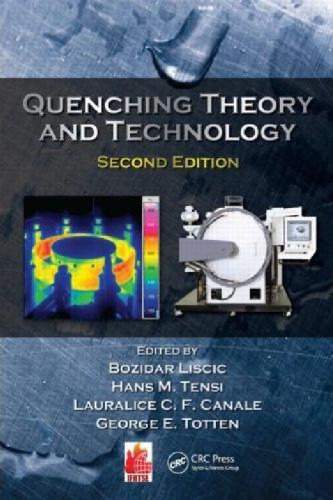 Author(s): B Liéséciâc; International Federation for Heat Treatment and Surface Engineering.; et al Publisher: CRC Year: 2010 Edition: 2nd ed Language: English Pages: 685 Features Updates and expands coverage of high pressure gas quenching (HPGQ) in vacuum furnaces Explores intensive quenching (IQ), a promising new technology that facilitates compressive surface stresses and minimized distortion Discusses modeling and simulation of coupled quenching phenomena: heat transfer, microstructure transformation, stress and strain development, and distortion of quenched workpieces Analyzes new quenching media, especially quench oils based on renewable basestocks (vegetable oils) Offers new details about quenching of aluminum alloys and titanium alloys, which are being used increasingly for lightweight constructions Summary Quenching is one of the most fundamentally complex processes in the heat treatment of metals, and it is something on which mechanical properties and distortion of engineering components depend. With chapters written by the most respected international experts in the field, Quenching Theory and Technology, Second Edition presents the most authoritative, exhaustive, and recent findings in this vital area. Understanding and control of quenching and quenchants is a critical constant in all well established and emerging heat treatment process technology. The collection of up-to-date knowledge in this book is the latest outcome from continuing formal and informal discussions by experts within the framework of the International Federation for Heat Treatment and Surface Engineering (IFHTSE). It covers topics including: Thermo-and fluid dynamic principles of heat transfer during cooling Wetting kinematics Residual stresses after cooling Computer modeling and prediction of microstructure transformation Hardness distribution Stress-strain and distortion With revised and updated content from the first edition, this book adds coverage of important technological developments. Although the primary focus continues to be on the quenching of steel, it also details quenching of aluminum and titanium alloys, quench severity of selected vegetable oils, gas quenching, intensive quenching, and simulation of quenching. Presenting the most recent findings in this area, this essential piece of literature is a substantial contribution to the general field of the thermal processing of metals. It is useful not only for specialists in heat treatment practice, but also those in higher education or numerous specialized courses and seminars worldwide. Table of Contents Hardening of Steels, L. de C.F. Canale and G.E. Totten Quenching of Aluminum Alloys, R.T. Shuey and M. Tiryakiogliu Quenching of Titanium Alloys, L. Meekisho, X. Yao, and G.E. Totten Mechanical Properties of Ferrous and Nonferrous Alloys after Quenching, H.-J. Spies Thermo- and Fluid-Dynamic Principles of Heat Transfer during Cooling, F. Mayinger Heat Transfer during Cooling of Heated Metals with Vaporizable Liquids, R. Jeschar, E. Specht, and C. Köhler Wetting Kinematics, H.M. Tensi Wetting Kinetics and Quench Severity of Selected Vegetable Oils for Heat Treatment, K.N. Prabhu Residual Stresses after Quenching, V. Schulze, O. Vöhringer, and E. Macherauch Effect of Workpiece Surface Properties on Cooling Behavior, F. Moreaux, G. Beck, and P. Archambault Determination of Quenching Power of Various Fluids, H.M. Tensi and B. Lišcic Types of Cooling Media and Their Properties, W. Luty Gas Quenching, G. Belinato, L. de C.F. Canale, and G.E. Totten Techniques of Quenching, H.E. Boyer, P. Archambault, and F. Moreaux Intensive Steel Quenching Methods, N.I. Kobasko Prediction of Hardness Profi le in Workpiece Based on Characteristic Cooling Parameters and Material Behavior during Cooling, H.M. Tensi and B. Lišcic Simulation of Quenching, C. Simsir and C. Hakan Gür Appendices Index |
 回复此楼
回复此楼» 本帖附件资源列表
-
欢迎监督和反馈:小木虫仅提供交流平台,不对该内容负责。
本内容由用户自主发布,如果其内容涉及到知识产权问题,其责任在于用户本人,如对版权有异议,请联系邮箱:xiaomuchong@tal.com - 附件 1 : Quenching_theory_and_technology.pdf
2014-12-23 12:00:27, 20.06 M
» 本帖已获得的红花(最新10朵)
 kuangsheng12
» 猜你喜欢


85楼2016-01-18 00:03:16
简单回复
2014-12-23 13:07
回复
五星好评 顶一下,感谢分享!
雷智锋石芸竹3楼
2014-12-23 18:24
回复
五星好评 顶一下,感谢分享!
cnsky4楼
2014-12-23 18:35
回复
五星好评 顶一下,感谢分享!
直言有碍和谐5楼
2014-12-23 21:00
回复
五星好评 顶一下,感谢分享!
junex6楼
2014-12-24 12:19
回复
五星好评 顶一下,感谢分享!
2014-12-24 17:06
回复
五星好评 顶一下,感谢分享!
zjjxl8楼
2014-12-24 21:31
回复
五星好评 顶一下,感谢分享!
suncc3119楼
2014-12-25 17:52
回复
五星好评 顶一下,感谢分享!
zjys588710楼
2014-12-25 18:53
回复
五星好评 顶一下,感谢分享!
casclzb11楼
2014-12-25 19:44
回复
五星好评 顶一下,感谢分享!
shenlanxinyu12楼
2014-12-25 22:46
回复
五星好评 顶一下,感谢分享!
peterflyer13楼
2014-12-25 23:10
回复
五星好评 顶一下,感谢分享!
wji32114楼
2014-12-25 23:42
回复
五星好评 顶一下,感谢分享!