









| 查看: 3949 | 回复: 94 | ||
| 当前只显示满足指定条件的回帖,点击这里查看本话题的所有回帖 | ||
[资源]
传热传质基础Fundamentals of heat and mass transfer
|
||

Kothandaraman等人著作的Fundamentals of heat and mass transfer第3版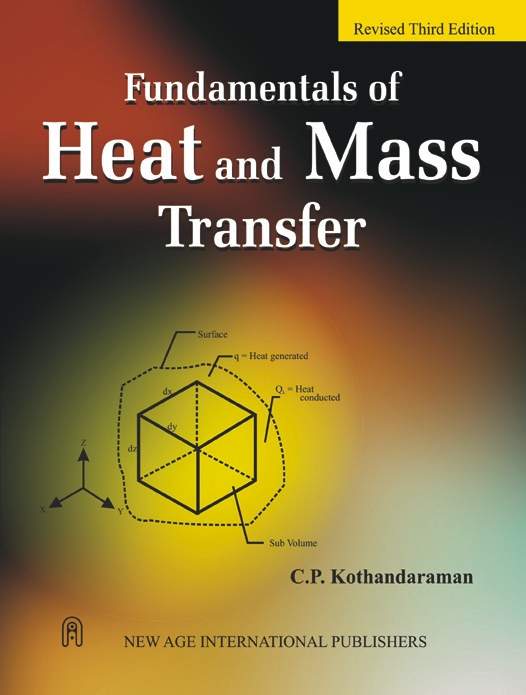 Professor Obert has observed in his famous treatise on Thermodynamics that concepts are better understood by their repeated applications to real life situations. A firm conviction of this principle has prompted the author to arrange the text material in each chapter in the following order. In the first section after enunciating the basic concepts and laws mathematical models are developed leading to rate equations for heat transfer and determination of temperature field, simple and direct numerical examples are included to illustrate the basic laws. More stress is on the model development as compared to numerical problems. A section titled “SOLVED PROBLEMS” comes next. In this section more involved derivations and numerical problems of practical interest are solved. The investigation of the effect of influencing parameters for the complete spectrum of values is attempted here. Problems involving complex situations are shown solved in this section. Two important ideas are stressed in this section. These are checking of dimensional homogeneity in the case of all equations derived and the validation of numerical answers by cross checking. This concept of validation in professional practice is a must in all design situations. In the next section objective type questions are given. These are very useful for understanding the basis and resolving misunderstandings. In the final section a large number of graded exercise problems involving simple to complex situations are included. In the first of the 14 chapters the basic laws for the three modes of heat transfer are introduced and the corresponding rate equations are developed. The use of electrical analogy is introduced and applied to single and multimode heat transfer situations. The need for iterative working is stressed in the solved problems. The second chapter deals with one dimensional steady state conduction. Mathematical models are developed by the three geometries namely Plate, Hollow Cylinder and Hollow Sphere. Multilayer insulation is also discussed. The effect of variation of thermal conductivity on heat transfer and temperature field is clearly brought out. Parallel flow systems are discussed. Examples on variation of area along the heat flow direction are included. The use of electrical analogy is included in all the worked examples. The importance of calculating the temperature gradient is stressed in many of the problems. In the third chapter models for conduction with heat generation are developed for three geometric configurations namely plate, cylinder and sphere. The effect of volume to surface area and the convection coefficient at the surface in maintaining lower material temperature is illustrated. Hollow cylindrical shape with different boundary conditions is discussed. Conduction with variable heat generation rate is also modelled. Preface to the Third Edition v 1 AN OVERVIEW OF HEAT TRANSFER 1–25 2 STEADY STATE CONDUCTION 26–98 3 CONDUCTION WITH HEAT GENERATION 99–127 4 HEAT TRANSFER WITH EXTENDED SURFACES (FINS) 128–175 5 TWO DIMENSIONAL STEADY HEAT CONDUCTION 176–201 6 TRANSIENT HEAT CONDUCTION 202–284 Solved Problems 550 Objective Questions 572 Exercise Problems 574 13 THERMAL RADIATION 578–655 14 MASS TRANSFER 656–701 Exercise Problems 680 Fill in the Blanks 682 State True or False 699 Short Questions 702 Appendix 707 References 712 |
 回复此楼
回复此楼» 本帖附件资源列表
-
欢迎监督和反馈:小木虫仅提供交流平台,不对该内容负责。
本内容由用户自主发布,如果其内容涉及到知识产权问题,其责任在于用户本人,如对版权有异议,请联系邮箱:xiaomuchong@tal.com - 附件 1 : Fundamentals_of_heat_and_mass_transfer.pdf
2014-12-11 08:44:47, 9.38 M
» 猜你喜欢
 极限拉扯,如何抉择
已经有16人回复
极限拉扯,如何抉择
已经有16人回复
-
40+中年人失业后,还能找到好工作吗?
已经有16人回复
-
人工智能虚构史料、伪造文献频现,多家期刊声明抵制
已经有4人回复
-
CsPbI2Br全无机钙钛矿SEM图像异常分析
已经有8人回复
-
用NBS溴化时溶剂除了CCl4外还有什么
已经有9人回复
-
申请科研项目纯靠实力能成功吗?
已经有12人回复

85楼2018-03-25 19:17:52
简单回复
2014-12-11 08:58
回复
五星好评 顶一下,感谢分享!
sherry894楼
2014-12-11 11:38
回复
五星好评 顶一下,感谢分享!
2014-12-11 15:33
回复
五星好评 顶一下,感谢分享!
muxinjin6楼
2014-12-11 16:06
回复
五星好评 顶一下,感谢分享!
2014-12-11 18:29
回复
五星好评 顶一下,感谢分享!
李加伟8楼
2014-12-11 22:53
回复
五星好评 顶一下,感谢分享!
jzw04129楼
2014-12-12 08:52
回复
五星好评 顶一下,感谢分享!
liusix10楼
2014-12-12 11:13
回复
五星好评 顶一下,感谢分享!
haowuyu11楼
2014-12-12 14:58
回复
五星好评 顶一下,感谢分享!
VDFEPI12楼
2014-12-12 15:17
回复
五星好评 顶一下,感谢分享!
luchhi13楼
2014-12-12 18:05
回复
五星好评 顶一下,感谢分享!
shileijerry14楼
2014-12-13 08:27
回复
