









| 查看: 7483 | 回复: 217 | |||
| 当前只显示满足指定条件的回帖,点击这里查看本话题的所有回帖 | |||
[资源]
2014新书:石墨烯的功能及其应用(Functionalization of Graphene)
|
|||

Functionalization of Graphene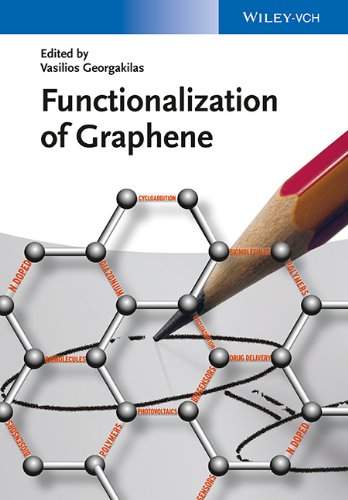 Author(s): Vasilios Georgakilas (Ed.) Series: Periodical: Publisher: Wiley-VCH City: Year: 2014 Edition: 1st Language: English Pages: 424 ISBN: 352733551X, 9783527335510 ID: 1193235 All set to become the standard reference on the topic, this book covers the most important procedures for chemical functionalization, making it an indispensable resource for all chemists, physicists, materials scientists and engineers entering or already working in the field. Expert authors share their knowledge on a wide range of different functional groups, including organic functional groups, hydrogen, halogen, nanoparticles and polymers. Contents Preface XIII List of Contributors XV 1 An Introduction to Graphene 1 Konstantinos Spyrou and Petra Rudolf 1.1 Brief History of Graphite 1 1.2 Graphene and Graphene Oxide 2 1.2.1 Preparation of Graphene from Graphene Oxide 3 1.2.2 Isolation of Pristine Graphene Monolayers 5 1.2.3 Large Scale Production of GO by Langmuir-Blodgett Methods 6 1.2.4 Other Methods of Graphene Production 6 1.3 Characterization of Graphene 9 1.3.1 Microscopic Observation 9 1.3.2 Raman Spectroscopy 11 1.3.3 Thermogravimetric Analysis 12 1.3.4 Optical Properties of Graphene 13 1.3.5 X-Ray Diffraction Pattern 17 References 18 2 Covalent Attachment of Organic Functional Groups on Pristine Graphene 21 Vasilios Georgakilas 2.1 Introduction 21 2.2 Cycloaddition Reactions 22 2.2.1 1,3-Dipolar Cycloaddition of Azomethine Ylide 22 2.2.1.1 Through a Substituted Aldehyde Pathway 24 2.2.1.2 Through Substituted α Amino Acid Pathway 27 2.2.2 Cycloaddition by Zwitterionic Intermediate 28 2.2.3 Diels–Alder Cycloaddition 29 2.2.4 Nitrene Addition 30 2.2.5 Carbene Addition 35 2.2.6 Aryne Addition 36 2.2.7 Bingel Type Cycloaddition 37 4 Chemical Functionalization of Graphene for Biomedical Applications 95 Cinzia Spinato, C′ecilia M′enard-Moyon, and Alberto Bianco 4.1 Introduction 95 4.2 Covalent Functionalization of Graphene Nanomaterials 97 4.2.1 Synthesis of GO and rGO 99 4.2.1.1 Synthesis of Graphene Oxide 99 4.2.1.2 Reduction of Graphene Oxide 99 4.2.2 Functionalization of Graphene Oxide with Polymers 100 4.2.2.1 PEGylated-GO Conjugates 100 4.2.2.2 Covalent Linkage of Biopolymers 103 4.2.3 Tethering of Antibodies 105 4.2.4 Attachment of Nucleic Acids 106 4.2.5 Grafting of Peptides and Enzymes 108 4.2.6 Attachment of Other Organic Molecules and Biomolecules 108 4.3 Non-covalent Functionalization of Graphene 110 4.3.1 Adsorption via π-Stacking 110 4.3.1.1 Adsorption of Drugs 111 4.3.1.2 Adsorption of Pyrene Derivatives 111 4.3.1.3 Non-covalent Interactions with Nucleic Acids and Aptamers 113 4.3.1.4 Immobilization of Enzymes, Proteins, and Other Macromolecules 116 4.3.2 Electrostatic and Hydrophobic Interactions 116 4.3.2.1 Coating with Polymers and Biopolymers 116 4.3.2.2 Deposition of Nanoparticles 119 4.3.2.3 Adsorption of Quantum Dots 121 4.4 Graphene-Based Conjugates Prepared by a Combination of Covalent and Non-covalent Functionalization 121 4.4.1 Polymer- and Biopolymer-Grafted Graphene Nanomaterials Used as Nanocarriers 121 4.4.1.1 Polymer-Functionalized GO for Drug Delivery 122 4.4.1.2 Polymer-Functionalized GO for Gene Delivery 123 4.4.1.3 Chitosan-Functionalized GO 125 4.4.2 GO Functionalized with Targeting Ligands and Antibodies 125 4.4.2.1 Folic Acid-Conjugated GO 125 4.4.2.2 Antibody-Functionalized GO for Radioimaging and Biosensing 127 4.5 Conclusions 129 Acknowledgments 130 References 130 5 Immobilization of Enzymes and other Biomolecules on Graphene 139 Ioannis V. Pavlidis, Michaela Patila, Angeliki C. Polydera, Dimitrios Gournis, and Haralampos Stamatis 5.1 Introduction 139 8.6 Conclusions 252 References 252 9 Functionalization of Graphene by other Carbon Nanostructures 255 Vasilios Georgakilas 9.1 Introduction 255 9.2 Graphene–C60 Nanocomposites 255 9.2.1 Covalent Bonding of C60 on GO 256 9.2.2 Deposition of C60 on Graphene 256 9.3 Graphene–CNT Hybrid Nanostructures 262 9.3.1 Graphene–CNT Composites by Simple Mixing 264 9.3.2 Graphene–CNTs Hybrid Nanostructures by Direct Development of CNTs on Graphene Surface 272 9.4 Graphene–Carbon Nanospheres 274 9.5 Graphene–Carbon Nitride Dots Hybrid Nanocomposite 277 9.6 Conclusions 279 References 280 10 Doping of Graphene by Nitrogen, Boron, and Other Elements 283 Achutharao Govindaraj and C.N.R. Rao 10.1 Introduction 283 10.2 Nitrogen-Doped Graphene 284 10.2.1 DC Arcing 284 10.2.2 Heating with Ammonia, Hydrazine, and Other Reagents 287 10.2.3 Chemical Functionalization Route 288 10.2.4 Solvothermal Synthesis 289 10.2.5 Chemical Vapor Deposition and Pyrolysis 293 10.2.6 Pyrolysis Methods 300 10.2.7 Other Methods 306 10.3 Boron Doping 320 10.3.1 Mechanical Exfoliation 321 10.3.2 Thermal Annealing 321 10.3.3 Chemical Vapor Deposition 323 10.3.4 Other Methods 326 10.4 BN Doping in Graphene 329 10.5 Doping with Other Elements 334 10.6 Properties and Applications 339 References 352 11 Layer-by-Layer Assembly of Graphene-Based Hybrid Materials 359 Antonios Kouloumpis, Panagiota Zygouri, Konstantinos Dimos, and Dimitrios Gournis 11.1 Introduction 359 11.2 LbL Graphene-Based Hybrid Films 360 |
 回复此楼
回复此楼» 本帖附件资源列表
-
欢迎监督和反馈:小木虫仅提供交流平台,不对该内容负责。
本内容由用户自主发布,如果其内容涉及到知识产权问题,其责任在于用户本人,如对版权有异议,请联系邮箱:xiaomuchong@tal.com - 附件 1 : Functionalization_of_Graphene.pdf
2014-12-08 21:06:49, 9.41 M
» 猜你喜欢
 修改论文,如何借助其他力量?
已经有4人回复
修改论文,如何借助其他力量?
已经有4人回复
-
中山大学潘越教授课题组2027级推免硕士研究生招生 新增一个专业医学技术名额
已经有21人回复
-
无机化学论文润色/翻译怎么收费?
已经有244人回复
-
哈尔滨工程大学国家级青年人才-27年申请考核制博士招生(材料、化学、生物医学专业)
已经有12人回复
-
HRTEM/原位TEM/HRSTEM检测|价格优·周期短·可加急
已经有0人回复
-
大家平时也可以交流下
已经有1人回复
» 本主题相关商家推荐: (我也要在这里推广)

118楼2014-12-15 08:36:10
nowitzki_ci
专家顾问 (著名写手)
-

专家经验: +139 - MN-EPI: 17
- 应助: 67 (初中生)
- 金币: 21070.8
- 帖子: 2329
- 在线: 1507.1小时
- 虫号: 1035941
2楼2014-12-08 21:18:29
简单回复
mlp3693楼
2014-12-09 00:05
回复
五星好评 顶一下,感谢分享!
2014-12-09 00:44
回复
五星好评 顶一下,感谢分享!
cord5楼
2014-12-09 01:02
回复
五星好评 顶一下,感谢分享!
2014-12-09 01:09
回复
五星好评 顶一下,感谢分享!
2014-12-09 04:04
回复
五星好评 顶一下,感谢分享!
Chuntetu8楼
2014-12-09 07:09
回复
五星好评 顶一下,感谢分享!
wtiger9楼
2014-12-09 08:02
回复
五星好评 顶一下,感谢分享!
lh52232410楼
2014-12-09 08:06
回复
五星好评 顶一下,感谢分享!
fengcanluoye11楼
2014-12-09 08:16
回复
五星好评 顶一下,感谢分享!
d73129712楼
2014-12-09 08:23
回复
五星好评 顶一下,感谢分享!
liping200913楼
2014-12-09 09:31
回复
五星好评 顶一下,感谢分享!
不第书生14楼
2014-12-09 09:53
回复
五星好评 顶一下,感谢分享!