












| 查看: 1541 | 回复: 33 | |||
| 【奖励】 本帖被评价28次,作者shileijerry增加金币 22 个 | |||
| 当前只显示满足指定条件的回帖,点击这里查看本话题的所有回帖 | |||
[资源]
不锈钢腐蚀开裂的研究方法(英文版)
|
|||

Methodology of Crevice Corrosion Testing for Stainless Steels in Natural and Treated Seawaters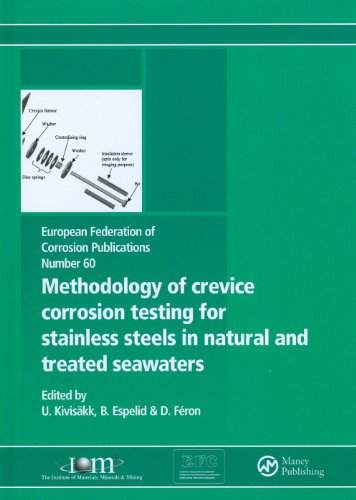 Crevice corrosion in chloride-containing environments, particularly sea water, poses a serious threat to the integrity of stainless steels and has been responsible for many failures. The need for a reliable test method to measure the susceptibility of passive metals to crevice corrosion in sea water has been addressed recently in a major European Programme, CREVCORR. This work was coordinated by Bard Espelid of DNV (Norway) and involved collaboration between ten different companies in six European countries. Many members of EFC Working Party 9 (Marine Corrosion) participated in the work. The first nine chapters of the book describe the development of the new crevice corrosion test method for plate and tubular materials and its application to a number of austenitic, ferritic and duplex stainless steels. A key aim was to develop a crevice corrosion test procedure where the biological activity and oxidation capacity of natural and treated sea waters are simulated electrochemically. Another important aspect of the work was to formulate a new synthetic sea water capable of simulating the corrosiveness of natural and treated sea waters, including the effects of the bio-films that can form in natural waters. The final chapter presents the results of two large collaborative test programmes involving a total of 19 laboratories in eight countries worldwide. These involved tests in natural and synthetic sea waters to evaluate the new crevice test and synthetic sea water. The book will be of value to scientists and engineers engaged in the selection of stainless steels for applications in sea water and other chlorinated natural environments Series introduction x Volumes in the EFC series xii Preface xvii 1 Crevice corrosion from a historical perspective 1 1.1 Introduction 1 1.2 The mechanism 1 1.3 The ferric chloride test 2 1.4 Field tests 3 1.5 Electrochemical tests 5 1.6 Conclusions 6 2 Objectives and background 8 2.1 Introduction 8 2.2 Establishment of the state-of-the-art 9 2.3 Formulation of a new synthetic seawater 9 2.4 Electrochemically controlled crevice corrosion test 10 2.5 Inter-comparison testing 10 3 Laboratory calibration 12 3.1 ‘Calibration’ of participating laboratories in the project 12 3.2 Experimental procedure 12 3.3 Test results 12 3.3.1 Weight loss 12 3.3.2 Number of etchings/attacks 13 3.3.3 Maximum depth of attack 16 3.4 Conclusions from the ‘calibration’ test 16 4 Crevice formers for specimens of plate material 17 4.1 Optimisation of test parameters of importance for crevice corrosion testing 17 5 Crevice corrosion testing of tubes 21 5.1 Introduction 21 5.2 Experimental 22 5.2.1 Materials 22 5.2.2 Design of crevice former 22 5.2.3 Finite Element Method Modelling 23 5.2.4 Crevice corrosion testing 23 5.3 Results 24 5.3.1 Finite Element Method modelling 24 5.3.2 Crevice corrosion testing 24 5.4 Discussion 26 5.4.1 Specimen area 27 5.4.2 Crevice former 27 5.4.3 Clamping force 27 5.4.4 Proposed crevice former procedure for tube specimens 28 5.5 Crevice corrosion testing of stainless steel tubes applied as umbilicals 28 5.6 Conclusions from crevice corrosion testing of tubes 28 6 Formulation of new synthetic seawater for aerobic environments 30 6.1 Introduction 30 6.2 Experimental 31 6.3 Electrochemical tests 32 6.4 Crevice corrosion experiments 33 6.4.1 After test examination 34 6.4.2 Chemical method versus the biochemical method 34 6.4.3 Infl uence of the tank material 38 6.4.4 Infl uence of the cathodic area 39 6.4.5 Infl uence of stainless steel grades 39 6.4.6 Infl uence of chemicals and biochemicals 40 6.4.7 Infl uence of temperature 41 6.4.8 Infl uence of the crevice holder system 41 6.5 Conclusion 42 7 Simulation of anaerobic environments 44 7.1 Introduction 44 7.2 Experimental 44 7.3 Results and discussion 46 7.3.1 Infl uence of the polarisation scanning rate 46 7.3.2 Breakdown potentials in sterile aerated seawater 48 7.3.3 Breakdown potentials in anaerobic seawater with SRB 50 7.3.4 Breakdown potentials Na2S solution 51 7.4 Conclusion 52 8 Synergy of aerobic and anaerobic conditions 53 8.1 Introduction 53 8.2 Synergy of aerobic and anaerobic biofi lms on EN 1.4404 54 8.3 Synergy of aerobic and anaerobic biofi lms on EN 1.4462 and EN 1.4547 57 8.4 Laboratory simulation of the synergy 58 8.5 Conclusion 58 9 Electrochemical simulation of aerobic environments with or without chlorine 60 9.1 Electrochemical simulation of biofi lm effects and treatment of seawaters 60 9.2 Conclusions from activities related to electrochemical simulation of natural and treated seawaters 66 10 Profi ciency of crevice corrosion methods: inter-comparison tests 67 10.1 Introduction 67 10.2 Experimental 68 10.2.1 Materials 68 10.2.2 Test procedure – general 68 10.2.3 Synthetic biochemical seawater tests 69 10.2.4 Natural seawater tests 70 10.3 Results 71 10.3.1 Natural seawater tests 71 10.3.2 Synthetic biochemical seawater tests 78 10.4 Discussion 78 10.4.1 Natural seawater 78 10.4.2 Spring loaded crevice formers 81 10.4.3 Corrosivity of the synthetic biochemical seawater versus natural seawater 83 10.4.4 Synthetic biochemical seawater and Critical Crevice Temperature 84 10.5 Conclusion 87 Appendix A Calibration procedures for crevice corrosion tests in 6% FeCl3 88 A.1 Scope 88 A.2 References 88 A.3 Test material 88 A.4 Test specimen 88 A.5 Specimen treatment 88 A.6 Crevice formers 88 A.7 Assembling of crevice formers 89 A.8 Apparatus 90 A.9 Test solution 90 A.10 Test temperatures 90 A.11 Procedure 92 A.12 Evaluation 92 A.13 Report 92 Appendix B Crevice corrosion tests in natural seawater and synthetic biochemical seawater: Test procedures for CREVCORR round robin tests 94 B.1 Scope 94 B.2 References 94 B.3 Test material 94 B.4 Test specimen 94 B.5 Specimen treatment 95 B.6 Crevice assembly 95 B.7 Assembly of crevice formers 95 B.8 Electrical connections and suspension method 97 B.9 Apparatus 97 B.10 Test solution 97 B.11 Test temperatures 97 B.12 Test procedure 98 |
 回复此楼
回复此楼» 本帖附件资源列表
-
欢迎监督和反馈:小木虫仅提供交流平台,不对该内容负责。
本内容由用户自主发布,如果其内容涉及到知识产权问题,其责任在于用户本人,如对版权有异议,请联系邮箱:xiaomuchong@tal.com - 附件 1 : Methodology_of_Crevice_Corrosion_Testing_for_Stainless_Steels_in_Natural_and_Treated_Seawaters.pdf
2014-12-01 10:14:45, 3.73 M
» 收录本帖的淘帖专辑推荐
 腐蚀与防护 腐蚀与防护 |
» 猜你喜欢
 26级博士申请
已经有2人回复
26级博士申请
已经有2人回复
-
寻找一款土质材料
已经有24人回复
-
金属材料论文润色/翻译怎么收费?
已经有65人回复
-
求助纳米氧化铝粉资源
已经有15人回复
-
HDPE粒子出现发黄的原因
已经有11人回复
-
太阳能界面蒸发协同发电
已经有2人回复
-
国家级高层次人才低维材料与器件力学团队招收博士研究生
已经有10人回复
-
有没有适合电极材料负极的3-4区期刊推荐,孩子要毕业,谢谢
已经有6人回复
-
南开大学杰青团队 招收理论计算方向 2026级博士生
已经有4人回复
-
中国科学院赣江创新研究院水下信息技术中心团队人才招聘
已经有0人回复
-
中国科学院赣江创新研究院水下信息技术中心人才招聘
已经有0人回复

» 本主题相关价值贴推荐,对您同样有帮助:
 奥氏体不锈钢 σ相 怎么鉴定
已经有9人回复
奥氏体不锈钢 σ相 怎么鉴定
已经有9人回复- 关于拉伸试样观察侧面的裂纹如何腐蚀啊
已经有16人回复
- 304奥氏体不锈钢的腐蚀问题
已经有8人回复
- 应力腐蚀开裂试验
已经有3人回复
- 304不锈钢怎么防盐的腐蚀
已经有10人回复
- 腐蚀试验机 SSRT SCC CT试验 腐蚀疲劳,电化学
已经有18人回复
- 请教——不锈钢,耐热合金用什么腐蚀好呢?
已经有4人回复
- 不锈钢用苦味酸腐蚀怎么像这样啊?
已经有5人回复
- 本人新虫,做了不锈钢腐蚀特性的电化学实验,数据处理遇到问题,贴图请教!
已经有9人回复
- 求助关于马氏体不锈钢的腐蚀方面的文献
已经有5人回复
- 关于管线钢的应力腐蚀中应力的方向
已经有7人回复
- 应力腐蚀的问题求助!
已经有4人回复
- 不锈钢腐蚀速率
已经有6人回复
- 不锈钢晶间腐蚀可能性
已经有5人回复
- 【资源】《金属的韧性与韧化》高清PDF版,肖纪美院士巨著【已搜索无重复】
已经有48人回复
- 【资源】《合金相与相变》第二版,高清PDF版,肖纪美院士巨著【已搜索无重复】
已经有31人回复
- 【求助】请教大家:钼为什么能够提高不锈钢的耐腐蚀性?
已经有4人回复
- 【求助】请问大家:316L不锈钢用什么腐蚀剂?
已经有21人回复
- 【求助】铁素体不锈钢的腐蚀问题
已经有10人回复
- 【请教】最近做超超级不锈钢的研究(UNS S32707) 大家有没有相关的文献
已经有12人回复
- 【分享】计算必备书籍之《合金能量学》(肖纪美院士)
已经有60人回复
- 【资源】中国不锈钢腐蚀手册
已经有62人回复
14楼2016-01-10 15:21:14
简单回复
万有引力2楼
2014-12-01 11:23
回复
五星好评 顶一下,感谢分享!
2014-12-01 12:05
回复
五星好评 顶一下,感谢分享!
屋檐儿4楼
2014-12-01 12:18
回复
五星好评 顶一下,感谢分享!
2014-12-01 17:55
回复
五星好评 顶一下,感谢分享!
mse_x6楼
2014-12-02 11:54
回复
五星好评 顶一下,感谢分享!
2014-12-04 10:09
回复
五星好评 顶一下,感谢分享!
2014-12-17 23:17
回复
五星好评 顶一下,感谢分享!
2014-12-21 23:05
回复
顶一下,感谢分享!
josiahimr10楼
2014-12-25 16:55
回复
五星好评 顶一下,感谢分享!
ding12311楼
2015-03-30 10:10
回复
五星好评 顶一下,感谢分享!
wwy1279_wu12楼
2015-04-04 12:58
回复
五星好评 顶一下,感谢分享!
yuanchang13楼
2016-01-08 20:47
回复
五星好评 顶一下,感谢分享!