









| 查看: 1147 | 回复: 12 | |||||||
| 【奖励】 本帖被评价11次,作者nowitzki_ci增加金币 8.8 个 | |||||||
nowitzki_ci专家顾问 (著名写手)
|
[资源]
2013年新著关于手性的好书:Differentiation of Enantiomers
|
||||||


|
Differentiation of Enantiomers I ISSN 0340-1022 ISSN 1436-5049 (electronic) ISBN 978-3-319-03238-2 ISBN 978-3-319-03239-9 (eBook) DOI 10.1007/978-3-319-03239-9 Springer Heidelberg New York Dordrecht London In the wake of enantioselective syntheses and chiral technologies, efficient analytical methods for the differentiation of enantiomers have become essential. Earlier compendia in this area need updating due to important recent advances made in the realm of enantiomeric differentiation. Precise analytical tools for the determination of enantiomeric proportions are important in many contemporary fields associated with various aspects of chirality. The distribution of enantioselective methods for the determination of enantiomeric proportions utilized in 319 published articles of Tetrahedron Asymmetry 2003, i.e., polarimetry , gas chromatography (GC), high performance liquid chromatography (HPLC), and nuclear magnetic resonance spectroscopy (NMR),has been compiled previously. These two volumes of Topics in Current Chemistry review various modern methods and techniques of enantiomeric differentiation. Individual chapters have been written by pioneers in the field and emerge from renowned laboratories which have contributed significantly to recent research. In each chapter emphasis has been given to an extended reference format including the titles of related original work which will enable readers to appreciate and consult the important secondary literature. The first volume begins with an introduction to historic and fundamental aspects of chirality followed by recommendations on how to quantify mixtures of stereoisomers. Enantiomeric differentiation by chiral liquid chromatography utilizing supramolecular chiral recognition systems and various chiroptic approaches is described. Enantiomeric differentiation by gas chromatography and capillary elec trophoresis concludes the first volume. The second volume begins with enantiomeric differentiation by NMR spectroscopy and sensor devices followed by chiral recognition phenomena in supramolecular chemistry, chromatographic studies of stereolabile interconverting enantiomers, and anisotropy spectroscopy as a novel extension of circular dichroism. The second volume is concluded with the self-disproportionation of enantiomers due to nonlinear effects. We hope that these volumes on the differentiation of enantiomers will provide inspiration and impetus to further advances in the ever-growing area of stereochemistry. The editor is grateful to all the colleagues who have helped to create this survey on modern tools for the differentiation of enantiomers. Contents Molecular Chirality: Language, History, and Significance ................. 1 Joseph Gal Terms for the Quantitation of a Mixture of Stereoisomers ................ 21 Volker Schurig Enantiomeric Differentiation by Synthetic Helical Polymers ............. 41 Eiji Yashima, Hiroki Iida, and Yoshio Okamoto Chiral Supramolecular Selectors for Enantiomer Differentiation in Liquid Chromatography ...................................................... 73 Alessia Ciogli, Dorina Kotoni, Francesco Gasparrini, Marco Pierini, and Claudio Villani Chiroptical Detectors for the Study of Unusual Phenomena in Chiral Chromatography ............................................................. 107 Nicolas Vanthuyne and Christian Roussel Salient Features of Enantioselective Gas Chromatography: The Enantiomeric Differentiation of Chiral Inhalation Anesthetics as a Representative Methodological Case in Point ........................ 153 Volker Schurig Differentiation of Enantiomers by Capillary Electrophoresis ............ 209 Gerhard K.E. Scriba Index .......................................................................... 277 Differentiation of Enantiomers II Contents Chiral Derivatizing Agents, Macrocycles, Metal Complexes, and Liquid Crystals for Enantiomer Differentiation in NMR Spectroscopy .......................................................... 1 Thomas J. Wenzel Chiral NMR Solvating Additives for Differentiation of Enantiomers .... 69 Gloria Uccello-Barretta and Federica Balzano Chiral Sensor Devices for Differentiation of Enantiomers ............... 133 Kyriaki Manoli, Maria Magliulo, and Luisa Torsi Enantiopure Supramolecular Cages: Synthesis and Chiral Recognition Properties ..................................................................... 177 Thierry Brotin, Laure Guy, Alexandre Martinez, and Jean-Pierre Dutasta Interconversion of Stereochemically Labile Enantiomers (Enantiomerization) .......................................................... 231 Oliver Trapp Anisotropy Spectra for Enantiomeric Differentiation of Biomolecular Building Blocks ............................................................... 271 A.C. Evans, C. Meinert, J.H. Bredeho¨ft, C. Giri, N.C. Jones, S.V. Hoffmann, and U.J. Meierhenrich Self-disproportionation of Enantiomers of Enantiomerically Enriched Compounds ........................................................ 301 Alexander E. Sorochinsky and Vadim A. Soloshonok Index .......................................................................... 341 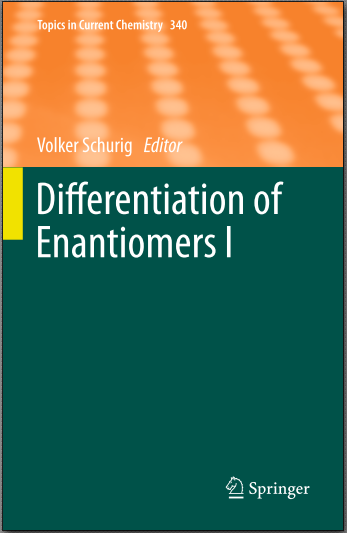 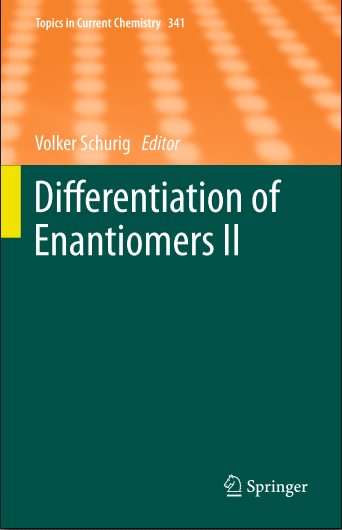 [ Last edited by nowitzki_ci on 2014-11-19 at 20:33 ] |
 回复此楼
回复此楼» 本帖附件资源列表
-
欢迎监督和反馈:小木虫仅提供交流平台,不对该内容负责。
本内容由用户自主发布,如果其内容涉及到知识产权问题,其责任在于用户本人,如对版权有异议,请联系邮箱:xiaomuchong@tal.com - 附件 1 : Differentiation_of_Enantiomers_I.pdf
- 附件 2 : Differentiation_of_Enantiomers_II.pdf
2014-11-15 15:49:41, 11.09 M
2014-11-15 15:51:37, 13.37 M
» 收录本帖的淘帖专辑推荐
 物理化学 物理化学 | 铁电压电 | 物理,光学 |
» 猜你喜欢
 修改论文,如何借助其他力量?
已经有4人回复
修改论文,如何借助其他力量?
已经有4人回复
-
中山大学潘越教授课题组2027级推免硕士研究生招生 新增一个专业医学技术名额
已经有21人回复
-
无机化学论文润色/翻译怎么收费?
已经有252人回复
-
哈尔滨工程大学国家级青年人才-27年申请考核制博士招生(材料、化学、生物医学专业)
已经有12人回复
-
HRTEM/原位TEM/HRSTEM检测|价格优·周期短·可加急
已经有0人回复
-
大家平时也可以交流下
已经有1人回复
简单回复
2014-11-16 22:07
回复
五星好评 顶一下,感谢分享!
2014-11-17 10:27
回复
五星好评 顶一下,感谢分享!
2014-11-17 12:44
回复
五星好评 顶一下,感谢分享!
lwg35楼
2014-11-17 13:03
回复
五星好评 顶一下,感谢分享!
zju1006楼
2014-11-17 13:39
回复
五星好评 顶一下,感谢分享!
2014-11-17 15:39
回复
五星好评 顶一下,感谢分享!
weirb108楼
2014-11-19 07:19
回复
五星好评 顶一下,感谢分享!
2014-11-29 12:35
回复
五星好评 顶一下,感谢分享!
nowitzki_ci10楼
2015-09-02 17:12
回复

pumcnsy11楼
2015-12-26 22:53
回复
五星好评 顶一下,感谢分享!
我要羽翼12楼
2016-02-25 14:18
回复
五星好评 顶一下,感谢分享!
hy_maomao13楼
2019-10-14 11:43
回复
五星好评 顶一下,感谢分享!

 10
10
