












| 查看: 3444 | 回复: 79 | ||||||||
| 【奖励】 本帖被评价74次,作者学员590ZnS增加金币 58.8 个 | ||||||||
| 当前只显示满足指定条件的回帖,点击这里查看本话题的所有回帖 | ||||||||
[资源]
Chem Soc Rev热点综述:石墨烯基宏观装配和结构
|
||||||||

|
Graphene-based macroscopic assemblies and architectures: an emerging material system共32页 引文331篇 Huai-Ping Cong,*ab Jia-Fu Chena and Shu-Hong Yu*a a Division of Nanomaterials and Chemistry, Hefei National Laboratory for Physical Sciences at the Microscale, Collaborative Innovation Center of Suzhou Nano Science and Technology, Department of Chemistry, University of Science and Technology of China, Hefei, Anhui 230026, P. R. China. b Anhui Key Laboratory of Controllable Chemical Reaction and Material Chemical Engineering, School of Chemistry and Chemical Engineering, Hefei University of Technology, Hefei, Anhui 230009, P. R. China. Due to the outstanding physicochemical properties arising from its truly two-dimensional (2D) planar structure with a single-atom thickness, graphene exhibits great potential for use in sensors, catalysts, electrodes, and in biological applications, etc. With further developments in the theoretical understanding and assembly techniques, graphene should enable great changes both in scientific research and practical industrial applications. By the look of development, it is of fundamental and practical significance to translate the novel physical and chemical properties of individual graphene nanosheets into the macroscale by the assembly of graphene building blocks into macroscopic architectures with structural specialities and functional novelties. The combined features of a 2D planar structure and abundant functional groups of graphene oxide (GO) should provide great possibilities for the assembly of GO nanosheets into macroscopic architectures with different macroscaled shapes through various assembly techniques under different bonding interactions. Moreover, macroscopic graphene frameworks can be used as ideal scaffolds for the incorporation of functional materials to offset the shortage of pure graphene in the specific desired functionality. The advantages of light weight, supra-flexibility, large surface area, tough mechanical strength, and high electrical conductivity guarantee graphene-based architectures wide application fields. This critical review mainly addresses recent advances in the design and fabrication of graphene-based macroscopic assemblies and architectures and their potential applications. Herein, we first provide overviews of the functional macroscopic graphene materials from three aspects, i.e., 1D graphene fibers/ribbons, 2D graphene films/papers, 3D network-structured graphene monoliths, and their composite counterparts with either polymers or nano-objects. Then, we present the promising potential applications of graphene-based macroscopic assemblies in the fields of electronic and optoelectronic devices, sensors, electrochemical energy devices, and in water treatment. Last, the personal conclusions and perspectives for this intriguing field are given.请小伙伴们下载后给个好评! 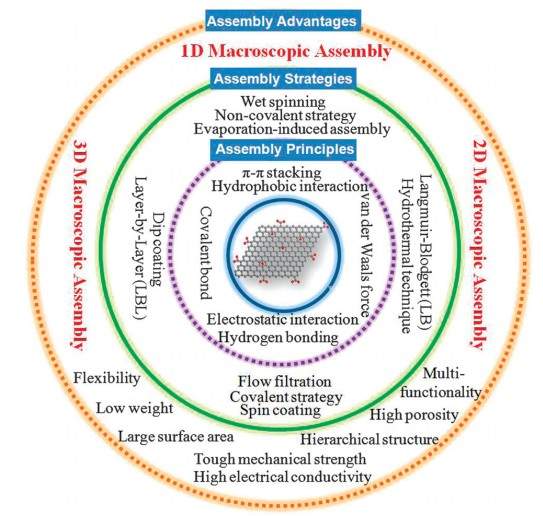 5.jpg |
 回复此楼
回复此楼» 本帖附件资源列表
-
欢迎监督和反馈:小木虫仅提供交流平台,不对该内容负责。
本内容由用户自主发布,如果其内容涉及到知识产权问题,其责任在于用户本人,如对版权有异议,请联系邮箱:xiaomuchong@tal.com - 附件 1 : 14-Graphene-based_macroscopic_assemblies_and_architectures__an_emerging_material_system.pdf
2014-11-13 01:10:16, 10.25 M
» 收录本帖的淘帖专辑推荐
 经典资源帖 经典资源帖 | 科研资料 | 电化学电源、电源管理 | 纳米材料+光电子学 |
| 高分子复合材料 | 材料物理与化学 |
» 本帖已获得的红花(最新10朵)
 Frank0903
» 猜你喜欢
 无机化学论文润色/翻译怎么收费?
已经有193人回复
无机化学论文润色/翻译怎么收费?
已经有193人回复

» 本主题相关商家推荐: (我也要在这里推广)

» 本主题相关价值贴推荐,对您同样有帮助:
 Chem. Soc. Rev最新掺杂石墨烯综述:Heteroatom-doped graphene materials
已经有316人回复
Chem. Soc. Rev最新掺杂石墨烯综述:Heteroatom-doped graphene materials
已经有316人回复- 石墨烯 综述文章汇总(2010-2013)
已经有376人回复
- Chem. Soc. Rev. 最新综述:石墨烷和氢化石墨烯
已经有117人回复
- Chem. Rev. 最新综述:类石墨烯的二维材料
已经有394人回复
- Chem. Soc. Rev.最新综述:由碳纳米管/石墨烯构成的三维多孔结构/气溶胶---合成与应用
已经有368人回复
- 石墨烯综述类文章分享
已经有71人回复
- Chem. Soc. Rev.最新综述:纳米复合物与宏观材料-化学修饰的石墨烯片的组装
已经有312人回复
- Chem. Soc. Rev.最新综述:石墨烯电化学---从基本概念到广泛应用
已经有273人回复
- Chem. Soc. Rev.最新综述:用于水分解光电极的纳米结构和材料设计
已经有268人回复
- Chem. Soc. Rev.最新综述:石墨烯及其衍生物在信息存储中的应用
已经有8人回复
- Small最新综述:石墨烯基材料在超级电容器中的应用
已经有253人回复
- 石墨烯於功能性高分子複合材料的應用
已经有3人回复
- Chem Soc Rev:仿生结构变色材料
已经有208人回复
- Chem Soc Rev最新:一篇金属-空气电池综述
已经有177人回复
- CHEM SOC REV综述一般可以带几个作者
已经有3人回复
- 石墨烯最新进展综述(Graphene nanosheet)
已经有734人回复
- 石墨烯复合材料的粒度分析
已经有5人回复