












| 查看: 5333 | 回复: 151 | ||
| 当前只显示满足指定条件的回帖,点击这里查看本话题的所有回帖 | ||
[资源]
金属材料的腐蚀与断裂
|
||

|
主要介绍断裂力学,工程材料的疲劳及腐蚀问题, This textbook, suitable for students, researchers and engineers, gathers the experience of more than 20 years of teaching fracture mechanics, fatigue and corrosion to professional engineers and running experimental tests and verifications to solve practical problems in engineering applications. As such, it is a comprehensive blend of fundamental knowledge and technical tools to address the issues of fatigue and corrosion. The book initiates with a systematic description of fatigue from a phenomenological point of view, since the early signs of submicroscopic damage in few surface grains and continues describing, step by step, how these precursors develop to become mechanically small cracks and, eventually, macrocracks whose growth is governed by fracture mechanics. But fracture mechanics is also introduced to analyze stress corrosion and corrosion assisted fatigue in a rather advanced fashion. The author dedicates a particular attention to corrosion starting with an electrochemical treatment that mechanical engineers with a rather limited knowledge of electrochemistry will well digest without any pain. The electrochemical introduction is considered an essential requirement to the full understanding of corrosion that is essentially an electrochemical process. All stress corrosion aspects are treated, from the generalized film rupture-anodic dissolution process that is the base of any corrosion mechanism to the aggression occurring in either mechanically or thermally sensitized alloys up to the universe of hydrogen embrittlement, which is described in all its possible modes of appearance. Multiaxial fatigue and out-of-phase loading conditions are treated in a rather comprehensive manner together with damage progression and accumulation that are not linear processes. Load spectra are analyzed also in the frequency domain using the Fourier transform in a rather elegant fashion full of applications that are generally not considered at all in fatigue textbooks, yet they deserve a special place and attention. The issue of fatigue cannot be treated without a probabilistic approach unless the designer accepts the shame of one-out-of-two pieces failure. The reader is fully introduced to the most promising and advanced analytical tools that do not require a normal or lognormal distribution of the experimental data, which is the most common case in fatigue. But the probabilistic approach is also used to introduce the fundamental issue of process volume that is the base of any engineering application of fatigue, from the probability of failure to the notch effect, from the metallurgical variability and size effect to the load type effect. Fractography plays a fundamental role in the post mortem analysis of fatigue and corrosion failures since it can unveil the mystery encrypted in any failure. Table of contents : 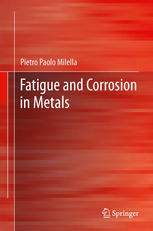 Content: Front Matter....Pages i-xx Nature and Phenomenology of Fatigue....Pages 1-72 Morphological Aspects of Fatigue Crack Formation and Growth....Pages 73-108 Factors That Affect S-N Fatigue Curves....Pages 109-191 Data Scatter and Statistical Considerations....Pages 193-243 Stress-Based Fatigue Analysis High Cycle Fatigue....Pages 245-308 Strain-Based Fatigue Analysis Low Cycle Fatigue....Pages 309-363 Notch Effect....Pages 365-403 Cumulative Damage: Cycle Counting and Life Prediction....Pages 405-476 Multiaxial Fatigue....Pages 477-520 Fracture Mechanics Approach to Fatigue Crack Propagation: Measurements and Observation....Pages 521-581 Crack Tip Plastic Zone Effect on Fatigue Crack Propagation....Pages 583-624 Fatigue in Welds....Pages 625-650 Corrosion....Pages 651-687 Hydrogen Embrittlement and Sensitization Cracking....Pages 689-729 Fracture Mechanics Approach to Stress Corrosion....Pages 731-765 Corrosion Fatigue....Pages 767-806 Back Matter....Pages 807-844 |
 回复此楼
回复此楼» 本帖附件资源列表
-
欢迎监督和反馈:小木虫仅提供交流平台,不对该内容负责。
本内容由用户自主发布,如果其内容涉及到知识产权问题,其责任在于用户本人,如对版权有异议,请联系邮箱:xiaomuchong@tal.com - 附件 1 : Fatigue_and_Corrosion_in_Metals.pdf
2014-11-07 20:34:45, 27.69 M
» 本帖已获得的红花(最新10朵)
 leezhw0123
» 猜你喜欢
 真诚求助:手里的省社科项目结项要求主持人一篇中文核心,有什么渠道能发核心吗
已经有8人回复
真诚求助:手里的省社科项目结项要求主持人一篇中文核心,有什么渠道能发核心吗
已经有8人回复
-
寻求一种能扛住强氧化性腐蚀性的容器密封件
已经有5人回复
-
论文投稿,期刊推荐
已经有6人回复
-
请问哪里可以有青B申请的本子可以借鉴一下。
已经有4人回复
-
孩子确诊有中度注意力缺陷
已经有14人回复
-
请问下大家为什么这个铃木偶联几乎不反应呢
已经有5人回复
-
请问有评职称,把科研教学业绩算分排序的高校吗
已经有5人回复
-
2025冷门绝学什么时候出结果
已经有3人回复
-
天津工业大学郑柳春团队欢迎化学化工、高分子化学或有机合成方向的博士生和硕士生加入
已经有4人回复
-
康复大学泰山学者周祺惠团队招收博士研究生
已经有6人回复

» 本主题相关商家推荐: (我也要在这里推广)


114楼2015-09-10 20:15:37

5楼2014-11-08 10:28:47
简单回复
zjys58872楼
2014-11-07 22:42
回复
五星好评 顶一下,感谢分享!
2014-11-08 06:48
回复
五星好评 顶一下,感谢分享!
suncc3114楼
2014-11-08 09:17
回复
五星好评 顶一下,感谢分享!
xu915276楼
2014-11-08 11:19
回复
五星好评 顶一下,感谢分享!
lujinwen7楼
2014-11-08 16:53
回复
五星好评 顶一下,感谢分享!
一枚材料8楼
2014-11-08 19:35
回复
五星好评 顶一下,感谢分享!
2014-11-08 19:37
回复
五星好评 顶一下,感谢分享!
stuljm10楼
2014-11-08 21:37
回复
五星好评 顶一下,感谢分享!
yaya21311楼
2014-11-08 22:02
回复
五星好评 顶一下,感谢分享!
明日12楼
2014-11-09 06:47
回复
五星好评 顶一下,感谢分享!
junex13楼
2014-11-09 06:51
回复
五星好评 顶一下,感谢分享!
qxzhao8814楼
2014-11-09 07:01
回复
五星好评 顶一下,感谢分享!