






| 查看: 7271 | 回复: 182 | |||||||||||
| 【奖励】 本帖被评价169次,作者海天天意增加金币 135 个 | |||||||||||
| 当前只显示满足指定条件的回帖,点击这里查看本话题的所有回帖 | |||||||||||
[资源]
Chem Soc Rev 10.20新鲜在线:二维过度金属硫化物可控合成综述
|
|||||||||||

|
Recent advances in controlled synthesis of twodimensional transition metal dichalcogenides via vapour deposition techniques Yumeng Shi,a Henan Lib and Lain-Jong Li*a (13页65篇文献) In recent years there have been many breakthroughs in two-dimensional (2D) nanomaterials, among which the transition metal dichalcogenides (TMDs) attract significant attention owing to their unusual properties associated with their strictly defined dimensionalities. TMD materials with a generalized formula of MX2, where M is a transition metal and X is a chalcogen, represent a diverse and largely untapped source of 2D systems. Semiconducting TMD monolayers such as MoS2, MoSe2, WSe2 and WS2 have been demonstrated to be feasible for future electronics and optoelectronics. The exotic electronic properties and high specific surface areas of 2D TMDs offer unlimited potential in various fields including sensing, catalysis, and energy storage applications. Very recently, the chemical vapour deposition technique (CVD) has shown great promise to generate high-quality TMD layers with a scalable size, controllable thickness and excellent electronic properties. Wafer-scale deposition of mono to few layer TMD films has been obtained. Despite the initial success in the CVD synthesis of TMDs, substantial research studies on extending the methodology open up a new way for substitution doping, formation of monolayer alloys and producing TMD stacking structures or superlattices. In this tutorial review, we will introduce the latest development of the synthesis of monolayer TMDs by CVD approaches.  c4cs00256c.jpg 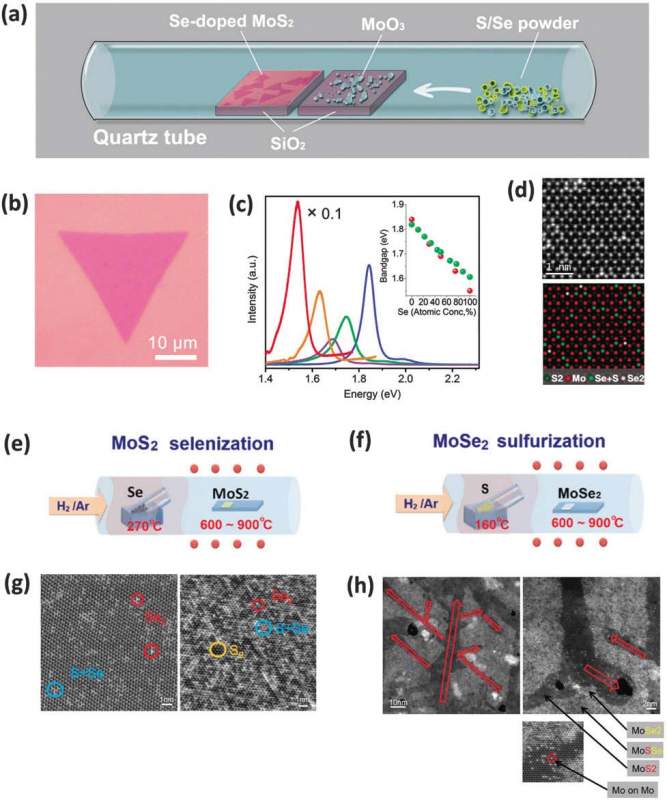 c4cs00256c.jpg |
 回复此楼
回复此楼» 本帖附件资源列表
-
欢迎监督和反馈:小木虫仅提供交流平台,不对该内容负责。
本内容由用户自主发布,如果其内容涉及到知识产权问题,其责任在于用户本人,如对版权有异议,请联系邮箱:xiaomuchong@tal.com - 附件 1 : c4cs00256c.pdf
2014-10-20 19:35:52, 4.02 M
» 收录本帖的淘帖专辑推荐
 纳米技术与能源及模拟 纳米技术与能源及模拟 | 科研资料 | 石墨烯+MoS2等 二维材料 | 第一性原理相关文档 |
| 石墨烯类二维材料 | 催化剂 | 综述专辑 | 光催化材料 |
| 纳米材料 |
» 猜你喜欢
 请问对标matlab的开源软件octave的网站https://octave.org为什么打不开?
已经有1人回复
请问对标matlab的开源软件octave的网站https://octave.org为什么打不开?
已经有1人回复
-
求助两种BiOBr晶体的CIF文件(卡片号为JCPDS 09-0393与JCPDS 01-1004 )
已经有0人回复
-
金属材料论文润色/翻译怎么收费?
已经有216人回复
-
哈尔滨工程大学材化学院国家级青年人才-26年硕士招生
已经有0人回复
» 本主题相关价值贴推荐,对您同样有帮助:
- 最新的Chem. Soc. Rev.碳材料综述
已经有12人回复
- Chem. Soc. Rev最新掺杂石墨烯综述:Heteroatom-doped graphene materials
已经有316人回复
- Chem. Soc. Rev.最新综述:二维材料图册
已经有398人回复
- Chem. Soc. Rev.最新综述:设计合成有机无机杂化胶囊及其生物技术方面的应用
已经有30人回复
- Chem Soc Rev2013年综述纳米四氧化三铁作为催化剂载体
已经有23人回复
- Chem.Soc.Rev. 最新综述:用于传感,成像药物载体的纳米材料化学修饰以及生物连接反应
已经有418人回复
- Yi Cui 在Chem Soc Rev上关于纳米硫正极材料 的最新综述
已经有135人回复
- Nature Chemistry最新综述:二维层状过渡金属硫属化合物纳米片
已经有744人回复
- Chem. Soc. Rev 综述2篇 : 关于氧化物化学合成
已经有67人回复
- Chem.Soc.Rev.最新综述:金属硫属化合物纳米片-制备、性质及用途
已经有361人回复
- Chem. Rev. 最新综述:类石墨烯的二维材料
已经有394人回复
- 【Chem Soc Rev综述】Nano-graphene in biomedicine: theranostic applications
已经有35人回复
- Chem. Soc. Rev.最新综述:纳米复合物与宏观材料-化学修饰的石墨烯片的组装
已经有312人回复
- Chem Soc Rev最新综述:贵金属纳米颗粒内在的治疗作用:过去,现在和将来
已经有262人回复
- Chem.Soc.Rev.综述:LiMPO4 (M = Fe, Co, Ni, Mn)三维碳基复合物纳米结构进展
已经有245人回复
- 一篇化学协会综述(Chem。 Soc。 Rev, IF=26)与一篇IF=7左右的文章哪个比较好呀
已经有30人回复
- Chem Soc Rev最新:一篇金属-空气电池综述
已经有177人回复
- CHEM SOC REV综述一般可以带几个作者
已经有3人回复
- Chem Soc Rev:一篇机械化学法综述
已经有309人回复

66楼2014-10-26 17:59:55