









| 查看: 6206 | 回复: 139 | ||
| 当前只显示满足指定条件的回帖,点击这里查看本话题的所有回帖 | ||
[资源]
最新“重磅综述”文章——二氧化钛的表面化学、固液界面化学及其合成化学
|
||

|
Chemical Review上最新上线了一篇名为“Titanium Dioxide (Anatase and Rutile): Surface Chemistry, Liquid–Solid Interface Chemistry, and Scientific Synthesis of Supported Catalysts”的综述文章,作者为Kyriakos Bourikas, Christos Kordulis, and Alexis Lycourghiotis ,全文70页,参考文献451篇。这篇文章比较长,写作的角度比较宽广,内容也比较全面,基本上涵盖了二氧化钛研究的大多数方面,比如二氧化钛的表面化学性质,固液界面反应性质以及合成方面的一些总结。 在2014年,Chemical Review已经刊登了二十篇左右有关二氧化钛的综述,但是看这个样子,估计还会有不少二氧化钛综述在排队等待发表。所以从这些可以看出,到目前来说,二氧化钛依然还是光催化领域的最为耀眼的明星光催化剂。 1. Introduction 2. Surface Chemistry 2.1. Bulk Structure of the Anatase and Rutile 2.2. Crystal Terminations of Anatase Crystals 2.2.1. Surface Atoms Exposed 2.2.2. Surface Energies before and after Relaxation 2.2.3. Geometrical Surface Relaxations 2.2.4. Surface Reconstructions 2.3. Reactivity of the Anatase Crystal Terminations with Respect to Water Molecules: The Majority (101) Surface 2.3.1. Modes of Adsorption of Isolated Water Molecules on the Perfect (101) Termination 2.3.2. Modes of Adsorption of Water Molecules for Various Temperatures and H2O Surface Concentrations on the Perfect (101) Termination 2.3.3. The Structure of Thin Water Overlayers on the Perfect (101) Termination 2.3.4. Modes of Adsorption of Isolated Water Molecules on the Defective (101) Termination 2.3.5. The Structure of Thin Water Overlayers on the Defective (101) Surface 2.3.6. Mobility of the Adsorbed Water Molecules 2.3.7. Steps on the (101) Termination 2.3.8. Experimental Studies Devoted to the Interactions of Water Molecules with the (101) Crystal Face 2.4. Reactivity of the Anatase Crystal Terminations with Respect to Water Molecules: The Minority (001), (100), and (110) Terminations 2.4.1. The (001) Surface 2.4.2. The (100) Surface 2.4.3. The (110) Surface 2.4.4. The Trend in the Surface Reactivity 2.5. Investigation of the Anatase Surfaces by Infrared Spectroscopy 2.6. Experimental Investigation of Morphology of the Anatase Nanocrystallites Using XRD, TEM, and FT-IR Techniques 2.7. Calculated Morphology of the Anatase Nanocrystallites 2.7.1. Introductory Remarks 2.7.2. Morphology of Anatase Nanocrystals: “Wulff Constructions” 2.7.3. Surface Chemistry and Morphology of Anatase Nanocrystals 2.8. Recent Methods for Investigating and Manipulating the Morphology of Anatase Nanocrystals 2.9. The (110) Crystal Face of Rutile 2.9.1. Introductory Remarks 2.9.2. Surface Structure 2.9.3. Surface Energy 2.9.4. Modes of Adsorption of Water Molecules 2.9.5. Recent Works Devoted to the Modes of Adsorption of Water Molecules 2.9.6. The Structure of the Water Molecules in the “Rutile (110)/Electrolyte Solution Interface” 2.10. The (011) Crystal Face of Rutile 2.10.1. Surface Structure, Energy, and Relaxations 2.10.2. Surface Reconstructions 2.10.3. Modes of Adsorption of Water Molecules 2.11. The (100) Crystal Face of Rutile 2.11.1. Surface Structure, Energy, Relaxations, and Reconstructions 2.11.2. Modes of Adsorption of Water Molecules 2.12. The (001) Crystal Face of Rutile 2.12.1. Surface Structure, Energy, Relaxations, and Reconstructions 2.12.2. Modes of Adsorption of Water Molecules 2.13. The (101) Crystal Face of Rutile 2.14. Surface Chemistry and Morphology of the Rutile Nanocrystals 2.15. Charges Localized above the Surface Atoms Exposed by the Anatase and Rutile Surfaces Studied 2.16. Surface Chemistry and Phase Transitions of the Anatase and Rutile Polymorphs 3. Interfacial Chemistry 3.1. A General Description of the Interfacial Region 3.1.1. The Music Model 3.1.2. Basic Stern Model 3.1.3. Triple Layer Model (TLM) 3.1.4. Three Plane Model 3.2. Studies on the Rutile (110) Crystal Termination/Electrolytic Solution Interface: A Bridge between the Surface and Interface Chemistry 3.2.1. Introductory Remarks 3.2.2. Theoretical Calculations 3.2.3. X-ray Studies 3.2.4. Sodium Ions 3.2.5. Calcium Ions 3.2.6. Rubidium Ions 3.2.7. Strontium Ions 3.2.8. Yttrium Ions 3.2.9. Zinc Ions 3.2.10. Cobalt(II) Ions 3.2.11. Chloride and Bromide Ions 3.2.12. Final Remarks 3.3. The Polycrystalline Titanium Oxide/Background Electrolyte Solution Interface 3.3.1. Historical Remarks 3.3.2. Description in Terms of the Music/Basic Stern Model: A Bond Valence Approach 3.3.3. The Influence of Temperature 3.3.4. Investigation of the Subtitle Interface for Anatase of a Nanosized Structure and High Surface Area 3.3.5. Description in Terms of a Multisite/Three Plane Model: An Ab Initio Approach 4. Deposition of Transition Metal Ionic Species on the “Polycrystalline Titanium Oxide/Electrolyte Solution” Interface Related to the Synthesis of Supported Catalysts 4.1. Regulation of the Mode of Deposition for a Tailor-Made Synthesis of a Supported Catalyst Based on Titanium Oxide 4.2. Deposition of Transition Metal Ionic Species on the “Polycrystalline Titanium Oxide/Electrolyte Solution” Interface Containing Catalytically Active Elements 4.2.1. Introductory Remarks 4.2.2. Co(II) Aqua Complexes 4.2.3. Fe(II) Aqua Complexes 4.2.4. Cu(II) Aqua Complexes 4.2.5. Cr(VI) Oxo-species 4.2.6. Mo(VI) Oxo-species 4.2.7. V(V) Oxo-species 4.2.8. Recent Efforts Based on a Modern Mapping of the Titanium Oxide Protonation/Deprotonation Sites and the Three Plane Model 5. Closing Remarks 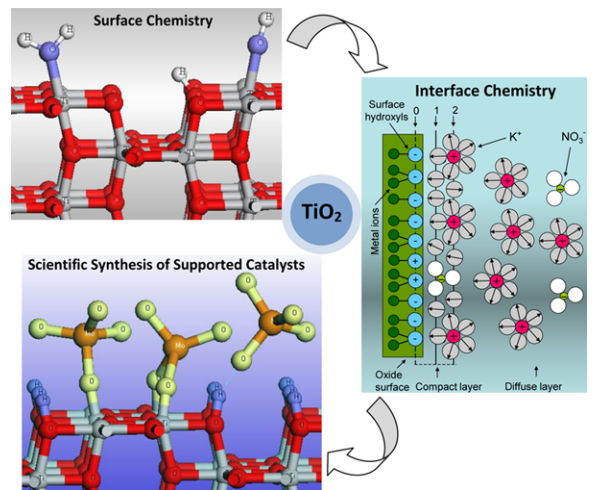 360软件小助手截图20140926090043.png |
 回复此楼
回复此楼» 本帖附件资源列表
-
欢迎监督和反馈:小木虫仅提供交流平台,不对该内容负责。
本内容由用户自主发布,如果其内容涉及到知识产权问题,其责任在于用户本人,如对版权有异议,请联系邮箱:xiaomuchong@tal.com - 附件 1 : 2014-cr300230qTitanium_Dioxide_(Anatase_and_Rutile)_Surface_Chemistry,_Liquid–Solid_Interface_Chemistry,_and_Scientific_Synthesis_of_Supported_Catalysts_(Review).pdf
2014-09-26 09:01:55, 45.19 M
» 猜你喜欢
 修改论文,如何借助其他力量?
已经有4人回复
修改论文,如何借助其他力量?
已经有4人回复
-
中山大学潘越教授课题组2027级推免硕士研究生招生 新增一个专业医学技术名额
已经有21人回复
-
无机化学论文润色/翻译怎么收费?
已经有56人回复

 本帖仅楼主可见 本帖仅楼主可见 |
135楼2017-07-02 09:46:54
简单回复
2014-09-26 11:56
回复
五星好评 顶一下,感谢分享!
2014-09-26 12:11
回复
五星好评 顶一下,感谢分享!
bluersky5楼
2014-09-26 12:27
回复
五星好评 顶一下,感谢分享!
lwg36楼
2014-09-26 13:07
回复
五星好评 顶一下,感谢分享!
andyao7楼
2014-09-26 13:54
回复
五星好评 顶一下,感谢分享!
流沙河8楼
2014-09-26 14:10
回复
五星好评 顶一下,感谢分享!
walkerby9楼
2014-09-26 14:20
回复
五星好评 顶一下,感谢分享!
csuzxc10楼
2014-09-26 15:05
回复
五星好评 顶一下,感谢分享!
hittang12楼
2014-09-26 16:57
回复
五星好评 顶一下,感谢分享!
dulledcn13楼
2014-09-26 17:06
回复
五星好评 顶一下,感谢分享!
hittang14楼
2014-09-26 17:13
回复
顶一下,感谢分享!